Showing posts with label Bradley Wiggins. Show all posts

Saturday, August 18, 2012

That snarling, feral beast is back

Without wishing to exaggerate - well, OK, allow me some licence – living in Paris in August feels a little like Robert Neville in I Am Legend, waking up to a post-apocalyptic New York and wondering where everyone has gone.

When you are so used to a day-long soundtrack of car horns, sirens and those urban siblings, hustle and bustle, the silence is a little disconcerting.

Then again, there are benefits: I can make leisurely progress crossing a street without someone driving through a red light and then through me. Even the city’s waiters have dialled down their usual passive-aggressive indifference and are now just mildly frosty. Not that you care as you lazily sit in the shade of a cafe's canopy, happily watching the tourists drift by.

Sadly these novelties do wear off and you find yourself seeking normality to anchor the spirits. It is here that I would otherwise cherish the urgency with which football returns mid-August. But this season...

Just a week ago the world was celebrating the greatest sporting jamboree in living memory. 16 days of ego-less, personality-laden excellence. Sport - or at least sport for us masses - took a welcome holiday from greed, petulance, personal abuse and, for the most part, shagging teamates' girlfriends.

What a pleasure it was to see delighted achievement not cheapened by fatuous badge kissing; Victoria Pendleton lost out to Anna Meares and still shook hands afterwards - without anyone ending up in a courtroom; and after Bradley Wiggins "enjoyed a few", no one got bottled in a McDonalds at one in the morning.

Diving was rewarded with cheers and flag-waving, rather than boos and hisses, and the overall camaraderie between teams was warm and genuine, of a kind you wouldn't even find within the same football club.

London 2012 felt like a two-week fling with someone fresh, intelligent, and richly different to your regular partner, a holiday romance that opened up the shutters on the increasingly loveless marriage that we have with football and its money.

I'm not the first to point out these contrasts and I won't be the last. It's not that football has suddenly lost its respect. Perhaps it never had it, or perhaps it was as simple as having the Olympics take place under our very British noses for us to notice what good looks like.

Football has never been perfect, and has never lacked the attention of snobs who regard it as a neanderthal art. But I can appreciate how familiarity can breed contempt. It was significant, for example, that no one, apart from Mexico - and large-brimmed hats off to them for taking Olympic gold - actually cared there was even a football discipline at the London games.

Many people (including, patently, the Team GB football players themselves) felt that the Olympics would have been a great time to take a break from the game. It's with us constantly. The last competitive game of the club season in Europe was the Champions League final on May 19, but no sooner had the streamers and celery* been swept away from Munich's streets, than June 8 had rolled around and Poland and Greece were kicking off Euro 2012. And with that concluding on July 1, there were already players reporting for pre-season training at their respective clubs.
*Best that you Google the words "Chelsea"+"fans" +"celery" for an explanation...

Maybe, then, we should ease up on our harsh opinons about professional footballers being snarling, excessively rewarded, feral and spoiled. It can't be easy to earn the average house price every fourteen days with only a couple of weeks off each summer, during which you and the good lady WAG get papped relentlessly in the hotel pool.
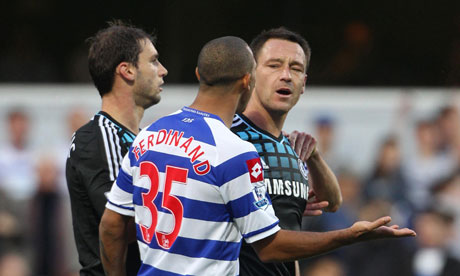

If London 2012 raised the bar, what of those of us who do still love football? Are we the sporting equivalent of the gangster's moll, so attached that we ignore the appalling behaviour?

Football is, for some, a soulmate, but if our brief summer dalliance has opened a window to a life less ordinary, we must acknowledge that our hearts belong to a sport with a tarnished reputation, even if its attraction remains undimmed.

If we're not going to budge - and I don't see any real reason to do so - the best the world can hope for is that football learned something from London 2012. Perhaps those who seek more money as their only reward, and who regard cheating and diving as legitimate means to achieve it, will take note of the sportsmanship, the good nature and the ethics of excellence that, even for the modern, professional Olympian, contributed to the enjoyment of the games, rather than was simply a product of it.

It is good to have football back, don't get me wrong. It gives us something to talk about, to socialise over, to get angry and write blog posts on. I'm sure, as I settle into my pint of Dublin's finest tomorrow afternoon to watch Wigan-v-Chelsea, I will feel the warmth returning to my long-term relationship. But I know it won't quite feel right. Farewell my summer love...

Sunday, August 12, 2012

We lit the flame and we lit up the world - so what happens next?


For longer than anyone can remember, Christmas has been beset by ridiculously sentimental records jingle-jangling away with sleigh bells and children's choirs and the sort of wintry greeting card schmaltz inspired by a time, before global warming, when snow actually fell in December.

Of too many songs in this genre, the one that stands out is Wizzard's dangerously infectious I Wish It Could Be Christmas Every Day. This is because it has, for the last 38 years, presented children with the ultimate dream: perennial Christmas.

Obviously it's a stupid notion. Turkey farms couldn't breed birds fast enough to sustain Christmas 365-days a year, and, secondly, are you going broach the idea with your household's designated Christmas Day cook? Don't even bother thinking about buying presents.

Over the last 17 days London 2012 has lowered a similar mist of fake snow, tinsel and glitter over rational thought. Logic has been suspended as grown-ups have, like open-mouthed cherubs, declared en masse on Twitter: "I wish the Olympics could be on every day".

Well they can't, but that hasn't stopped hyperventilation over what is normally, and we certainly haven't been let down in this regard, considered to be the greatest sporting spectacle on earth.

Even the most sleep-deprived, Pringles-overdosed, couch-affixed football fan would agree that the games knock the World Cup into a cocked hat (although, from an English perspective, staging the World Cup daily would, via the Law of Averages, raise the possibility of England actually winning something).

This Monday morning, as 16,000 athletes and spectators attempt to leave Britain via Heathrow Airport the world is a very different place than it was on the evening of July 27.

We are emerging from the TV equivalent of an all-you-can-eat-restaurant (I know, a highly inappropriate comparison); we have indulged and devoured the sporting feast to end all feasts, feeling like a Nile crocodile that has snapped up one zebra too many at the riverbank. We may be bloated and pallid but also free of any guilt, simply because we have just consumed the most brilliant explosion of warmth and endeavour and collective effort and colour and fun.

Watching it all from a foreign country - and, ironically, the city that lost out to London - has been an experience in itself. French national television certainly has been enjoying itself - and the London-ness of it all. Fair play to them.

Reuters/Stefano Rellandini
Because from kick-off to final whistle, it has just been the most glorious blowout. We've had Usain Bolt demonstrating (and telling us) that he is the greatest sporting personality since Ali; Bradley Wiggins proving that, ultimately, Mods are better than Rockers; the incredible Mo Farah reducing grown men to tears with his gold medals in the 5,000 and 10,000m; Sir Chris Hoy in tears as he eclipsed Sir Steve Redgrave's record of five Olympic gold medals by winning an amazing sixth; Jessica Ennis demonstrating that normality can become extraordinary by taking the world title in a discipline involving seven individual pursuits; Women with French and German names have won medals for Britain in the dressage.

Michael Phelps became the greatest Olympian in history; Ben Ainslie won a fourth gold medal to become Britain's greatest sailor since Sir Walter Raleigh; Laura Trott proved that a succession of childhood illnesses and a diminutive stature are no barriers to Olympic glory; Nicola Adams made Olympic history as the first woman to win a boxing gold medal; Andy Murray beat Roger Federer on the Center Court; let's read that again - Andy Murray beat Roger Federer on the Center Court; and HRH Queen Elizabeth II parachuted out of a helicopter with James Bond. For real. Well, almost. And those are just the highlights.

It has been brilliant to see all of this - and much, much more - taking place in my home country, my home city and even, a couple of bits, in my home neighbourhood. For a nation so self-deprecating that it usually sees itself as the slightly crap kid handling out leaflets to parents on school sports day rather than taking part in the relay race - London 2012 has been Christmas every day, ever since Danny Boyle unwrapped his glittering parcel of magic in the opening ceremony.

Britain has demonstrated itself to be a country of remarkable cyclists, an island nation at strength on the water and in the water, and, with the right coaching, the right training facilities, and the right gumption, capable of competing with the very best in the track and field.

Britain has also projected (what we knew anyway) its charm, its sense of humour, a capital city to be proud of. Who would have thought it possible, 12 months ago, as youths used the mask of their apparent disaffection to set fire to British city centres and help themselves to LCD TVs and pairs of high-end Nikes. Britain, then, was broken. Two weeks of sporting excellence, sadly, doesn't mean it is now fixed.

Now the party's over, as Bryan Ferry crooned, what happens next? Actually, the London 2012 party isn't quite over - the Paralympics continue for the rest of the month, and while their profile won't reach anywhere near the level of the main games, the endeavour and achievement will be no less impressive.

It's what happens after August 29 that really matters: the so-called 'Olympic Legacy'. Before the closing ceremony had even taken place last night there were already politicians applying their customary reptilian skills of predation to opportunistically grab the moral high ground on how Britain builds on London 2012.

This is partly a discussion about what to do with an indoor cycling centre, a large swimming pool, all that sand on Horse Guards Parade, and preventing Olympic Park from returning to the toxic East London waste ground it was on June 6, 2005 when London declared victory in its Olympic bid. And it is partly about where Britain's next Hoy, Pendleton and Ennis will come from.

The two are partly connected. The issue isn't just about whether the £1 billion worth of London 2012 construction projects were worth it in the current economy, but whether or not encouraging Britain's indoor-rooted, Xbox-addicted youth to get off their fattening backsides is an important enough political priority when the nation has other challenges to contend with.

London 2012 didn't happen just to encourage kids to take up sport and thus prevent a future meltdown of the NHS due to cancers and cardiovascular diseases. But since it did happen, and given everyone both a good time and the initiative to squeeze into Lycra cycling shorts, then why shouldn't these Olympics stimulate the return of physical education to being a fixture, not a forgotten option of school life? Why shouldn't it mean the British government thinking again about its programme of selling off school playing fields? It's just a thought.

To this comes the topic of funding in general. There are some who were uncomfortable with the professionalisation of the Olympic disciplines to start with. More, in Britain, have been discomforted by the amount of National Lottery funding and commercial sponsorship.

Sponsorship is fine - when it comes from appropriate sponsors - and the Lottery should do more than provide Saturday night TV with 15 minutes of Dale Winton-presented inanity. Hats off to whoever dipped a hand to pay for Mo Farah's training in America, or the facilities for Britain's incredible band of cyclists, or Team GB as a whole to win a record 65 medals including 29 golds.


Back in 2002, Tessa Jowell, the-then minister for Culture, Media and Sport, read a report suggesting that a British bid for the 2012 Olympics would be unviable. Too expensive, was the civil servants' advice, and Paris had already sown up enough votes from IOC members to virtually have the 2012 games in the bag. Jowell chose to pursue it anyway.

Whether stunning arrogance or obstinate belligerence, her signature approving the formal launch of an Olympic bid set in motion an effort that has given London, Britain and the world a momentary high at a time when it could most do with it. No one knew in 2002 that the global economy would be in its fifth year of recession by the time these games came about, and that the UK could probably afford these games as much as any other country. Perhaps it has just been one of the best - or worst - examples of retail therapy, but man, has it been good.

It's now down to those custodians of the London 2012 legacy to make sure that our purchases will last, and that, unlike the Olympic facilities in Sydney, Athens and Beijing, London's purpose-built venues don't fall into disrepair - but keep on generating incredible people prepared to put their lives on hold for four or more years, getting up at 5am every day to train, train, train and train. Participation has been everything. Winning has been something else.

And if there is to be a legacy from 2012, it should be that in 2016 and beyond, there will be people from every country with the same hunger and ambition to make the Olympic Games the greatest show on Earth. Every four years, of course.