Showing posts with label football. Show all posts
Sunday, July 28, 2013
...and we're back
The British press have been referring to the recent period of hot weather - which you or I might otherwise call "summer" - as the longest heatwave since...er...the last one.
Some might say, cynically, that a few days of oppressive heat and prematurely melting ice creams does not a summer make, but here in Paris - where it has been simply "hot" - there has been a noticeably extended period of sleepless, sweaty nights, the odd stray mosquito strafing like a disorientated Luftwaffe pilot over Kent in 1940, and a tendency for crankiness first thing in the office.
But that's it. The French roads haven't melted. There are no hosepipe bans in force. In Britain, the "Level 3 Heat Health Alerts" has now been upgraded to a "Level 3 Flood Alerts" as storms move in (with The Sun actually putting the emphasis on France being their origin, as if it is the fault of the French).
It is worth noting, however, that whatever the impending calamity in Britain - be it excess sunshine, rainfall, plagues of locusts or frogs - the threat level is always "3". Never lower, never higher. No need for any kind of Nigel Tufnell excess here then.
However, all this is to say that the extended heatwave that has locked Britain into seven weeks of perspiration and knotted handkerchief wearing has also coincided with what has seemed like an eternal closed period between football seasons.
With this summer lacking by serious tournament, the period since the Barclays Premier League kicked its last on May 19, and Bayern Munich decided the Champions League a few days later, seems like an eternity.
Of course, for us success-starved Brits, we've had Andy Murray, Chris Froome and the England cricketers to cheer over, but - and, sorry, those of you who care deeply about tennis, cycling or cricket - but life as we know it will only get back to normal once the football season proper gets under way.
There have been glimpses, sweet, sweet glimpses, like a flash of Victorian ankle: the transfer sagas of Bale, Rooney and Fabregas have kept the Fleet Street rumour mill turning, and there have been the requisite number of shirt-selling foreign tours by the elite to hint at what is to come under the teams of Moyes, Pellegrino, Mourinho, Wenger and co. But really, it ain't enough.
That said, WWDBD? had taken a leave of abstinence from football commentary for these last few weeks. There have been days of temptation. Days when giving in almost became too easy. This has reminded me, somewhat worryingly when thinking about it, of one the funniest Seinfeld episodes - The Contest.
Like all 179 other episodes in the show's nine-year run, The Contest revolved around a single topic. But, where the others made fun out of the very ordinary - buying a car, dealing with dry cleaners, soup or male genital shrinkage - this episdode tested the boundaries of prime-time televisual taste by concerning itself with "self-gratification".
If you've seen it, you'll recall that Jerry, George, Elaine and Kramer challenge themselves to see who could abstain the longest from onanistic pleasure, to be "master of my own domain" (along with many other euphemisms used to avoid actual use of the 'M' word). Kramer - being Kramer - caved first (and quickly), crashing into Jerry's kitchen and slapping down his wager declaring "Well I'm out!"
And thus I've managed to get almost to the end of July before committing fingers to keyboard on The Beautiful Game ™. But today I'm caving. "I'm out!". Because it's back. Football is back. Almost properly.
Actually, it's been back a while - first qualifying round matches for the Champions League were played as far back as July 2 between Armenia's Shirak and San Marino's culinary-sounding Tre Penne (Shirak won the two legs 3-1 on aggregate) and FC Lusitanos of Andorra getting hammered 3-7 on aggregate by EB/Streymur, who play in the Faroe Islands Premier League. Yes, you read that correctly.
Since then we've had, inevitably, the second qualifying round, which brought some seniority to proceedings with European footbal evergreens such as Steaua Bucureșt, Celtic and Maccabi Tel Aviv entering the fray.
This Tuesday night - hence all the excitement, we reach the third qualifying round for the 2013-14 Champions League, adding a load more European titans with the word "Dinamo" in their names, along with previous members of the awkward squad for English teams like the shoutily-accronymned APOEL of Cyprus and Zenit Saint Petersburg, along with the excessively caffeinated Red Bull Salzburg, French talent pool Lyon and PSV Eindhoven.
Even though I have yet to apply toe to sun-kissed sand yet, the idea of the Champions League already reaching such a crucial stage has my appetite whetted. Believe it or not, there's more to come this week: the UEFA Europa League also enters its third qualifying round on Thursday (good luck Swansea!) and then on Friday night, the gambling addiction-inducing Sky Bet Championship - once known innocently as the Football League, launches the British domestic season. On August 2. Sheffield United and Notts County will have a lot to live up to. Welcome back football. We really have missed you.
Saturday, August 18, 2012
That snarling, feral beast is back
Without wishing to exaggerate - well, OK, allow me some licence – living in Paris in August feels a little like Robert Neville in I Am Legend, waking up to a post-apocalyptic New York and wondering where everyone has gone.
When you are so used to a day-long soundtrack of car horns, sirens and those urban siblings, hustle and bustle, the silence is a little disconcerting.
Then again, there are benefits: I can make leisurely progress crossing a street without someone driving through a red light and then through me. Even the city’s waiters have dialled down their usual passive-aggressive indifference and are now just mildly frosty. Not that you care as you lazily sit in the shade of a cafe's canopy, happily watching the tourists drift by.
Sadly these novelties do wear off and you find yourself seeking normality to anchor the spirits. It is here that I would otherwise cherish the urgency with which football returns mid-August. But this season...
Just a week ago the world was celebrating the greatest sporting jamboree in living memory. 16 days of ego-less, personality-laden excellence. Sport - or at least sport for us masses - took a welcome holiday from greed, petulance, personal abuse and, for the most part, shagging teamates' girlfriends.
What a pleasure it was to see delighted achievement not cheapened by fatuous badge kissing; Victoria Pendleton lost out to Anna Meares and still shook hands afterwards - without anyone ending up in a courtroom; and after Bradley Wiggins "enjoyed a few", no one got bottled in a McDonalds at one in the morning.
Diving was rewarded with cheers and flag-waving, rather than boos and hisses, and the overall camaraderie between teams was warm and genuine, of a kind you wouldn't even find within the same football club.
London 2012 felt like a two-week fling with someone fresh, intelligent, and richly different to your regular partner, a holiday romance that opened up the shutters on the increasingly loveless marriage that we have with football and its money.
I'm not the first to point out these contrasts and I won't be the last. It's not that football has suddenly lost its respect. Perhaps it never had it, or perhaps it was as simple as having the Olympics take place under our very British noses for us to notice what good looks like.
Football has never been perfect, and has never lacked the attention of snobs who regard it as a neanderthal art. But I can appreciate how familiarity can breed contempt. It was significant, for example, that no one, apart from Mexico - and large-brimmed hats off to them for taking Olympic gold - actually cared there was even a football discipline at the London games.
Many people (including, patently, the Team GB football players themselves) felt that the Olympics would have been a great time to take a break from the game. It's with us constantly. The last competitive game of the club season in Europe was the Champions League final on May 19, but no sooner had the streamers and celery* been swept away from Munich's streets, than June 8 had rolled around and Poland and Greece were kicking off Euro 2012. And with that concluding on July 1, there were already players reporting for pre-season training at their respective clubs.
*Best that you Google the words "Chelsea"+"fans" +"celery" for an explanation...
Maybe, then, we should ease up on our harsh opinons about professional footballers being snarling, excessively rewarded, feral and spoiled. It can't be easy to earn the average house price every fourteen days with only a couple of weeks off each summer, during which you and the good lady WAG get papped relentlessly in the hotel pool.
If London 2012 raised the bar, what of those of us who do still love football? Are we the sporting equivalent of the gangster's moll, so attached that we ignore the appalling behaviour?
Football is, for some, a soulmate, but if our brief summer dalliance has opened a window to a life less ordinary, we must acknowledge that our hearts belong to a sport with a tarnished reputation, even if its attraction remains undimmed.
If we're not going to budge - and I don't see any real reason to do so - the best the world can hope for is that football learned something from London 2012. Perhaps those who seek more money as their only reward, and who regard cheating and diving as legitimate means to achieve it, will take note of the sportsmanship, the good nature and the ethics of excellence that, even for the modern, professional Olympian, contributed to the enjoyment of the games, rather than was simply a product of it.
It is good to have football back, don't get me wrong. It gives us something to talk about, to socialise over, to get angry and write blog posts on. I'm sure, as I settle into my pint of Dublin's finest tomorrow afternoon to watch Wigan-v-Chelsea, I will feel the warmth returning to my long-term relationship. But I know it won't quite feel right. Farewell my summer love...
Tuesday, January 31, 2012
When Two Tribes Go To War
As anyone who regularly attends English Premier League football matches will attest, the idea that in this prawn sandwich-munching, bring-the-wife-and-kids-for-a-family-day-out, multi-million pound fan "experience" era of the game, its nefarious side has been completely extinguished would be regarded as foolish.
No doubt, things are vastly improved, certainly from the days of my own youth, when standing in 'The Shed' of Stamford Bridge made owls out of inquisitive boys, as we rotated our heads fully through 180 degrees to see the newest outbreak of mayhem on the terracing behind us.
There is no doubt, too, that the orchestrated warfare that erupted with grim regularity in the '70s and early '80s between entire armies of clubs' fans - Millwall and West Ham, Chelsea and Tottenham, Arsenal and Leeds - has disappeared from the neighbouring streets of these clubs' grounds (although it would be the height of naïveté to suggest that it has disappeared altogether).
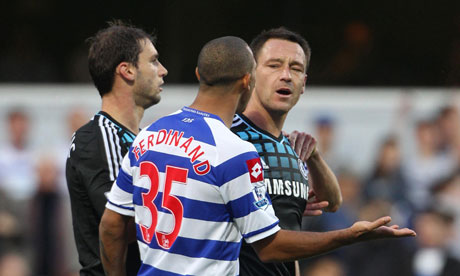
There is also no doubt that in recent weeks the word "tribal" has crept back into the football writers' lexicon as the supposed 'race rows' between Liverpool's Luis Suarez and Manchester United's Patrice Evra, and Chelsea's John Terry and Queens Park Rangers' Anton Ferdinand have been ratcheted up.
Tribal is not just an unfortunate word in the racial context, but entirely inappropriate in the actual context of what it is to be a football fan. I don't consider Chelsea or my fellow Chelsea fans any more of a tribe as any other group with whom I claim association - be it England supporters, owners of the complete recordings of Nick Drake, or corpulent male professionals in their mid-forties from the south-west suburbs of London.
However, fate, irony, some perversion or a combination of all three contrived to bring Liverpool and Manchester United, QPR and Chelsea together last Saturday for the FA Cup 4th Round's lunchtime kickoffs. Sports hacks couldn't believe their luck with the column inches they were gifted to stoke up the tension - and risk creating self-fulfilled prophesy. For things easily evolved from being about four football players, to being entire sets of supporters pitched against each other.
For a start, the North-West derby just didn't need it. Liverpool-Manchester United was already one of the longest running team rivalries in professional sport; Suarez from one side was serving his suspension, while Evra from the other had returned to his football. Unfortunately The Kop didn't receive the memo, and spent much of the game's rancourous 90-plus minutes barracking the Frenchman for being "a lying bastard", amongst other choice suggestions, for reporting Suarez to the FA, the result of which being the Uruguayan receiving an eight-game ban.
The Ferdinand-Terry affair, on the other hand, was still an open goal. Ever since the QPR-Chelsea league match on October 23rd when Terry is alleged to have made a racist slur against Ferdinand, the Chelsea and England captain has been allowed to play on by the FA, as they maintained the position that he was facing a public prosecution, rather than an FA disciplinary charge, as Suarez had.
I am sure that some legal expert somewhere will explain the significance of the two, different situations, but to me, the Crown Prosecution Service and the Metropolitan Police, in claiming to have sufficient evidence to charge Terry with a public order offense, did the FA a favour, as it allowed them to totally swerve the tricky issue of their national captain being accused of racism.
So, if Terry is found not guilty, he and the FA will simply go back to some form of normality, and if found guilty, his England career as captain and player would most probably be over. Responsibility well and truly offloaded.
Unfortunately, things were ballsed up - quite literally - by QPR drawing Chelsea in the FA Cup 4th round, in a tie to be played just days before Terry's case opens, today, at Westminster Magistrates Court. No doubt under the most hawkish of legal advice, nothing official had been heard from either player or club on the matter since Terry was charged - until it was revealed, on the eve of the cup tie, that Ferdinand had received in the post a "malicious communication" (which, according to different reports, contained either an air gun pellet, a bullet or a shotgun cartridge).
Naturally, the package lacked a return address, but the nods and winks were already heading the way of Chelsea fans amid suggestions that some form of highly misguided support for Terry had been enacted. Internet discussions sprang to life and Chelsea's historic - and unwanted association - with far-right groups became a convenient charcoal brick with which to warm up the barbecue further.
Thankfully the Ferdinand mailbag became a sideshow to the less injurious topic of "Will they? Won't they?" and whether Ferdinand would shake Terry's hand in the somewhat ridiculous pre-kickoff 'Respect' handshake ritual between the two teams.
In this the ever-reliable "friends close to the star" suggested that Ferdinand would blank Terry (which would not be a first for the defender - Wayne Bridge came close to the old thumb-to-nose finger waggle gag when he confronted Terry on the pitch for the first time after it was revealed he'd been enjoying relations with Bridge's then-fiancée).
Shortly before kickoff on Saturday it was reported that there would be no team handshake at all. It was explained that they didn't want to risk a handshake snub towards Terry prejudicing the court case about to open today. In truth, the QPR players had decided as a team on Friday to blank Terry, causing a cataclysmic humiliation for the Chelsea and England skipper, and the FA itself.
The only thing this messy piece of PR really prejudiced was the ability of football to stand up above racism itself. Whether Terry did call Ferdinand a "f****** black c***" or not is now for a court to decide. The fact is that Ferdinand and his teammates could have shown themselves to be bigger indivduals by accepting Terry's handshake and moving on. They may have believed it was supporting the cause, but instead it would only have prolonged and provoked things further.
And there lies the biggest issue of all. If you go looking for a rift you'll find one and make it larger, and racism and tribalism are two causes football could do without. If Terry did use such a slur, he's an idiot and should be punished. We all know that many players are blighted by a red mist that descends in the heat of battle. It is debatable as to whether Terry's alleged epithet, uttered in a high-pressure London derby his team were losing, makes him a congenital racist. Stupid, but not malevolently racist.
He is , however, a role model, a senior player and his club and country's captain. In both jobs, he works every day in multi-cultural squads, being a high-profile ambassador for the FA's Respect and the 'Racism - Kick It Out' campaigns. He needs to command the utmost respect from the players he spends most of his week in the company of. And he should have remembered that before opening his mouth in a game monitored by 13 high definition television cameras, unprecedented online scrutiny and the video pinboard that is YouTube.
In no way do I endorse racism or the use of language that draws malicious attention to someone's racial origin, physical appearance, sexual preference or any other tag.
Football is strange theatre. I doubt any, or at least many, of the fans who chant "Yiddo" towards Spurs supporters are card-carrying Nazis, or even know the significance of the slur. And while I've always baulked at the despicable song that refers to Auschwitz, one is wearily resigned to the fact that most members of this chorus line are morons braying with their fellow terrace sheep in complete ignorance of true anti-semitism, and certainly the full, sordid and abhorrent ugliness that was the Holocaust.
The Evra/Suarez and Ferdinand/Terry spats are no more than that - spats. What we have to avoid is the creeping return to English football of the Neanderthal monkey chants that are still projected towards black players from the terraces and stands of football grounds in Spain, Serbia, Poland and Germany. As it is, an eagle-eyed smartphone owner caught sight of an idiot at Anfield on Saturday impersonating King Louis. This shouldn't be allowed to be a return to the disgraceful banana-throwing days of the 70s, when the likes of Luther Blissett, the young John Barnes and Chelsea's heroic pioneering black debutant Paul Canoville ran a gauntlet of hate and ignorance from their own supporters.
I like to think that football has moved on and, for the most part, it has. Supporters might still mockingly draw attention to Liverpool fans' employment status, to Arséne Wenger apparently lacking both a plan and money, and to Ashley Cole having the temerity to cheat on the nation's unoffical sweetheart, Cheryl Cole (God help him if it was Susan Boyle), but this is no more than mild joshing, baiting to get a rise out of the opposition rather than any declaration of war.
Football really isn't a matter of life and death. It's a game. You scream your lungs out at your own midfield, the myopic referee or the small contingent of noisy away fans (who will give as good as they get), all in the name of giving a match some atmosphere. Within this pantomime will be some of the funniest songs, the sharpest wit and the most cutting of self-depreciation. Left to itself, it's harmless. It just doesn't need journalists to turn it into something else, as we all know that friendly abuse can quickly become something decidedly unfriendly.
Friday, August 5, 2011
Any Given Sunday...or Friday, or Saturday or Monday...
For those of us of a footballing persuasion early August is like early December for children. The expectation is the same, as is the restless excitement.
So, while most fans are only just at the lobster pink stage of their summer tans, league football is back (if you're reading this in Scotland, it's been back for two weeks. Don't ask).
A whole two months have passed since the end of the 2010-2011 season, although for the desperate, the European Under-21s in June provided some respite, and for those truly desperate to break the void last month, there was the Women's World Cup.
Tonight, in England, the dynamically-named npower Championship (League Division Two in very old money) will kick off, closely followed on Sunday by The Traditional Curtain Raiser™ - the Charity/Community/Sponsorsnameinhere Shield between the Manchesters City and United.
The following weekend will see the Barclays Premier League heave to expensively-seated, excessively-rewarded, Bentley GT-driving life. And that's when the trouble will start. You see, already-high expectations build pretty quickly as the season ramps up. In recent weeks, many of us football obsessives have kept a cheeky eye on the pre-season program, that ritual in which clubs patronise the fans of lesser teams by turning out showcase XIs in friendles, while the game's elite traipse off to joke tournaments in exotic climes, essentially to sell more shirts and TV subscriptions under the auspices of pre-season match experience. However, that has only served to raise expectations further.
The first two or three games proper will, of course, be pointless processions in the sense that they will say absolutely nothing about how the next 35 games will play out. That's not to say there won't be anything to watch. Over the next few weeks, teams in all leagues will be keenly showing off their exorbitant new purchases, and nervous managers will be summoning up Wellingtonesque bombast and bravado to defend their summer outlay (or lack of). There will be thrills, spills and bellyache (which sums up 90 minutes of Didier Drogba alone). But it will lack a certain...fizz.
For a start, despite being phenomenally fit by yours or my standard (especially mine), two weeks off with Mrs WAG in Sardinia, Cap d'Antibes, Centerparcs or wherever is in vogue for footballer wages this year will have taken their toll on sharpness and match smarts. We will blindly make a certain allowance for this. That's OK for August, but by September, through October and into November, when the first of the season's managerial firing squads are lining up their sights, we'll be expecting a different pace. And woe betide any of them if, from then until March, these richly rewarded princes of the park are still not earning the dubbin for their boots, we'll be rightfully caterwauling like the grumpy sods we fans can be.
Money is the root of the gripe. The football fan will deftfully sidestep the moralilty of football players earning more in one day than a qualified nurse earns in a year. But once they start to see their own hard-earned going to waste, different matter.
Some years back, when Chelsea was gleefully turning into a retirement home for Serie A and La Liga players with expensive wage demands and knackered legs, a Dutchman by the name of Winston Bogarde joined the club.
Apparently, then-manager Claudio Ranieri knew nothing about the acquisition, and subsequently tried to have Bogarde offloaded. Having been signed for 40 grand a week – which ten years ago was considered high – Bogarde ended up languishing in the reserves.
Legend has it that he would eventually fly in each morning from his home in Amsterdam to Chelsea’s training ground near Heathrow Airport, train on his own and then fly back to Schiphol in time for a biertje overlooking the Amstel.
"They should get the same as teachers get," is the regular comment of the non-believer. True, it is mad that a 21-year-old who left the education system at the age of 17 to kick an inflated sack of leather about for a living, should end up earning more in one year than the annual budget of the average primary school.
Yes. Mad. You can't argue with the free market. Well you can, but that involves growing a beard and not showering very much. Truthfully, trying to compare the relative pay of worthy public servants with overpaid athletes is a rabbit hole anyone with a sense of the shortness of life should avoid. It certainly wasn’t a healthy pursuit when MTV Cribs consisted exclusively of the homes of excessively-salaried basketball stars showing off their South Beach condos to cameras held at wonky angles.
What a football player earns is not the issue. Whether he deserves it is another discussion. In the current financial climate, you’d wonder whether club owners and chairmen have really got a foot in reality with the way player remuneration has been set up. All clubs and even individual players’ contracts have a variety of incentivisation methods like win and appearance bonuses. But one sometimes wonders whether these are worth the paper their written on.
In a recent article in The Times, the former Millwall, Aston Villa and Chelsea striker Tony Cascarino argued that clubs would do well to install pay-as-you play deals, especially for older players. In his piece, Cascarino cited the wage policy at relegated West Ham as an example of how clubs can get it wrong, with Kieron Dyer his example: a transfer fee of £6 million from Newcastle, a £65,000-a-week deal and only 35 appearances in four years, many as a sub. There are similar horrors in West Ham’s recent history, which may go some way to explain their disappearance through the Premier League trap door, yet again.
Cascarino’s point was that putting players on appearance bonuses first and foremost, rather than salaries which required no effort to maintain, would sharpen output. He referred to Alan Curbishley’s tenure of Charlton Athletic, a period during which the club enjoyed relatively consistent success, while paying its players well in appearance money and bonuses, but lower base salaries.
The problem with all this, of course, is that it’s a seller’s market. While the transfer window stays open for the remainder of August, it will be the agents and their craft that will set the pace, not the clubs eager for their clients’ signatures. The merry-go-round of big money moves will continue to turn, and with it, the monied elite will be adding to their ranks players who can command a modest fee, but whose salaries will only add to football’s own spiraling debt crisis. Taxi for Señor Torres?
Thursday, January 27, 2011
Replays from every angle
"Sky Sports is not inherently sexist. It is something that is a leftover from when we started."
Apparently, that was something of an apology, an explanation by Sky Sports' Richard Keys on talkSPORT of why he and fellow Sky football presenter Andy Gray had a less-than enlightened conversation about female assistant referee Sian Massey. The conversation was meant to be off-air, but somehow a recording made its way into the public domain.
As last weekend unfolded, additional evidence surfaced of Gray and Keys demonstrating behaviour that Sky would come to deem "unacceptable". By Monday, Gray had been sacked and by Wednesday, Keys had fallen on his sword, figuratively speaking. You might say "who cares?": after all, this is just a juicy media story - the perfect media story, actually, combining celebrity, sex and salacious scandal. It has, however, unleashed two separate debates. Firstly, the issue of sexism. Ironically, Sky can be credited with the modernisation of televised football and probably football itself.
When, in 1991, Sky successfully bid £474 million for the rights to broadcast the inaugural four seasons of the Premier League, it not only bid way over the top to secure those rights (leaving fellow bidders trailing by some considerable margin), but established a pattern that Rupert Murdoch's media interests would replicate elsewhere. David Hill, the ebullient Aussie who masterminded the Sky bid for the Premier League, went on to do the same for Murdoch in the US, where he was the architect of Fox Sports hijacking NFL American Football coverage from the CBS network using the exact same tactic.
Sky brought a brash new approach to live football coverage, turning its Sunday afternoon broadcasts into "destination TV", and introducing another American institution, Monday Night Football, to British audiences. Keys - a refugee from TV-am - and the ex-Everton and Scotland forward Gray were installed as the faces of Sky's football coverage, presenting a more laddish appeal than the BBC or ITV style, and clearly targeting Bloke At Home or Blokes Down The Pub.
When the Premier League rights came up for renewal a few seasons later, Sky - once again - pitched up a whopping bid to retain them, somewhere in the region of £700 million. Move on to the next renewal, and their [successful] bid exceeded £1 billion. With each successful bid, Sky consolidated its influence over the Premier League. The notion of football matches kicking off at 3pm on a Saturday or 7.45 on a Wednesday evening disappeared for good, as the broadcast schedule started to dictate the fixture list.
Money talks, clearly, and by now you'll be making the connection between Sky's dominance of football coverage, the money it has been prepared to pay for it, and the money sloshing around the Premier League itself. All those mansions in Cheshire and Surrey, WAG holidays and the parade of blingmobiles parked outside club training grounds have been funded largely through television revenue.
Sky not only revolutionised football financially, but also the football debate. It innovated where rivals like the BBC and ITV had not. Sky introduced 13-camera match coverage, generating multiple angles from which to see every goal, every tackle and, significantly, every disputed decision over and over again. This saturation created armchair referees and saloon bar linesmen, unsolicited second opinion and unprecedented pressure on the actual match officials getting every decision right. Barely a weekend goes by today without a referee's judgement being called into question over some disputed penalty, red card or offside decision, all thanks to the greater availability of media.
It's ironic, then, that this week's kerfuffle is the result of unguarded moments being caught on camera and on audio. Neither Keys' or Gray's behaviour comes as a shock to anyone who knows their reputations. A long-standing media rumour suggested that Roger Mellie, Viz comic's foul-mouthed and profoundly misogynist "Man On The Telly" was strongly based on Keys' somewhat 'earthy' vernacular. Gray's iffy history with women has been lengthily documented by the tabloids this week, and I can certainly concur that when I worked at Sky, I regularly witnessed Gray acting the star and in particular, chatting up anyone in a skirt, which must have been hazardous for some of his fellow Scotsmen.
Whatever your view of their behaviour, Keys and Gray's departure has certainly been accelerated by the apparent ready availability of audio and video material of the duo being boorish. Arguably, their behaviour has been no different to anything else witnessed in a pub on a Saturday night, but that doesn't make it any more acceptable for Sky who, as a modern employer and publicly traded company, must maintain a spotless reputation as an organisation of the highest ethical and moral standards, and a positive, inclusive place to work. This, of course, doesn't reflect the fact that Sky has appeared to have an editorial policy of promoting female presenters of the "phwoar" variety for its sports, news and entertainment channels, clearly aimed at appealing to the 18-35 year-old male who represents the bulk of their target advertising audience. That, by the way, is not a sexist comment. Just take a look at Sky's presenter roster.
The issue of whether a woman can be an assistant referee or even the 'man in the middle' (yeah, I know...), shouldn't even be in question. The interchange between Keys and Gray about Sian Massey may have been Neanderthal, and may have been no different from conversations going on in every pub since this issue first surfaced, but it's irrelevant. If Massey is good enough to boss the line, then she's good enough. End of discussion. A match official's chromosome content shouldn't really make any difference (and I'm going to swerve clear of that rabbit hole about men and women in sport in general).
What truly is murky is why this has become such a media storm in the first place. Why so much content has been released to the press, ironically condemning Keys and Gray to trial by video replay. The conspiracy theory doing the rounds is that, with Rupert Murdoch's News Corporation looking to wrest total control of British Sky Broadcasting (despite his dominance, Murdoch has always been a minority shareholder), Sky could do without any reputational diversions. As it is, there have been all sorts of hints and suggestions over David Cameron's relationship with various Murdoch executives, as well as the disastrous way Vince Cable was removed from the process to approve the takeover.
Knowing the individual reputation of the two presenters involved, it was probably only a matter of time before something like this happened. Television stations - like newspaper offices - are notoriously leaky sieves, and the release of video of Gray being lewd towards a female presenter didn't have to travel far to reach the surface.
Perhaps Sky were even looking for a reason to change anchors of their football coverage? It's been 18 years since Keys and Gray first came on air, heralded by Simple Minds' Alive And Kicking, and until this week, pulling in £2.3 million a year in salary between them would have made them easy targets for change. As I know from my own experience, when there's a target on your back at Sky, someone will find a reason to pull the trigger. The trouble is that Keys and Gray made that reason just too easy to find.
Subscribe to:
Posts (Atom)