Showing posts with label Tulsa. Show all posts

Tuesday, August 13, 2013

From Tulsa to Shamrock - go West, young man


The British glam rock band Slade made a habit in the early 1970s of deliberately annoying English teachers by misspelling their song titles. Stompy rockers such as Mama Weer All Crazee Now, Cum On Feel The Noize, Coz I Luv You and Look Wot You Dun had the education community in Britain up in arms for apparently making teachers' jobs harder, and being seen as somewhat subversive. Slade, of course, knew exactly what they were doing, and reaped the benefits of notoriety.

I am reminded of this as I head out of Tulsa and am instantly reduced to a sniggering 13-year-old by stopping for fuel at the Kum and Go gas station.

Thankfully I manage to regain my composure in time to speak to journalist Dave Bakke, a columnist on the oldest newspaper in Illinois, The State-Journal Register, who has caught up with my musings on Springfield (America's everytown). Dave wants more of my visitor's perspective (see "Brit blogger critiques Springfield, downtown Hilton") , particularly on the town's monstrous Hilton hotel, which, he informs me, is known locally as "the Penis of the Prairie". Thank God it was built long after Missouri's Bald Knobbers ceased their activities.

This outbreak of juvenility does, I fear, suggest that Road Fatigue is already setting in. Today's drive won't help: the drive to Shamrock in Texas is only supposed to take six hours and cover 300 miles, but somehow contrives to be a lot longer. Some 280 of those 300 miles are within the state of Oklahoma, which means driving through a lot more tribal territory country, including the Kickapoo nation. Cue more sniggering.

Actually, the further west I travel through Oklahoma's prairies, I become aware of the number of casinos in the middle nowhere and run by the Indian tribes. Over the last 20 years Indian-run casinos in the US have grown to the extent they rake in some $27 billion every year, and represent 43% of all gambling institutions in America, picking up just as gambling in more traditional places like Las Vegas tails off.

© Simon Poulter 2013
At least, then, someone is enjoying some commercial success out here. When Route 66 was commissioned in 1926, stitching together existing pieces of highway between Chicago and Los Angeles, its intention was to allow further expansion west. Farm produce needed a better route to market, and as the road grew, so did the businesses along it.

Thomas Jefferson, a hundred years previously, had advocated western expansion as good for the nation's welfare, believing that the further America spread, the stronger the nation would be thanks to settlers working the land (“those who labor in the earth are the chosen people of God", he wrote).

As history has shown, this came at a terrible price, which its victims may now be earning back.

Everything and everyone has its price in America. Today, many of Route 66's original roads are in some disrepair, but no worse than the many more towns you pass through in Oklahoma which have clearly faded from glory. The sight of defunct motels, diners and stores of every variety graphically depict the success of the Interstate highway system which, I have discovered, was created by President Eisenhower after he was impressed by the German autobahn network. Given that the Nazis claimed the autobahns to be their own idea, we can therefore ultimately blame the decay of Route 66 on Adolf Hitler.

Halfway to Texas, 66 cuts through Oklahoma City. As a city it doesn't hold any particular interest for me, but warrants a stop to visit the Oklahoma City National Memorial, built on what was, until April 19, 1995, the site of the Alfred P. Murrah Federal Building.

It, you might remember, was blown up by former US Army soldier Timothy McVeigh in the worst act of terrorism on US soil until 9/11. 168 people - including 16 children - died and 680 were injured in the explosion, which damaged or destroyed 324 buildings within a 16-block radius.

© Simon Poulter 2013
The three-acre memorial, much like that at Ground Zero in New York, holds an eerie presence. It is dominated by two giant bronze 'Gates of Time', representing the two minutes between destruction - at 9.01am - at one end, and the first moments of recovery - at 9:03am - at the other.

Between the gates is the hauntingly placid Reflecting Pool, flanked by the Field of Empty Chairs - 168 empty chairs hand-crafted from glass, bronze, and stone, arranged in nine rows to represent those who died on the nine floors of the Murrah building. Alongside it, a substantial museum tells the story further.

Until McVeigh detonated the massive truck bomb, terrorism in America seemed to be viewed as someone else's problem, somewhere else. But here in the land of the free, in a city that Route 66 - one of the ultimate symbols of American freedom - runs through, McVeigh changed that perception for ever.

While planning the atrocity, he wrote: "A man with nothing left to lose is a very dangerous man, and his energy/anger can be focused toward a common/righteous goal." Similar sentiment to that which drove the attack on September 11, 2001 - exactly three months to the day after McVeigh was executed.
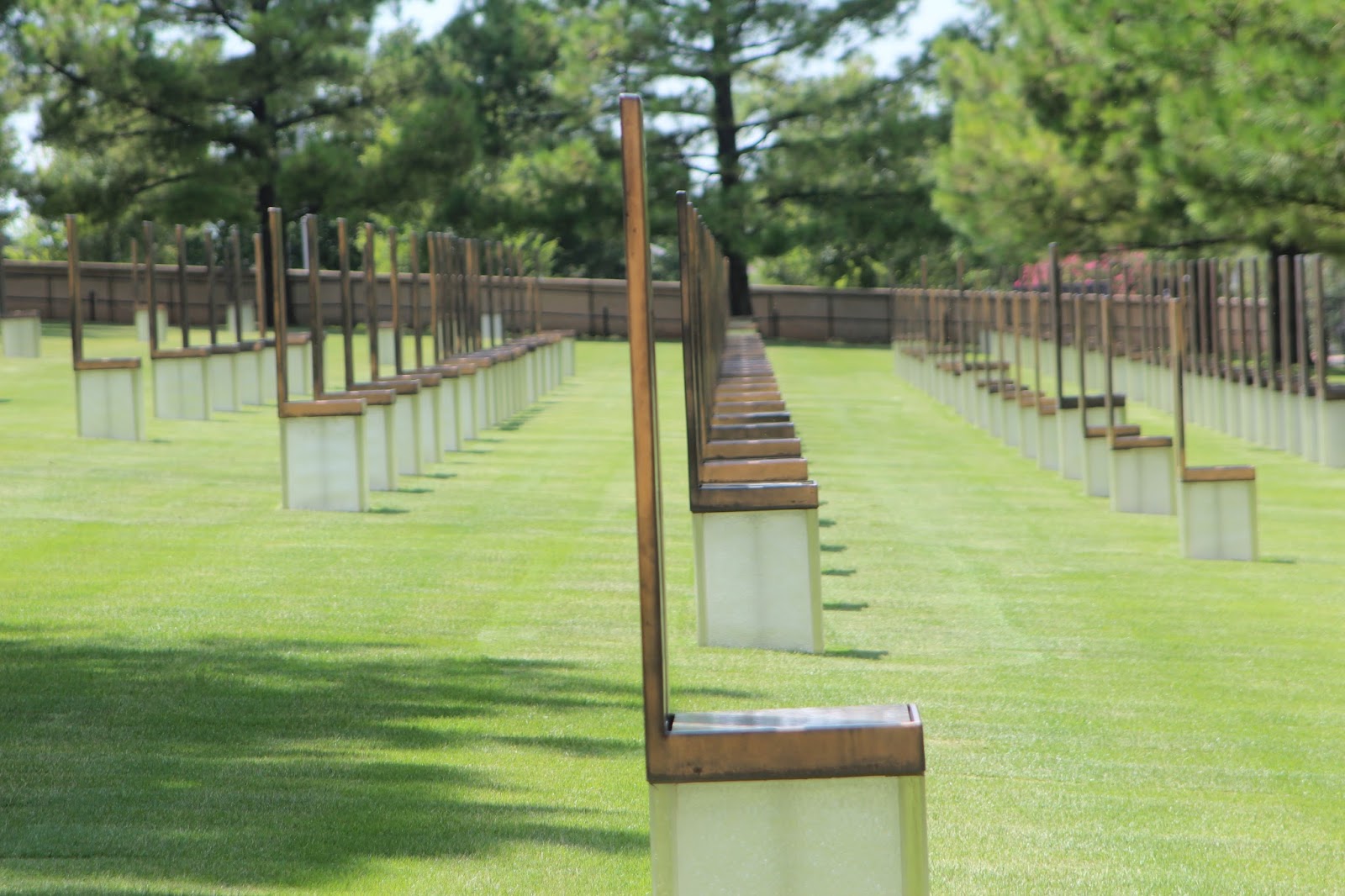
© Simon Poulter 2013
The Oklahoma City memorial is a sombre but poignant deviation on the journey. But I must press on. Beyond it, Route 66 appears and disappears again alongside I-40, the road that largely replaced it. I am now getting an increasing sense of heading west. This might appear to be a ridiculous statement, seeing as signposts and the sat-nav are telling me the direction I'm heading, but I am noticing the landscape opening up and the sky getting 'bigger'.

Over the many years I've been visiting the US, I've spent more time in its western half than anywhere else. The sky is a distinct shade of light blue out here, and as I drive towards Texas, this colour becomes contrasted by the reddish-brown of the soil, something I've only ever seen elsewhere in Devon in the UK.
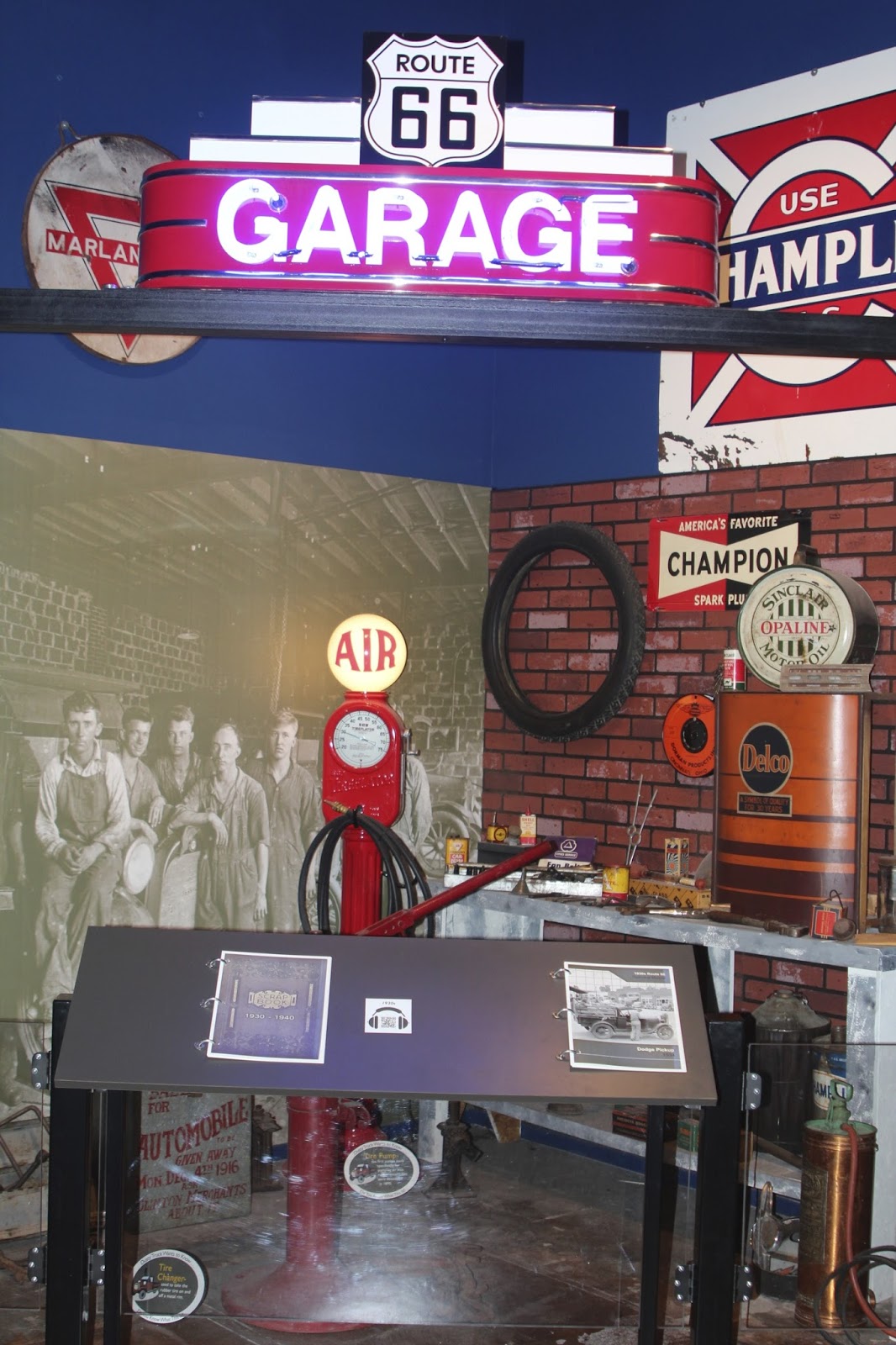
© Simon Poulter 2013
At Clinton, another must-see - the excellent Oklahoma Route 66 Museum - brilliantly tells the whole story of 66, from its inception to its role in the great migration west from the Dust Bowl, through the years of wartime austerity and post-war economic boom in America, up to the arrival of the interstate system and the eventual demise of Route 66 as an official Federal Highway.

The story the museum tells, however, isn't a depressingly negative one: it successfully conveys the meaning of America, that everything is there if you're prepared to work hard for it.

Even today, with 66 more of an ideal than actual road, there are plenty of people still "turning a buck", as one commentator in a film at the museum says, on the back of it.

However, on we go into the 'Panhandle' of Texas. Tomorrow's post will contain more thoughts on America's second most populous state, largely because as I arrive in it, it is absolutely hosing it down and I can't see anything of the place.

© Simon Poulter 2013

Which brings me to the particularly depressing town of Shamrock for the night. It is, now, essentially a stop-off for I-40, comprising four chain motels, a similar number of gas stations, a McDonalds and just over two acres of mostly boarded up shops and homes. To add to the fun, a local blogger and activist claims the town to be awash with meth-amphetamine dealing and prostitution. Good to see, then, that someone is still turning a buck along Route 66.


The motel I've chosen is, at least, conveniently located. More importantly, it is complete. Some weeks back I had something of a shock when I looked up the place on Google Streetview, only to find one view showing the hotel built, and another showing it still under construction.

Thankfully, as the biblical monsoon continues, I am relieved to discover it fully roofed and fully functional, and lock myself in for the night.

As I do, a John Mellencamp song comes into my head: "Ain't that America."


Tomorrow:   WWDBD? heads for Heisenberg country

Monday, August 12, 2013

From St. Louis to Tulsa: three states and five dead armadillos


Quite frankly, the last thing you need, when you're still adjusting to a new timezone and you've got a 400-mile drive ahead of you, is the hotel fire alarm going off at 5am. Especially when nothing actually happens.

First, there's a slightly creepy recorded message pumped through the hotel's speaker system: "An alarm has been detected. We are investigating. Please remain calm and standby for further announcements. Thank you." Throughout the hotel you hear the noise of toilets being flushed. The collective bladder of an entire building has been prematurely woken.

The promised further announcement doesn't come. Instead, a steady PARP-PARP-PARP-PARP. Neither alarming nor piercing. Just annoying. PARP-PARP-PARP-PARP. Consulting, for the first time ever in a hotel, the 'What To Do In An Emergency' instructions on the back of the door, I am informed that in the event of a fire, we'll get a WHOOP-WHOOP, which could turn out to be Arsenio Hall with a megaphone. But no, we are instead forced to endure the PARP-PARP-PARP-PARP with no announcement, and no clue whatsoever what's going on.

If the hotel is to be burned to a cinder, with everyone of us with it, no-one appears in a rush to get out. Every few minutes you hear the sound of flip-flops slapping past the door, another sleepy, curious guest on the hunt for news. And then the all-clear.

© Simon Poulter 2013
Dawn is breaking rather attractively over St. Louis. A normal person would just go grumpily back to bed, but with a long drive ahead, I decide to go for an early morning swim before checking out and, after a brief detour to photograph the Gateway Arch on the banks of the Mississippi, this road warrior sets course for Oklahoma.

I know precisely four things about Tulsa:

1) Burt Bacharach and Hal David's Twenty Four Hours From Tulsa made an international superstar out of Gene Pitney, and has prompted endless pub debates as to where Pitney was when a day's travel from Tulsa, and who made him give in to temptation and having it away in a motel room.

2) Eric Clapton has covered a Hank Williams song called Tulsa Time, in which he sings "Well, I left Oklahoma, drriving in a Pontiac, just about to lose my mind. I was going to Arizona, maybe on to California, where people all live so fine." Clearly he was driving on Route 66.

3) Clapton's great friend, JJ Cale, who died three weeks ago, was the driving force behind the Tulsa Sound, a blend of country, blues and rock which was adopted by Clapton himself when he covered Cale's After Midnight and Cocaine, and defined the Dire Straits sound.

4) In an episode of Friends, Chandler falls asleep in a meeting and gets relocated to Tulsa. In trying to get out of the appointment, he pleads with his boss: "Here's the thing. I went home and told my wife about Tulsa and she won't go. Me, I love Tulsa. Tulsa is heaven. Tulsa is Italy. Please don't make me go there."

Getting to Tulsa on Route 66 provides another solid reason why getting anywhere on Route 66 is proving to be a delight. You could do the journey in an uninspiring, 396-mile straight dash down I-44 in just under six hours. 

Or you can follow "Main Street America" or "The Will Rogers Highway" - two alternative names for 66 I've yet to hear anyone use - and add almost 50 miles and three hours to your journey.

Thanks to the St. Louis hotel shenanigans, I have to confess right here and now that I have cheated a bit on this stretch, and for the first hour or so have followed the interstate to make up some time. It's at this point that I glance at the sat-nav and realise that I am on a long, straight and apparently featureless road.

© Simon Poulter 2013
So, at Stanton I find myself on 66 again, and the rewards for doing so become instantly apparent. Astonishingly green fields, thick, wooded vegetation, vineyards and a never-ending parade of small communities which all seem to have, as their common denominator, atrociously-named hair salons, such as 'Kay's Kut And Kurl'. I wonder whether the initials KKK were intentional?

As 66 rolls up and down like the gentlest of rollercoasters through Missouri, the interstate is - like that in Illinois - never far away. 

But even when it is running parallel, the pace of 66 and the fact you're not locked in mortal combat with everyone else bombing along the freeway's three lanes does genuinely relax.

Drives like this are a holiday for the senses. The smell of fresh cut grass is everywhere. At an estimate, I would say that every household in rural Missouri can claim to have 2.5 vehicles, those being two cars and the 0.5 a lawn mower with a seat. Being Sunday, everyone is out on them, laboriously tending to the substantial amount of lawn most of the houses alongside 66 appear to have.

Not far ahead I come to the town of Bourbon. Evidently Bourbon is a popular tourist stop owing to its giant water tower with 'Bourbon' painted on the side. While most people see this as a photo gag, I'm hungry and the name Bourbon only makes me think of the double-layer chocolate biscuits back in the UK. Wisely, I drive on.

© Simon Poulter 2013
Further on down the road, past more random wax museums, reptile ranches and other tourist ephemera, the town of Cuba declares itself "Route 66 Mural City" and doesn't disappoint with the walls of shops covered in what appears to be highly artistic graffiti depicting things like soldiers going off to war.

Then it's back out into open countryside, where 66 takes you through Fanning and, for reasons best known to itself, the world's largest rocking chair.  

Quite what took someone to achieve this feat is beyond me, and I am left wondering who  lost the record to Fanning and by what margin. And is there, like the current race to outbuild the largest skyscrapers in London, someone already at work on building a new world record winner?

The superlatives continue. The word "giant" appears frequently in the tourist attractions. After the giant rocking chair, Waynesville offers a giant frog. Thankfully, this is not the Godzilla of the frog species (though nearby Rolla does contain the first ever nuclear reactor in the state of Missouri...), but in fact a large boulder on the side of a hill painted like a giant frog. Paint and geology can be a dangerous combination.

© Simon Poulter 2013
After a brief reconnection for convenience with I-44 through yet another Springfield, at Paris Springs I rejoin Route 66 for the remainder of the drive into Tulsa. Near Baxter Springs I leave Missouri and enter the state of Kansas, and at a stroke start to notice the alarming number of dead armadillos in the road. 

It is not clear why there hadn't been any expired armadillos in Missouri, and no one was around to tell me whether Kansas armadillos are barred from travelling out of state to be killed by speeding motorists. 

But in the short amount of time Route 66 takes you through Kansas, I counted five of the suckers, bloated and lying on their armoured backs, legs up in the air. 

These scenes, dear reader, are too shocking to show you, but the picture to your left will give you some idea of what it looked like. Oh, the humanity.

With the temperature now north of 90F (32C in Euros), it's time to switch off the AC, wind down the windows and get rural. For all its agricultural functionality, there is a timeless beauty to this part of the drive. But there is also a reminder that this is a part of America struggling. 

The opening of the interstate highways may have provided a straighter line to get from A to B, but the dilapidated, paint-peeling towns along Route 66 aren't there to show the tourists the America of another era, they're there because they are stuck, decaying from another era.

Across the Oklahoma state line, and I'm into Indian territory. I respect that's not the politically-correct term, but even the guidebooks don't know whether to call the indigenous tribes "American Indians" or "Native Americans". Either way, Oklahoma is home to more tribal headquarters than any other state, such as the Quapaw, whose town is one of the first you encounter on 66.

© Simon Poulter 2013
Three or four miles later you reach Miami, and a town as starkly contrasting with the pastel-coloured pleasure pit 1400 miles away in Florida. Being a Sunday there is little sign of life, but one wonders what life on a Monday might be like here. Like many of the towns I've encountered, economic hardship is visible. 

Once thriving storefronts are dimmed, just empty carcasses. Named after the Miami (pronounced "my-am-uh") tribe that settled at the juncture of the Neosho and Spring Rivers, 66 drives a straight line through the town, passing the recently refurbished Coleman Theater, which was built in 1929 and today shows classic films as well as silent movies, complete with traditional organist.

© Simon Poulter 2013
For real Route 66 authenticity, however, the road takes a bumpy detour south of Miami. Here the relatively smooth surface gives way to lose gravel and potholes galore, as you take the "9-foot Highway", so named for being very narrow, with a concrete strip up the middle. This fragile section of 66 is partly there as a monument to the road before 1937.

© Simon Poulter 2013
At first you think you've taken a wrong turn, and will end up in someone's private property, or worse, with a toothless kid playing banjo sitting on a wall, until you emerge at the southern end of this zig-zagging diversion where a monument explains it all.

The 9-foot Highway lasts just a mile or so, and then it's back out on the open road to Tulsa. More rolling farmland, more Indian relics, more one-stoplight towns like Chelsea (had to mention that...), until the rustic charm gives way to the outskirts of the big city.

Oklahoma has more miles of the original Route 66 than any other state, so before I cross into Texas tomorrow, there will be more of the farmland, relics and single red light towns. But, noticeably, no dead armadillos.

Since crossing from Kansas, there hasn't been one lying by the side of the road. You've got to hand it to the little fellas - they may have absolutely no sense of road safety, but they do respect state boundaries.

Tomorrow: Go West, young man