Showing posts with label Eric Clapton. Show all posts

Monday, October 14, 2013

Deep In The Motherlode: John Martyn - The Island Years

The Greatest Hits collection: for some, the perfect Christmas gift. To others, the ideal introduction to a grander canon. And to another category - let's call them The Suits - an opportunity to plunder a back catalogue.

But what if there were no Top 40 singles, and barely any meaningful flickering of attention beyond a faithful cognoscenti? What justification, then, the release of a compilation of 'hits'?

Logic, presumably, doesn't even enter the equation when considering John Martyn - The Island Years, a truly lavish package weighing in at a chunky couple of kilos, and containing 17 CDs, a DVD, 120 rarities, four songs never even heard before, a press kit from 1973, and a lovingly curated book by longtime biographer John Hillarby.

No one is expecting anyone other than the deepest fan to part company with close to £150 for such a weighty tome, especially one containing a lot of material the fan might already possess. But that is part of the tragedy of John Martyn and, oddly, his appeal.

It's singularly impossible to imagine that 40 years hence Justin Bieber will be regarded with the same reverence for the heart-stripping depths to which he would descend with his songwriting, his utterly unique guitar virtuosity, and even the depravity to which his tour jinks would reach. Because, quite frankly, they don't make 'em like Martyn any more, and that's what makes The Island Years more than just a fan's treasure trove.

It charts Martyn's most formidable period, when Chris Blackwell made him Island's first white signing in 1967, taking him from Surrey-born, Glasgow-raised gauche exponent of finger-in-ear bucolic folk to ethereal classics like Solid Air and the beautiful woozefest of Go Down Easy (with its opening line "You curl around me like a fern in the spring" and the intonation of "...eazzzy" that perfectly harmonises Martyn's voice and Danny Thompson's upright bass).


Picture: Island Records

There will be no shortage of people, I'm sure (and I'm not going to put this to the test, either) who will say that What Would David Bowie Do? bangs on a tad too much about Martyn. But like so many - and there are many - who love his work, we all share the same adoration and the same frustration. Adoration for a body of work that gouged open the human condition and frustration at the way Martyn's talents were largely ignored by the mainstream and came close to being wasted by Martyn himself.
Picture: Island Records

The former Iain David McGeachy, born on September 11, 1948 in a street in New Malden, Surrey, not far from the one I arrived in 19 years later, was often regarded as "a musician's musician". This is a term I always consider to be the musical equivalent of patronisingly describing someone not blessed with much beauty as having a great personality.

Martyn, however, was - and remains, posthumously - a musician whom those who know their music, and especially their singer-songwriters, will hold considerable reverence for. True, I wouldn't be able to throw any hit singles at you for reference, but to a certain generation, Solid Air remains a stoner's choice.

Clapton's cover of May You Never kept Martyn in Guinness during a career whose critical success was rarely matched by commercial success. Eclectic collaborations with David Gilmour, Phil Collins and Sister Bliss, plus the collection of artists like Beck, The Cure's Robert Smith, Paolo Nutini, Morcheeba, Beth Orton, Joe Bonamassa, Lisa Hannigan, David Gray, Snow Patrol and Collins (again) who contributed to the 2011 tribute album Johnny Boy Would Love This were the tip of the iceberg as far as Martyn's standing in the business was concerned.

"I'd never heard anything like him," Orton recently recalled. "Like all good music, it scared me a little, but it was so tender as well, wise and mysterious. He opened a door to another world of beauty and sensuality that until that moment I knew little of. To this day I still love the tenderness of his words and delivery."


Picture: Island Records
When he died, in January 2009, aged 60 and just after being awarded an OBE in the New Year's Honour's List, the tributes came from right across the industry. He was one of music's loveable rogues, a once whip-thin folkie with an angelic voice who ended his life a vast bear of a man, with a whiskey-soured Gorbals rasp, one leg missing below the knee, and the sort of history a rascally old cove in a dockside pub might retell.

That he survived his sixth decade was a surprise to some, but a blessing to all who continued to enjoy new material right up until his death. The Island Years comes to represent Martyn at his most creatively fertile and his most technically inventive in the studio (and out of it - One World's wigout Small Hours was recorded at three in the morning next to a Berkshire lake, just to capture ambient sounds like a flight of geese taking to the air).

The package includes all 12 studio albums recorded for Island and although most - and especially Bless The Weather, Solid Air, Inside Out, One World and Grace And Danger should be nailed-on fixtures of any existing Martyn collection - the additional CDs containing outtakes and complete live recordings (such as one from Richmond-upon-Thames' Hanging Lamp, as well as the Live From Leeds album) provide more than just a completist's satisfaction.


Picture: Island Records
The inclusion of a DVD featuring Martyn's various TV appearances - including seminal performances with partner-in-crime Danny Thompson on The Old Grey Whistle Test - chart his evolution from genius of a folk, rock, blues and even reggae hybrid with an acoustic guitar and EchoPlex delay, to besuited electric guitarist trying to fit the mid-80s effete with over-produced AOR gloss that seemed intended to turn Martyn into the next Chris De Burgh.

But even there, amid echoey sax solos and the battered Martin acoustic replaced by Stratocasters and Les Pauls, the essence of John Martyn can be seen for all its fragility, the raw, heart-on-sleeve (in fact heart as sleeve) emotion. Even a cover version of Somewhere Over The Rainbow turns into a song of wrought honesty only Martyn could have made.

The Island Years is a sumptuous Aladdin's Cave of John Martyn's music. The stuff you know too well bear repeated listening; the stuff you've heard in different forms will provide a fascinating glimpse of the creative process of a consummate innovator; and the absolute rarities - the demos, the previously unreleased, the obscure BBC sessions, even a cover version of Hi-Heel Sneakers by (the first record Martyn ever bought) - conspire to put one of the most event-filled, colourful and tragic careers into one mighty, postman-challenging box of never ending delight.


Monday, August 12, 2013

From St. Louis to Tulsa: three states and five dead armadillos


Quite frankly, the last thing you need, when you're still adjusting to a new timezone and you've got a 400-mile drive ahead of you, is the hotel fire alarm going off at 5am. Especially when nothing actually happens.

First, there's a slightly creepy recorded message pumped through the hotel's speaker system: "An alarm has been detected. We are investigating. Please remain calm and standby for further announcements. Thank you." Throughout the hotel you hear the noise of toilets being flushed. The collective bladder of an entire building has been prematurely woken.

The promised further announcement doesn't come. Instead, a steady PARP-PARP-PARP-PARP. Neither alarming nor piercing. Just annoying. PARP-PARP-PARP-PARP. Consulting, for the first time ever in a hotel, the 'What To Do In An Emergency' instructions on the back of the door, I am informed that in the event of a fire, we'll get a WHOOP-WHOOP, which could turn out to be Arsenio Hall with a megaphone. But no, we are instead forced to endure the PARP-PARP-PARP-PARP with no announcement, and no clue whatsoever what's going on.

If the hotel is to be burned to a cinder, with everyone of us with it, no-one appears in a rush to get out. Every few minutes you hear the sound of flip-flops slapping past the door, another sleepy, curious guest on the hunt for news. And then the all-clear.

© Simon Poulter 2013
Dawn is breaking rather attractively over St. Louis. A normal person would just go grumpily back to bed, but with a long drive ahead, I decide to go for an early morning swim before checking out and, after a brief detour to photograph the Gateway Arch on the banks of the Mississippi, this road warrior sets course for Oklahoma.

I know precisely four things about Tulsa:

1) Burt Bacharach and Hal David's Twenty Four Hours From Tulsa made an international superstar out of Gene Pitney, and has prompted endless pub debates as to where Pitney was when a day's travel from Tulsa, and who made him give in to temptation and having it away in a motel room.

2) Eric Clapton has covered a Hank Williams song called Tulsa Time, in which he sings "Well, I left Oklahoma, drriving in a Pontiac, just about to lose my mind. I was going to Arizona, maybe on to California, where people all live so fine." Clearly he was driving on Route 66.

3) Clapton's great friend, JJ Cale, who died three weeks ago, was the driving force behind the Tulsa Sound, a blend of country, blues and rock which was adopted by Clapton himself when he covered Cale's After Midnight and Cocaine, and defined the Dire Straits sound.

4) In an episode of Friends, Chandler falls asleep in a meeting and gets relocated to Tulsa. In trying to get out of the appointment, he pleads with his boss: "Here's the thing. I went home and told my wife about Tulsa and she won't go. Me, I love Tulsa. Tulsa is heaven. Tulsa is Italy. Please don't make me go there."

Getting to Tulsa on Route 66 provides another solid reason why getting anywhere on Route 66 is proving to be a delight. You could do the journey in an uninspiring, 396-mile straight dash down I-44 in just under six hours. 

Or you can follow "Main Street America" or "The Will Rogers Highway" - two alternative names for 66 I've yet to hear anyone use - and add almost 50 miles and three hours to your journey.

Thanks to the St. Louis hotel shenanigans, I have to confess right here and now that I have cheated a bit on this stretch, and for the first hour or so have followed the interstate to make up some time. It's at this point that I glance at the sat-nav and realise that I am on a long, straight and apparently featureless road.

© Simon Poulter 2013
So, at Stanton I find myself on 66 again, and the rewards for doing so become instantly apparent. Astonishingly green fields, thick, wooded vegetation, vineyards and a never-ending parade of small communities which all seem to have, as their common denominator, atrociously-named hair salons, such as 'Kay's Kut And Kurl'. I wonder whether the initials KKK were intentional?

As 66 rolls up and down like the gentlest of rollercoasters through Missouri, the interstate is - like that in Illinois - never far away. 

But even when it is running parallel, the pace of 66 and the fact you're not locked in mortal combat with everyone else bombing along the freeway's three lanes does genuinely relax.

Drives like this are a holiday for the senses. The smell of fresh cut grass is everywhere. At an estimate, I would say that every household in rural Missouri can claim to have 2.5 vehicles, those being two cars and the 0.5 a lawn mower with a seat. Being Sunday, everyone is out on them, laboriously tending to the substantial amount of lawn most of the houses alongside 66 appear to have.

Not far ahead I come to the town of Bourbon. Evidently Bourbon is a popular tourist stop owing to its giant water tower with 'Bourbon' painted on the side. While most people see this as a photo gag, I'm hungry and the name Bourbon only makes me think of the double-layer chocolate biscuits back in the UK. Wisely, I drive on.

© Simon Poulter 2013
Further on down the road, past more random wax museums, reptile ranches and other tourist ephemera, the town of Cuba declares itself "Route 66 Mural City" and doesn't disappoint with the walls of shops covered in what appears to be highly artistic graffiti depicting things like soldiers going off to war.

Then it's back out into open countryside, where 66 takes you through Fanning and, for reasons best known to itself, the world's largest rocking chair.  

Quite what took someone to achieve this feat is beyond me, and I am left wondering who  lost the record to Fanning and by what margin. And is there, like the current race to outbuild the largest skyscrapers in London, someone already at work on building a new world record winner?

The superlatives continue. The word "giant" appears frequently in the tourist attractions. After the giant rocking chair, Waynesville offers a giant frog. Thankfully, this is not the Godzilla of the frog species (though nearby Rolla does contain the first ever nuclear reactor in the state of Missouri...), but in fact a large boulder on the side of a hill painted like a giant frog. Paint and geology can be a dangerous combination.

© Simon Poulter 2013
After a brief reconnection for convenience with I-44 through yet another Springfield, at Paris Springs I rejoin Route 66 for the remainder of the drive into Tulsa. Near Baxter Springs I leave Missouri and enter the state of Kansas, and at a stroke start to notice the alarming number of dead armadillos in the road. 

It is not clear why there hadn't been any expired armadillos in Missouri, and no one was around to tell me whether Kansas armadillos are barred from travelling out of state to be killed by speeding motorists. 

But in the short amount of time Route 66 takes you through Kansas, I counted five of the suckers, bloated and lying on their armoured backs, legs up in the air. 

These scenes, dear reader, are too shocking to show you, but the picture to your left will give you some idea of what it looked like. Oh, the humanity.

With the temperature now north of 90F (32C in Euros), it's time to switch off the AC, wind down the windows and get rural. For all its agricultural functionality, there is a timeless beauty to this part of the drive. But there is also a reminder that this is a part of America struggling. 

The opening of the interstate highways may have provided a straighter line to get from A to B, but the dilapidated, paint-peeling towns along Route 66 aren't there to show the tourists the America of another era, they're there because they are stuck, decaying from another era.

Across the Oklahoma state line, and I'm into Indian territory. I respect that's not the politically-correct term, but even the guidebooks don't know whether to call the indigenous tribes "American Indians" or "Native Americans". Either way, Oklahoma is home to more tribal headquarters than any other state, such as the Quapaw, whose town is one of the first you encounter on 66.

© Simon Poulter 2013
Three or four miles later you reach Miami, and a town as starkly contrasting with the pastel-coloured pleasure pit 1400 miles away in Florida. Being a Sunday there is little sign of life, but one wonders what life on a Monday might be like here. Like many of the towns I've encountered, economic hardship is visible. 

Once thriving storefronts are dimmed, just empty carcasses. Named after the Miami (pronounced "my-am-uh") tribe that settled at the juncture of the Neosho and Spring Rivers, 66 drives a straight line through the town, passing the recently refurbished Coleman Theater, which was built in 1929 and today shows classic films as well as silent movies, complete with traditional organist.

© Simon Poulter 2013
For real Route 66 authenticity, however, the road takes a bumpy detour south of Miami. Here the relatively smooth surface gives way to lose gravel and potholes galore, as you take the "9-foot Highway", so named for being very narrow, with a concrete strip up the middle. This fragile section of 66 is partly there as a monument to the road before 1937.

© Simon Poulter 2013
At first you think you've taken a wrong turn, and will end up in someone's private property, or worse, with a toothless kid playing banjo sitting on a wall, until you emerge at the southern end of this zig-zagging diversion where a monument explains it all.

The 9-foot Highway lasts just a mile or so, and then it's back out on the open road to Tulsa. More rolling farmland, more Indian relics, more one-stoplight towns like Chelsea (had to mention that...), until the rustic charm gives way to the outskirts of the big city.

Oklahoma has more miles of the original Route 66 than any other state, so before I cross into Texas tomorrow, there will be more of the farmland, relics and single red light towns. But, noticeably, no dead armadillos.

Since crossing from Kansas, there hasn't been one lying by the side of the road. You've got to hand it to the little fellas - they may have absolutely no sense of road safety, but they do respect state boundaries.

Tomorrow: Go West, young man

Monday, July 15, 2013

The Great Summer Of Shows™ - what we have learned


Way back at the end of May, What Would David Bowie Do? came to the stark realisation that it was going to be an amazing summer of live music, kicking off with Eric Clapton at his surrogate home, London's Royal Albert Hall, before setting up camp in Paris with the Stone Roses, Rodriguez, Depeche Mode, Mark Knopfler, The Who, Bruce Springsteen and Hugh Laurie, ending at the Montreux Jazz Festival with Prince.

Though we're only at the midpoint of July, it is safe to say that it has been a Great Summer Of Shows™. It has also been an education. Here's what we have learned:

The Merchandise Stand

Just because, when you first walk in, you see a caged-off 'shop' of sorts selling merchandise doesn't mean you have to cause a minor riot for your "exclusive" all-black XL tour T-shirt, which your other half will eventually purge from your collection. Nor does it mean wearing the thing over the clothes you came out for the evening in (especially if you just came straight from the office) or draping round your shoulders like you've just looted it from a branch of Top Man during a riot. This thing called the Internet has just been invented and you can use it to buy stuff from bands and their "websites"

Banned Items

Patrons of stadium gigs should refrain from bringing in the following items:
  1. Binoculars (because you don't want to look a total prat), 
  2. Inflatable beach toys (because they're designed for the beach, not for annoying 50,000 irritable people who've been drinking in the sun since lunchtime)
  3. Bra-less girlfriends who want to be carried on your shoulders (because they will be ogled at as soon as they appear on the big screen and you will end up taking the week off work due to your back giving out).
Picture  © Simon Poulter 2013

The Mexican Wave

If you are at a stadium gig it is seriously not cool to start a Mexican Wave. It was amusing once, during the 1986 World Cup, which was held in Mexico. It is not amusing in the 21st century at a football stadium in the north of England.

The Support Act

The support act may be completely unknown to you, they may have a weedy voice and a total lack of charisma, but that doesn't mean you should talk all the way through their act. The person you've really come to see believes in this frail singer-songwriter/angst-ridden balladeer/quirky-looking pretty boy your girlfriend suddenly takes interest in and it's just damn rude to yack away during their 30-minute set. Bugger off to the bar instead.

Learn How It Works #1

The act you've come to see will get on stage when they're good and ready. No measure of slow-hand clapping, whistling or stamping of feet will advance the situation.

Picture  © Simon Poulter 2013

You're Not HBO

If you must video the show, first buy a television station or DVD company, negotiate with the artist for video rights, and then record the event using professional cameras and the ubiquitous Louma crane. Do not spend the entire night holding your iPhone in the air to the annoyance of all standing behind you.

Singing

If you feel compelled to sing along to the hits, take a few singing lessons first. Nobody wants to deal with the band not properly lip-synced with the video screen and your drastically off-key caterwauling. Especially if your breath stinks of Hades because you decided to have a cheeky curry before the show.

Recognise That You're Not In The Photographers' Pit

If you must take photographs, learn how to use your camera or smartphone first. Some poor drone at the consumer electronics company who made your fantastic new compact super-zoom spent time and effort translating the Japanese instruction manual into your native language. At least have the courtesy to learn how to switch off the annoying BEEP-BEEP that will drive your fellow punters to kill if it happens every time there's a quiet bit. 

Picture  © Simon Poulter 2013

The Stage Lighting Is There For A Reason

And while you're at it, learn how flash guns work on compact cameras. If you have the flash on, all you will be doing is illuminating the row of bald heads immediately in front of you, not the stage which - by the way - is already lit up by lots of lovely coloured lights. So you don't have to.

Sit Down, Dickhead #1

If you do take photographs, take only a few as souvenirs. Recognise that there are people behind you who weren't so successful in getting seats near the stage, and will not appreciate spending all that money to watch Mr. or Ms. Big Time through the LCD screen of your camera.

Sit Down, Dickhead #2

If I see that iPad appear above your head one more time...

Sit Down, Dickhead #3

Yes, we know it's cool that your lifelong idol is just in front of you, in the flesh, and close enough to touch, should you actually be that close, but that's no reason to stand up like a giddy child forcing every single person in every single row behind you to do the same. There are people who've paid good money for a seat, and are ruddy-well going to use it without having your lard arse block the view.

Picture  © Simon Poulter 2013


Stop Tweeting

Yes, it's cool for your followers to know you're at a concert, but do you need to give a running commentary? Do you need to miss the show because you're hunched over your Facebook page giving song-by-song updates? Do we need to see your face lit up like Indiana Jones in front of the Lost Ark because you're trying to redefine the zeitgeist in 140 characters or less?

Avoid The Clap

Everyone likes to clap. Pop concerts are the one venue outside gospel churches where communal rhythmic clapping in public is acceptable. Except that in a gospel church it will be rhythmic. And in time. Unlike your uncoordinated attempt to catch a particularly agile fly.

Learn How It Works #2

The act will go off towards the end, your less informed fellow punters will clap/whistle/stomp, the act will reappear for an encore. When they're good and ready.

Give It A Whistle

Actually, don't. The bluesman Blind Willie McTell may have started the practice of whistling during concerts as a means of getting audiences to join in with him, but he did not intend for ear drums to suffer permanent damage because the middle-aged adolescent next to you is trying to show off by sticking two fingers between his teeth and blowing. Not big. Not clever. Just painful.

Picture  © Simon Poulter 2013

Lighters Aloft

In the era when people smoked at concerts (and I mean regular cigarettes as well as those sweet-smelling roll-ups people still think it subversively cool to take a puff on), it was considered to be an appropriate indication of togetherness to hold a cigarette lighter in the air during an emotionally-wrought song to create the "ooh-aah" effect of hundreds of flickering flames. Where this practice began, no-one quite knows. Some say it was at Woodstock, when such hippy soppiness would have been contextually acceptable. Others claim it was at a Neil Diamond concert in the early '70s, and happened by random accident. Either way, it should have stopped by now, and certainly should not have been succeeded by cretins who have amusingly loaded a flickering lighter app on to their iPhone and are now holding it aloft during the 'slow one', right in front of you.

Learn How It Works #3

When 'the big lights' come up, that's your cue to head for the door. By the time you've stopped clapping/whistling/stomping the band will already be in a limo heading for the, erm, 'aftershow refreshment'. Go home. Or go home with someone. Or go next door to the pub. Or what-ev-ah. Those fat blokes on stage in Iron Maiden T-shirts coiling up microphone cables are roadies packing up Mr/Ms. Big Time's gear for the next gig, where all the above rituals will be played out once more.


Sunday, May 26, 2013

Eric Clapton live at the Royal Albert Hall: God comes home. Again.

Photo: Ron Kirby
Call him what you like, call him "Clapped-Out", call him Slowhand, even call him the Almighty, Eric Clapton is still at heart a blues guitarist whom, if you're into blues guitar, outshines most others.

Purists will say he's a charlatan because he doesn't use all six strings, or that he sold out when he went country, or that he swapped heroin and booze for Ferrari and Armani and lost his credibility in the process.

But at 68, the somewhat shy superstar who walks on stage at the Royal Albert Hall with the sort of brief, awkward wave you give an unfamiliar neighbour, is still - when he allows himself - as thunderous a player as he was when a cheeky graffitist dawbed "Clapton is God" on a Tube station wall, 45 years ago.

That wave - repeated with equal abbreviation for the encore - is as much crowd interaction as you get with Eric. There are no rambling tales, jokes or orchestrated crowd singalongs; applauding fans get a cursory "thankyew!" after each song and then it's on with the next one. This isn't, by the way, a detached rock legend failing to engage with the faithful: to a certain extent, this is still the diffident Surbiton schoolboy who learned his craft busking, under-age, in the riverside pubs of Kingston-upon-Thames. Before, obviously, becoming the world's most talked about British guitarist.

We are here for the fifth night of his seven-night residency at the Albert Hall, a venue Clapton has played almost 200 times since his debut there in 1964, and a venue that has become regarded as his spiritual home.

It is, though, an odd place for rock deity to ply their trade. Despite being more ornate Victorian wedding cake than rock amphitheatre, with its plush red velvet boxes and debenture seating, its surprisingly low stage and modest 4,000 capacity gives an intimacy that, perhaps, veers closest to the suburban saloon bars Clapton would travel by Green Line bus, from rural Ripley in Surrey, to play.

© Google
It is still an incongruous venue to hear the music of the Mississippi Delta. But it is still a joy to hear it. Clapton has, of course, come a long, long way from churning out Robert Johnson and Big Bill Broonzy songs on his Hoyer acoustic, bought for £2 by his grandmother in Bell Music on the Ewell Road in Tolworth. Which is now a hairdressers and a cafe.

This run at the Albert Hall - part of a tour to promote his enjoyably easy-going album Old Sock and celebrating his 50th year as a professional musician - condenses into one 22-song set the variety of his repertoire: the bluesy ones, the soulful ones, the quiet ones and the sort of fretboard workouts that started all the fuss in the first place with The Yardbirds, John Mayall and Cream.

Tonight, however, the somewhat sedate figure on stage seems a world away from the British Blues demon of the 60s, the 70s rock casualty, or the recovering playboy of the 80s. Throughout all these eras, all five decades of his coin-earning years, Clapton has been a sturdy professional, surrounded by the similarly proficient. Tonight he has with him the superb Paul Carrack - Britain's best white soul voice, bar none - on organ and vocals, longtime supporting keyboard player Chris Stainton, young buck Doyle Bramhall II (a ringer for the frizzy-haired 1967-version Clapton) on guitar (and who takes his fair share of soloing), Greg Leisz on pedal steel, Willie Weeks on bass and Steve Jordan on drums.

For those who go back a while with Clapton's work, the opening number of Hello Old Friend, from 1976's No Reason To Cry, is a bold and refreshingly unexpected beginning to the set.

My Father's Eyes, which follows, is a mere whippersnapper at only 15 years old, but the guitarist stretches back even further with his third track of the night, resurrecting Tell The Truth from the Layla And Other Assorted Love Songs album recorded under the guise of Derek and the Dominos. Those less familiar with Clapton's oldest canon might be fooled into thinking they're listening to new tracks, such is the fresh energy this band applies to such old material.

Gotta Get Over actually sounds like it was first written and recorded in the early 70s, despite being one of two new compositions included on Old Sock, while Black Cat Bone messes completely with chronology - a choppy blues first cut in the mid-80s by Albert Collins, as opposed to those in the set with considerably older heritage.

Then we're back to raid the Dominos era with the uplifting Got To Get Better In A Little While, here given a hefty gospel treatment that allows backing singers Michelle John and Sharon White to open the taps fully.

Carrack gets his first chance of the evening to showcase that voice, taking the lead vocal on the much-covered standard Come Rain Or Come Shine, before handing back to Clapton for the first hair-on-neck 'moment' of the evening: Badge.

The trouble with listening to legends playing the material that first established their legend status is that familiarity - especially for a 45-year-old song like Badge - can inhibit any fresh listening. How can the Stones go through playing Jumpin' Jack Flash and Satisfaction still, or McCartney with Yesterday, after all these years is beyond me (revenue, I suspect, helps), but Clapton still manages to make Badge sound box-fresh. Over the years I must have heard that solo - including trying to play it myself - and the familiar V-IV-II-I-V riff thousands of times. Clapton will have played it even more, and yet he continues to effortlessly put passion through that Stratocaster even now.

It is perfectly understandable, then, that we reach the "Seated" part of the evening. Electrified instruments are swapped for acoustic and chairs are brought on for the band as we cruise through a lengthy, seven-song sequence of gentler, 'unplugged' numbers - starting with the 1940s blues hit Driftin', the venerable Nobody Knows You When You're Down And Out and Paul Carrack singing his own composition It Ain't Easy (To Love You).

Photo: Linda Wnek

Layla, which you'll remember is an agitated song about infatuation, is reduced to something of a cabaret shuffle. A shame, really. The MTV Unplugged version was an entertaining novelty but should have been left as a one-off before returning to the full-blooded version.

Tears In Heaven - which must still be a painful song for Clapton to reproduce, given it's inspiration - is given a frivolous Caribbean lilt that defies the tragedy behind it. And then Wonderful Tonight, that contractually-obliged, dewy-eyed wedding reception perennial, is delivered with the only bespoke alteration being Bramhall getting to play the famous slowed down country riff beloved of amateur guitarists and loathed by those violently indifferent to the song's insipidness in fairly equal measure.

Appropriately, as the music stops the chairs are taken away, the band blasts into more vintage fare: Blues Power. A 12-bar boogie from Clapton's eponymous solo debut in 1970, it was recorded in that purple period of rock music between 1967 and 1971 when vitality was at its peak, drugs were a creative spur rather than financial and social millstone they were to soon become, and output was a rich mid-Atlantic soup of blues, country, folk and any other genre that came to mind.

It was during this period that the Rolling Stones made an authentic recording of Robert Johnson's Love In Vain (featuring, I recently discovered, Ry Cooder on guitar). Clapton applied his own authenticity to it on his tribute album Me And Mr. Johnson, but tonight gives it a full R'n'B oomph with the entire band flailing away (later to do the same with another Johnson cover from that album, Little Queen of Spades).

Crossroads, another unavoidable entry in Clapton's live repertoire, emerges at a frantic pace. Such are the different tempos I've heard it played over the years, in my head it sounds like someone messing with the RPM. Moreover, like so many interpretations of classic songs of the Delta, Crossroads has long lost the high-pitched folksiness of the Johnson original, but as a old friend of Clapton's - it's the name he's given both his Antiguan drug recovery centre and the fundraising guitar festival in its honour - it's a song he could play a thousand different ways without losing anything.

Though open to less variation, Cocaine is, at least, more of a crowd singalong than we've had all night. Myriad bar room blues bands have given it a go, but no-one - not even JJ Cale who wrote and recorded it in the first place - has managed to give the song the same crowd-pleasing amplitude.

And that is part of Clapton's enduring appeal: he may never have been the most pioneering songwriter - though his songwriting has, at times, been tragically overlooked by his instrumental prowess - but his true gift is that blues-rooted guitar. Yes, there may even be better contemporary blues guitar players - Rory Gallagher, Albert Lee, even fellow Surrey suburbanite Jeff Beck, but such competition should never detract from how good Clapton has always been, and still is.

I've seen Clapton before, but this was, after many attempts, is the first time I've seen him at the Albert Hall. A venue is just a venue, of course, but within its rotund chamber, Clapton's fluidity as a truly unique guitarist comes through with rich and enveloping clarity. Even if you've never had much interest in the blues, or guitars, or even Clapton himself, you can't help being impressed by true virtuosity which may have improved with age, but must have been mind-blowing when, as an 18-year-old, he first rocked south-west London after joining The Yardbirds in October 1963.

Seeing him at a venue he has likened to playing his front room (I presume for its familiarity rather than opulent expanse) could be a little like going to a West End musical like Les Miserables: it's been going a long time, you more or less know all the tunes, and you know that most of the rest of the audience will be mainly older than you and wearing their smart going out to the theatre togs.

Yes, the audience will be a little bit conventional, notably white, middle class and probably driving Jags, but sooner or later they will loose their English shackles. On this particular evening, it takes the encore to leave everyone standing on their feet for the finale of Sunshine Of Your Love.

Still, to this day, the only psychedelic rock song to feature a riff from Blue Moon, it is dispatched by the Clapton ensemble with hearty relish, much to the crowd's clear glee. Why, there are even a few awkward attempts at air guitar. Thankfully these were few, and rendered ridiculous by the arrival onstage of Gary Clark Jr., the brilliant bluesman-come-actor whom Clapton has had as support act during the Albert Hall residency.

Closing with the old Joe Cocker song High Time We Went, with Carrack again making his presence felt on vocals and Stainton - who co-wrote the song - pumping away at the piano - it draws a warming blanket of comfort over the evening.

Clapton leaves the stage scratching his head as if going indoors for a cup of tea after putting in some bedding plants. It's a saunter, but not one of audience disrespect, just one who has seen it all before. As a guitarist, he still is God. I just would expect him to be rather bored of that tag by now.

Saturday, May 11, 2013

What we didn't know already: girls dig guys with guitars

Tony Montana got it all wrong. "You gotta make the money first, then you get the power. And when you get the power, then you get the women," he opines in Scarface

Had he been better informed he could have gone straight to the home plate by acquiring a guitar (though a ukulele would better serve the line "Say hello to my little friend", hem hem...).

Anyway, a team of researchers at the Université de Bretagne-Sud in Brittany have discovered that ownership of a guitar seriously boosts a chap's chances with the ladies. The team sent a plucky 20-year-old actor into a Brittany shopping centre to chat up 300 women aged between 18 and 22. Nice work if you can get it.

The actor approached the first 100 targets holding a sports bag, the second 100 with a guitar case, and went up to the third 100 without any prop at all, just a line about how pretty they looked and would they fancy a date.

All of the women he approached with the case gave up phone numbers, 14% responded positively to charm alone, and only 9% took any interest from the sports bag. In your face, Fit Billy. One qualifying detail, however, is that the actor was, and I quote directly, "previously evaluated as having a high level of physical attractiveness".

This is where my 45-year-old carcass, coupled with my Eric Clapton-signature Fender Stratocaster, may not generate quite the same results. Even wearing a T-shirt with ROCK GOD emblazoned across the stretched chest.

Between the ages of 11 and 13, I lugged a Spanish guitar to and from school every Wednesday. At lunchtime I would put up with my guitar tutor, a useless tool who spent each lesson noisily consuming the nutritious school lunch of sausage, baked beans and chips, while my stubby fingers tried to appropriate something which would, eventually, sound like Segovia on a bad day.

With alarming clarity, I recall that on no particular Wednesday did any women throw themselves at me out of carnal lust. Which is just as well, as it would have been illegal, and we'd have all ended up in in the Daily Mail.

In fact, in 36 years of unblemished guitar ownership, neither guitar or even guitar case have generated anything resembling frisky intent. I've walked through airports carrying guitars and the most recognition ever received was either a request for directions or the look of someone clearly thinking - and on one occasion, actually saying - "Who does that twat think he is?".

David Brent - the exception to the rule
It is clearly me. Because the Brittany research, which was led by a Professor Nicholas Guegen, (whose previous work includes discovering that waitresses can earn better tips if they wear red) and published in Psychology of Music, is borne out by at least five decades of plank-spanking rock gods who - bar a few weirdos interested in learning obscure finger-picking techniques - have routinely declared that they took up the guitar to meet women.

The author, photographed in Israel.
Included in this post by pure coincidence.
A magazine cuttings library could have spared Guegen's team the effort. In fact, his research comes just a year after the Ben Gurion and Tel Aviv universities in Israel jointly conducted a similarly indicative study, in which 100 single women were sent friend requests for Facebook along with the slightly creepy message "Hey, what's up? I like your photo".

Quite why it took two universities to do this is beyond me, but the salient outcome was that three times more women responded to Guitar Dude than Mr. Hands Free.

So now we know what we already suspected: girls dig guys with guitars. What we didn't, perhaps, fully appreciate, is that - according to the Brittany research team - playing a musical instrument is regarded as an indication of intelligence, the ability to learn new skills, and a sign of independent interests. Furthermore, say the researchers, years of rock stars prancing about with guitars have led women to associate a guitar with wealth, status and success.

I would, however, challenge anyone to put this to the test with a kazoo, violin and - sorry, Mumford boys - a banjo. On the other hand, show up with a guitar, saxophone or blues harmonica, or a flute if you're Ron Burgundy, and, well, fill-yer-boots.

So, while there are clearly more valuable academic interests to pursue - like curing cancer for a start - the research does at least put some quantification on what has sent decades of horny teenage boys to guitar shops on a Saturday to hammer out the opening riff of Smoke On The Water or the jangly bit from Stairway To Heaven.

Again, though, it didn't really require such exhaustive studying, though hats off to the mall actor for a job well done. As Cosmopolitan blogger Rose Surnow pointed out this week: "Why do you think all these amazing babes date John Mayer? Because he’s super nice? It’s because he strums an instrument and literally sings, 'Your body is a wonderland'." Surnow's thesis was that guitar-girl attraction had nothing to do with brains but that "we associate guitars with hot bodies, long hair, and a bad attitude."

So, if you don't already own a guitar, it being a Saturday, why not visit your local axe shop, push all those pimply specks out of the way, and audition your own Les Paul, Telecaster or Strat. Once you've found something you like, you will be able to learn one of the ten songs below which, according to Guitar World, will make an instant impression on the opposite sex*.
  1. More Than Words - Extreme
  2. Crash - Dave Matthews Band
  3. Melissa - Allman Brothers Band (you'll know it as the Top Gear theme tune)
  4. Just Like Heaven - The Cure
  5. Name - Goo Goo Dolls
  6. Wonderful Tonight - Eric Clapton
  7. You And Me - Lifehouse
  8. Baby I Love Your Way - Peter Frampton
  9. Your Body Is A Wonderland - John Mayer
  10. Babe, I’m Gonna Leave You - Led Zeppelin
*This author, the publishers and editorial staff of Guitar World, and the artists listed cannot be held responsible for any failure in the use of aforementioned songs in the procurement of female company.


Sunday, March 31, 2013

One foot in the grave

If the arrival of David Bowie's new album seemed unlikely, given concerns he was in the throes of terminal illness, the release of a new album from Jimi Hendrix is even more improbable, seeing as he's actually been dead since 1970.

Still, it being Easter Sunday and all, it seems slightly fitting to draw attention to the fact that the ephemeral guitar legend has in fact released a brand new record, more or less.

People, Hell & Angels is, clearly, posthumous. I have seen Hendrix's memorial slab in a suburban Seattle cemetery and was pretty convinced he was lying beneath it.

It is, though a collection of 12 tracks 'rescued' from the vast vaults of material curated over by the Hendrix family corporation, and the latest of several albums and films that have been released in recent years to further mine the guitarist's brief but extraordinarily prolific career.

Thus, this isn't the first album Hendrix rarities to be released and I doubt it will be the last, either, considering that he shuffled off this mortal coil with hundreds of hours of material in the vaults, some of it experiments and most of it even now yet to see the light of day.

The trouble with posthumous releases is that often don't quite deliver on what they promise. When The Beatles released Free As A Bird in 1995 there was a certain disappointment at the development of an old Lennon home demo into a latter day Beatles single, over-produced by Jeff Lynne, no to mention the thought that it was a somewhat cynical attempt to shift more copies of the Anthology box set.

People, Hell & Angels is, thankfully, nothing like that. It does, inevitably, sound like a collection of offcuts, but that doesn't make it bad - this is still Jimi Hendrix. But after four decades, you can't help wondering if these tracks had been unreleased for a reason.

It should also be pointed out that many of the tracks on the album have appeared in some form previously: Earth Blues was included on a posthumous 1997 release, having been originally recorded for a planned fourth album by the Experience; Somewhere was on the sumptuous purple box set, The Jimi Hendrix Experience, 13 years ago;  and Bleeding Heart, Izabella, Easy Blues, Crash Landing and Gypsy Boy have all appeared on other posthumous albums. Indeed, only Let Me Move You is actually properly 'new',

So that's the 'picky' bit. The fact remains, this is a Jimi Hendrix record and is therefore very good, with pristine production that belies the 45 years most of the tracks have been sitting in storage somewhere.

Released to sort of coincide with what would have been Hendrix's 70th birthday last November, People, Hell & Angels' recordings all date back to an experimental phase in the guitarist's career between 1968 and 1969 when he was experimenting with different musicians and musical textures.

Having released Electric Ladyland, Hendrix was itching to get a fourth album under his belt, in particular breaking some of the restraints he'd felt the Experience format had placed on him. The restless culture of the time was also encroaching on his own restlessness, and the wider circle of musicians playing on these sessions brought about a noticeably broader sound.

Organ, brass, even Harlem funk, such as Mojo Man (with Albert Allen on vocals) indicate a magpie-like Hendrix picking away at the shiniest baubles of the scenes he engaged with in New York. There are nods, too, to Stax, with the jam Let Me Love You featuring legendary bandleader Lonnie Youngblood on vocals and Mar-Kays-style sax workouts, so much so that Hendrix's guitar is almost reduced to a supporting player.

With so much of Hendrix's career, life and, of course, demise, pegged to London, there's also a taste of the influences the British capital was bringing to bear on the guitarist, with echoes of Cream and Eric Clapton's next project, Blind Faith, coming through on Earth Blues.

There is no shortage, either, of the blues that drew so much initial attention to Hendrix. Izabella chops about at a frenetic pace, while Easy Blues finds Hendrix swinging along, cabaret style, with his Stratocaster playfully sparring with the jazzy backing. Here My Train A Comin' is a looping, near-six-minute blues stomp, while Somewhere - featuring Stephen Stills on bass - takes the guitarist into woozy, pleasantly sleazy territory, his wah-wah pedal providing distinct Hendrix phrasing to a sweaty, club-like workout.

Hendrix may have been trying to go in different directions with the tracks on this album, but in truth doesn't stray too far. There is plenty of value and enjoyment to be had, however. It might feel like you've stumbled in on an extended jam session (which, let's face it, didn't bother Neil Young's Psychedelic Pill last year), but that is what makes listening to Hendrix - posthumously and 40 years on - still such an unbridled fun.

And a little frustrating. To think that, prior to these sessions, it had only been two years before that Keith Richards' then-girlfriend, Linda Keith, had heard Hendrix playing in a New York club, and, eventually via Richards and Rolling Stones manager Andrew Loog Oldham, the guitarist found his way into Chas Chandler's management, that the Jimi Hendrix we have come to revere came into being.

People, Hell & Angels, then, performs a somewhat superfluous task in perpetuating the Hendrix legend.  He was, simply, the most gifted guitarist in history, and few people would ever challenge that assessment. This is an album for completists, for sure, but do not dismiss it as a curious snapshot of what Jimi Hendrix was trying to do next before he died at the age of 27 in a Notting Hill flat, having overdosed on barbiturates.


When I visited Hendrix's grave in Renton, Washington, in 1998, it was a simple slab, lying next to his father's plot, and featuring the outline of a Stratocaster and a simple inscription. I believe there's a more elaborate gazebo-type construction there now, to which Japanese tourists flock by the busload, but when I was there that drizzly Sunday morning, the only other person in the cemetery was a solitary widow tending the grave of her husband.

The point is, that simple inscription reminded me how mercurial Hendrix was in life, but what an incredible body of work he crammed into the three years he was a recording artist. The fact that thousands of hours lie somewhere is mind boggling.

Having stood graveside that Sunday, it is weird to be able to go into a record shop today and buy a new album from Jimi Hendrix. But is is also a privilege.

Friday, February 22, 2013

Now would do nicely


It is, perhaps, not surprising that the 43-year-old Ethan Johns maintains a foot or even all ten toes in the era of music his father played such an instrumental, if not obvious, role in.

As the son of Glyn Johns, producer of such seminal rock-era albums as Who's Next, The Faces' A Nod's As Good As A Wink To A Blind Horse and Eric Clapton's Slowhand, Ethan has had some extraordinary influences around him. And just for good measure, his uncle, Andy, engineered Led Zeppelin's entire studio canon, along with the Rolling Stones' output during the early '70s.

Quite some pedigree. But today, Johns Jr. is, in his own right, a much-respected musical polymath, producing, mixing, engineering, writing and master of numerous instruments, with an amazing list of credits including work with Kings of Leon, Laura Marling, Rufus Wainwright, Ryan Adams, Crowded House and Crosby, Stills and Nash, and the Best British Producer award at last year's Brits.

You could claim that such is the quality of Johns' behind-the-scenes work that coming front-of-cloth might be considered a tad greedy. But such is the sheer richness of his debut solo album, If Not Now Then When, there should be no complaints at all.

For a lad born in the London Borough of Merton, Johns has the canyons and valleys of Los Angeles in his veins. If Not Now Then When is an ear-warming channeling of the era of easy-going folk rock, a time when singer-songwriter albums came about through mandatory beard growing, wearing head-to-toe denim, and gatherings of like-minded heads in secluded cottages somewhere between LA's Laurel Canyon and Mulholland Drive.

The result is a gentle, stroll through folk, blues and acoustic rock, steered by father Glyn at the mixing desk, and with encouragement in the early stages from Marling.

Initial tracks were written and tested while Johns was touring with Ray LaMontagne: "I just thought, 'Well, wow, maybe these things don't have to live on the shelf at my studio anymore," Johns explains. "Maybe I can roll these out. Because it's so much fun.'"

The outcome is a mellow melange of folk, rock, folk-rock and blues - or combinations thereof - that opens with the line "Goodbye cruel world, hello sunshine..." above the sparse entrance of the opening track, which builds from gentle acoustic to electric guitar, single to multi-track vocal, and from a tight intimacy to a cinematic roadtrip.

Morning Blues is a noirish swamp stomp, with much of the stomp provided by powerhouse drummer Jeremy Stacey (the Droog-attired go-to sticksman I last saw pounding the skins for Noel Gallagher). As Seasick Steve has proven, the beauty of blues music is often its simplicity. Likewise Red Rooster Blue, with its sunny and strummable bluegrass disposition, digging roots-deep into the folksy origin of music Americana.

If I were to describe Elijah as "Beatley" I would be committing one of the cardinal sins of music reviews. It is one of the most overworked descriptions of all, especially given that it refers to a band that began as greased-up rockers and ended as midwives to prog rock. But as a descriptor of anything with a melodic familiarity that your granny could hum or your four-year-old can wail along to from the backseat of the car, Beatley covers most of the Neil Finn oeuvre, that of Jeff Lynn (almost by default) and. now, John's Elijah, standing out for its delightful, perfectly formed Abbey Road-era piano, Ringo drum fills, and a vocal that could easily have found its way onto Let It Be.

This is an album of expressed freedom. If that sounds a little hippy-dippy, then it probably is. John's low, close-to-the-mic vocal (similar to that of Mark 'E' Everett of Eels) pulls you into his stripped-down domain, all acoustic guitars and bare feet on the floorboards. Thus the likes of Willow offer a personal, soul-bearing charm while The Turning finds a reflective Johns considering the march of time, something we all get to sooner or later after our 40th summer.

Mixed by dad Glyn, and with other collaborations from Danny Thompson (John Martyn's legendary bassist and - literally - sparring partner), Marling and Adams - all of whom turn up on the gloriously mellow Whip-Poor-Will, If Not Now Then When is a delight, a record you feel you've been listening to for years, but with more than enough about it to feel new. Yes, it harks back to a Californian lifestyle from over 40 years ago, but there's enough here to warm the most complicated of modern days.

Indeed, having recently spent a couple of days enjoying the top-down joys of that stretch of Pacific Coast Highway between Santa Monica and Malibu, this is the album I would like to have had while driving. Gentle, introspective, intimate and soulful all at once and individually.

Saturday, October 20, 2012

CP company - Keane, live in Paris:

Picture: Keane/Facebook
Let's face it, as rock music instruments go, the piano just isn't sexy.

Sorry if you were put through hell as a child to achieve your Grade 6 piano certificate, but it really is just a piece of noisy furniture.

No attempt to make it more interesting has ever worked. Chris Martin dawbing his Sunday school upright in right-on graffiti didn't do it either.

And, as for bone-domed Jan Hammer, poncing about on TV with a keyboard strapped to him like a guitar while performing the Miami Vice theme, this was about as far removed "rock god" as it is possible to be.

The guitar, on the other hand, is rock and roll itself; for its leading practitioners, it's an appendage, an extension and in some cases the distinction of themselves. BB King's vibrato is the most recognisable guitar technique in guitar history, and I would wager that most people would identify Eric Clapton, Keith Richards, Jimi Hendrix, Jimmy Page, Jeff Beck, David Gilmour and U2’s The Edge simply from a snippet of their guitar sound.

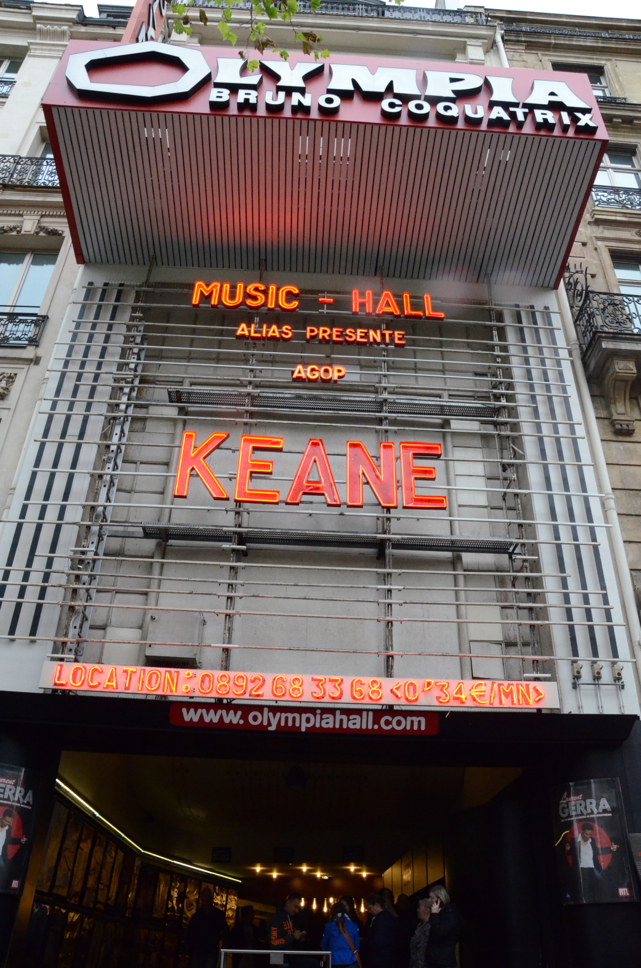
Keane, however have quite stubbornly ignored all of this. At the elegant but cavernous L'Olympia in Paris on Wednesday night, the only appearance of a guitar was the red Telecaster singer Tom Chaplin strummed along to Neon River, off their latest album Strangeland.

From the outset of their career, Keane have built their entire musical proposition around the piano of principal songwriter and keyboard player Tim Rice-Oxley, and one piano in particular. And here, forgive me a brief diversion into the realms of trivia. For, I strongly suspect, there is another band, who also started out in the somewhat blue-blooded environs of southern England, to thank for the Keane signature sound.

Banks of keyboards. Ho and, indeed, ho.
In the middle of their transformation from progressive rock giants to American FM radio-friendly...er....giants, Genesis made an album called Duke. Marking the acquisition of a more pop-rock sensibility than their former extensive forays into the ethereal, Duke - released in 1980 also marked the abandonment by keyboard player Tony Banks of the grand pianos, Moogs synths, Mellotrons and Hammond organs that had marked their territory and, essentially, defined prog rock in the 1970s.

On an album of notably shorter, poppier songs, Banks made liberal use of the Yamaha CP70 electric piano. You may not know or even care about the CP70. But it became one of the most important tools of the trade in the 1980s, it's distinctive "tinkly" sound turning up everywhere (think Alive & Kicking by Simple Minds or Peter Gabriel's In Your Eyes).

With this change of tone, Genesis started noticing women at their concerts. And hit singles. Their albums sold in the millions, and then in the multi-millions, the result of adopting bright, breezy English pop-rock. Rice-Oxley was clearly listening. Because the CP70 has been Rice-Oxley's - and, therefore, Keane's - principal instrument and defining sound.

Traces of Duke-era Genesis DNA can be found throughout their earlier albums, including Hopes & Fears, widely hailed as one of the best debut albums by a British band in decades and containing the likes of Somewhere Only We Know and Bedshaped.

Picture: Keane/Facebook
Live, Keane are a pleasant anomaly. The somewhat gauche, public schoolboyish intensity that characterised their public emergence when Hopes & Fears took off in 2004 is still there.

The lanky Rice-Oxley is hunched over his CP70, stabbing away at its keys like Lucy's brother Schroeder in the Peanuts cartoons. "Cherubic" (contractually-obliged description) vocalist Tom Chaplin is still a mixture of polite choirboy and energetic rocker. Drummer Richard Hughes just gets on with drumming without superfluous percussive pyrotechnics, and bass player Jesse Quin does what most bass players do - keep pace at the back and try not to draw too much attention to themselves.

Keane are still in a hard to define area of rock. Or pop. Or pop-rock. Warming the audience up with Bruce Springsteen's Dancing In the Dark unfortunately conditioned the expectation. Springsteen has, on occasion, veered away from his trademark time card-punchin' denim-clad rock'n'prole with songs like that. With Keane you sometimes wish they veer away from songs like that and grow a pair. I mean that kindly.

They could rockout, but I suspect they don't because their audience just adores the rock-pop/pop-rock they stick to. Their live show isn't a great deal more raucous than their album work, but whereas their albums make perfectly pleasant living room listening, their relatively sparse, drums-bass-piano-vocals structure fills out the space of a venue as spacious as L'Olympia.


Neither anthemic Coldplay pomp nor vacuous Euro clapalong pop, Keane more than satisfied the enthusiastic French audience with a string of energetic renderings of You Are Young, Meet Me In The Morning, and Is it Any Wonder, the latter building around its circuitous rhythm, with Chaplin adopting that theatrical semi-lunge into the mic stand of his, giving him the appearance of a slightly fey-looking Damon Albarn from a distance.


Picture: Keane/Facebook
At various moments of the evening Chaplin declared Keane's love for France, which was inevitably rewarded enthusiastically by the partisan crowd, which included a set of parents with toddler in toe. You can interpret this either as a sign of Keane's unthreatening nature, or an apparent dearth of babysitters in the Paris area. She seemed to enjoy herself, nevertheless.

It's unlikely that you'll find Keane stretching into extended live versions of their hits. The likes of Everybody's Changing, This Is The Last Time, Bedshaped and Somewhere Only We Know lasted the length of the album version, albeit with passionate audience participation. Some bands, when they stick resolutely to recreating their album versions, do so with sterility.

Keane could easily just phone in their hits - and with a set of some 16 songs, you realise just how much they've produced in the 15 years since their formation, but live they put heart and soul into every note. And yet you still get the feeling that this is a band that is just getting going. Coldplay, the band to which Keane probably get compared to more than most, came together just a year before, and yet have already given us the impression that they've outlasted their welcome. On this evidence, Keane have got plenty left in the tank.