Showing posts with label Smash Hits. Show all posts

Tuesday, October 15, 2013

Sorry kids, but Uncle Macca's still got it: Paul McCartney - New

In the barmy world that was Smash Hits magazine, pop stars who were, in the 1980s, considered venerable then, were given nicknames of affection. 

Thus, David Bowie became 'The Dame' (a handle that has universally pursued him ever since), Freddie Mercury was known as 'Lord Frederick of Mercury' (and, on occasion, 'Lord Lucan of Mercury' on account of his resemblance to the absconding, moustachioed nobleman), and Kate Bush was regularly referred to as Kate 'Hello Trees, Hello Sky' Bush. Because she was nuts.

Paul McCartney, on the other hand - and before he was appropriately knighted by HRH - was simply Paul 'Sir Wacky Macca Thumbs Aloft' McCartney, thanks to his noticeable habit of raising one or both of his preaxial digits every time a camera came into proximity. Strangely, Ringo Starr, who has his own 'double peace sign' signature affectation, never received the honour of a Hits nickname. I mean, what could you do to a name like Ringo?

The point of all this was that back in the 80s, to a Smash Hits audience, SWMTA was already considered a tad on the crusty side, if you get my drift. To be in his 40s was beyond the comprehension of a readership who considered their 18th birthday the ultimate milestone in life.

On June 18 this year, Paul McCartney turned 71. A month later Mick Jagger celebrated his 70th birthday. On paper, you have to question what either of them are still doing being rock stars. But the truth of the matter is that, on recent evidence, they're both doing it quite well. You could even claim they're doing it better than much of the talent a quarter of their ages. OK, that's a dangerously middle-aged thing to say, but on the evidence of both the Stones' shows in the last 12 months, and McCartney continuing to tour more now than he ever did as a grown-up Beatle, there is certainly a case to answer that these national treasures are still putting the hours in.


Still, though, the cynics maintain that such artists are no longer relevant, that despite Jagger's annoyingly lithe frame, and despite McCartney's continued passion for making new music - as evidenced by the release this week of New - there's something of the embarrassing uncle about both of them. Indeed, most of the 60s and early 70s-era performers who are still performing - be they Beatles, Stones, Kinks, Daltrey and Townshend, Stewart, Plant, Page - are frequent targets of "give it up mate" trollery.

Odd, then, that BB King (88) and Chuck Berry (86) don't suffer such snarkiness, nor Britain's original rock stars, Sir Cliff Richard (known to Smash Hits readers as...er..."Sir" Cliff Richard, and 73) and Tommy Steele (76).

The Beatles are long gone. In the context of human history, they were a blink of the eye. 1957 - McCartney meets Lennon at Woolton village fĂȘte; 1963 - Love Me Do; 1966 - Revolver; 1967 - - Sgt. Pepper; 1969 - Abbey Road; 1970 - McCartney quits. 13 years between a teenage skiffle group and cynical, bearded, warring bandmates. Having, in between, turned the world - no exaggeration - on its head.


McCartney has been tilting at windmills ever since. Lennon was the radical, but cool, maverick; Ringo remained the jester; Harrison the serious and ever so slightly dull muso, right up until his death. But Macca?

Recent reissues of McCartney's Ram and Wings' Band On The Run have reminded us that post-Fabs, McCartney didn't lose any of his natural gift for writing brain-burrowing melodies, he just took it in different directions. 

Ignore the supposed follies of The Frog Chorus or Give My Regards To Broad Street, forget the winsome Mull Of Kintyre or the cheesy Say, Say, Say duet with "Jacko" (yes, the Hits again). When he walked out on The Beatles in 1970, aged 32, McCartney needn't have picked up a guitar or sat down at a piano ever again.

But to get back to the point of this rant, he's released an album at the age of 71 which is as vibrant and as enjoyable as anything he's put out in decades. And I mean that. His last four - Driving Rain, Chaos And Creation In The Backyard, Memory Almost Full and last year's standards covers album Kisses on the Bottom - have all been OK, but not thrilling. And while, of course, nothing could ever compare with anything he did with The You-Know-Whos, New is different. Plenty different. So new that it had to be called New, which I presume wasn't a holding title for something better.


There may also be some significance in the fact McCartney has gone from his 60s to his 70s in the period between an album called Memory Almost Full and an album called New, the 70s being the new 50s, or whatever ageist guff the Daily Mail has come up with recently. 

And while it could be tempting to suggest that, with a history of working with 'name' producers in the past, his choice of Mark Ronson, Ethan Johns, Paul Epworth and Giles (son of George) Martin for New is an attempt at hedging his bets with credibility, the foundation of any Paul McCartney album is going to be its songwriting. Which, on New, is easily his best in more than 30 years.

The album stomps to life with Save Us, an angry protest (well, as angry as Macca will ever get) which draws some comparison to the fuzzbox guitar of the Fabs' Revolution. Being A) a former Beatle and B) Paul McCartney, such comparisons with that little rock'n'roll band from Liverpool are inevitable. McCartney, however, has never tried shying away from his past, but not wishing to be ironic or cute, he embraces his heritage, even using it as a platform for broader reflection. Thus Early Days seeks to reset perceptions of who did what in the L&M partnership, both lyrically and melodically through the kind of acoustic balladry that made Fool On The Hill and Blackbird such fragrant entries to the Beatle body of work. 

It's here you become acutely aware that Paul McCartney may be the only living, working musician who can justifiably carry the tag Beatlesque' (sorry Liam), but that doesn't mean he feels compelled to slavishly follow the formula. True, Queenie Eye walks into the The Beatles' whimsy, and its rhythm track bears more than a passing resemblance to the Starr/McCartney forerunner of drum'n'bass, but here the listener starts thinking: "Am I listening to a Paul McCartney song that references The Beatles, or am I listening to a Paul McCartney song that I expect to reference The Beatles?"


Overall, there is a compelling energy about New, and none more so than on its title track, which dances through a pop sensibility that straddles both the old (Swinging Sixties) and the new (the not-so swinging...erm...whatever decade we're in now). Appreciate is a brave stab at modernity that might not work quite so well, but it is still a more present McCartney than some of the doe-eyed family-friendly fare of his recent musical history.

It can't be easy being Paul McCartney. It can't be easy being a living legend, a national treasure and one of the most famous human beings in the 20th century or indeed any century rolled into one. He is, or at least appears to be, normal, and if that is just act - as his critics have said it is - he's managed to maintain it for more than 50 years. He will maintain that it is down to his working class Liverpudlian roots, that he's just carrying on doing what he does because that's all he's known, and all he's known is to carry on doing what he does best. And while the earnest intent hasn't always been matched by the output, on New, it's there in spades.

Wednesday, August 29, 2012

Knights out


“Be careful what you wish for!” is the finger-wagging threat oft-made by maiden aunts, crusty medieval crones and, the generally annoying.

Some years ago plain, vanilla Paul McCartney was ritually referred to in Smash Hits magazine as "Sir Fab Macca Wacky Thumbs Aloft". To this day I don't think anyone knows why he needed a nickname, but he certainly did (and does still) have a tendency to extend his thumbs skyward whenever adoring crowds are near. Anyway, in 1997 - long after the Hits first applied the moniker - Macca became a knight proper for "for services to music". Be careful what you wish for indeed.

Roll on another 15 years, and no sooner has Thumbs Aloft belted out his final "na-na-na-nah" to close the London 2012 opening ceremony, than the show's creative director is being installed by Twitter patrons as "Sir" Danny Boyle.

This was no flippant idea, but an earnest attempt to promote Boyle's investiture in recognition of his incredible tour de force on July 27. Such groundswell inevitably led to newspapers reporting that Boyle would be a shoe-in for a gong come the New Year's Honours list. Boyle himself - a dyed-in-the-wool member of the fraternity unlikely to support such things - has so far simply laughed it all off with a curt "I don’t think so".

Even if Boyle turns down a KBE, there will be no shortage of Olympic heroes and heroines queuing up at the Palace to be entitled. Indeed in the proud national glow that followed the London games, Twitter was "awash" (the modern equivalent of switchboards being "jammed") with suggestions that virtually anyone who pulled on a Team GB tracksuit this summer should get the nod for a meeting with James Bond's new parachuting partner, Her Majesty, The Queen. Fleet Street layout artists have no doubt already prepared their front page splashes for the final week of December to declare "Arise Sir Mo!" or "Arise Dame Jess!".

There have been past precedents for such populist clamour to actually succeed: Bruce Forsyth (for non-British readers of WWDBD?, the nation's pre-eminent octogenarian game show host, golfer and catchphrase merchant) endured years of humiliation with just a CBE to his name before HMTQ  wiped the ceremonial cutlass on his newly-knighted shoulders and said "Nice to see you, Sir Brucie, to see you, nice!".

A similar, but less well supported campaign has been lurking in the shadows to have David Beckham knighted in recognition of his services to hairdressers and tattoo parlours.

Old Goldenballs is, I concede, a national icon. Like Mr Bean replacing Benny Hill, Beckham has replaced Bobby Charlton as a shorthand reference for Britain. You can find yourself in the remotest, far-flung corner of the earth untouched by the English language or modernity itself, and you will still - at the slightest hint of Britishness - be met with a smile and the collection of syllables that is "David Beckham! Yes. Very good!".

Beckham is, of course, more than just an underwear model with excellent ball skills - sorry, that should have read "excellent footballer who dabbles in underwear modeling" - and his charidee work, not to mention salesmanship to help land the 2012 Olympics for London, does mark him out as a worthy candidate for national honour. But I do struggle to see why we should be collectively preparing to welcome Sir David and Lady Posh into the pantheon of great Britons knighted or damed (not sure if that's correct, but it's only one letter short of a curse, so it will do).

There are those in the British establishment who've never quite got over the number of actors being knighted, let alone rock stars like messrs McCartney, Jagger and John (which would make an interesting firm of suburban solicitors), whose knighthoods placed dual stamps in the passport marked Sodom and Gomorrah.

So with this we read that the Public Administration Select Committee, the British parliamentary institution responsible for, er, public adminstration, has called for a change in the honours system. T'committee has called for an independent commission to ensure that any government obsessed with image and spin doesn't do anything ridiculous like awarding all five members of One Direction gongs for whatever it is they do.

More importantly, the committee has called for greater transparency and less influence by politicians and their civil servants in the selection process of honours candidates: "We believe that no-one should be honoured for simply 'doing the day job', no matter what that job is,"  t'committee states.

Well if that doesn't set the proverbial big cat amongst the Clacton pigeons, I don't know what will. Because beyond pop stars and Olympians getting rewarded for generally being excellent and putting a smile on people's faces, there are still too many gongs being handed out to senior civil servants and business leaders on the basis that they are due one.

The select committee's chairman, Bernard Jenkin MP, points out that many Britons struggle to understand why the bulk of honours are handed out, which doesn't help public confidence in the system. "In particular," says Jenkin, "honours should not be awarded to civil servants or businessmen unless it can be demonstrated that there has been service above and beyond the call of duty."


And, capturing the spirit of these beleaguered, austere times he adds: "It is distasteful and damaging for people who already command vast personal remuneration packages for doing their job, to also be honoured for simply being at the helm of large companies. This must stop."

However, a spokesman for the government has denied that establishment figures and celebs dominate the honours system, running the old yarn about three-quarters of awards go to "ordinary" people who do charity work.

That, of course, wouldn't rule out a Beckham knighthood, even if he is also at the helm of a large commercial enterprise - David Beckham....


Monday, July 23, 2012

The Last Word

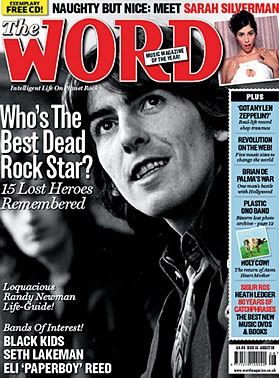
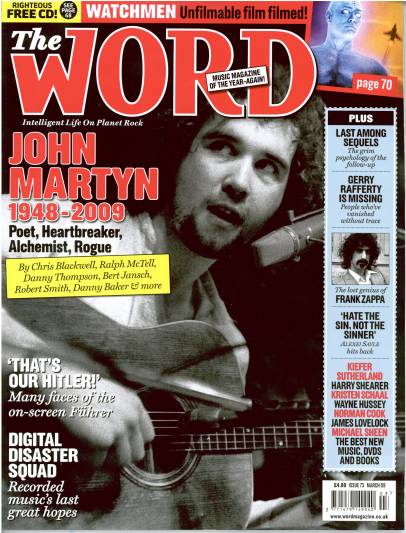
Apologies if this is an overshare, but I have just emerged from one of my preferred indulgences, marinating in the bath for an hour or so reading The Word.

This practice must, alas, now come to an end. This is not because someone is waiting to use the bathroom, nor have I developed a prune-like complexion, but because The Word - without doubt the best cover-to-cover magazine read of the last decade - has ceased to be. Tragedy.

Co-founded by Mark Ellen and David Hepworth, veterans of the music magazine industry (Smash Hits, Q, MOJO, et al) and sometime Whistle Test and Live Aid presenters, The Word set out to be more than just another monthly for those over-30s who still actually buy CDs.

"We want to marry the New Yorker and Entertainment Weekly," Hepworth told The Observer prior to its launch in 2003. "Our target is men who know where their nearest bookshop is." As opposed to their local betting shop, one had to have assumed at the time.

The Word managed to be blokey, rather than laddish (there was plenty of that around with Loaded and FHM), knowing, rather than just knowledgeable, and literate, rather than literal. It catered for the urban Nick Hornby fan, someone who cared about the minutiae of owning an entire shelf of Robyn Hitchcock albums and had the appetite to read a seamlessly lengthy treatise on the same.

With Q - launched just as my first magazine, LM was struggling to get off the ground - Ellen and Hepworth successfully imported the irreverence of Smash Hits, shedding items such as the sock preferences of Morten Harket and the hair product advice from We've Got a Fuzzbox and We're Gonna Use It, in favour of drawing attention to the emergent CD artists of the mid-80s. Ellen and Hepworth successfully created an adult brand in music and entertainment reading, catering for music-consuming and salaried 18-34-year-olds coveted by advertisers and record labels alike. With the later MOJO, a certain reverence was applied, providing a monthly landing for musos who would have, in their youth, devoured every last inch of newsprint in the NME and Melody Maker, who wanted the latest and the oldest, and harboured strong opinions about Bob Dylan, Hot Chip and Radiohead in equal measure.

The Word addressed a different reader. Older and wiser but not without a sense of the frivolous, he (and The Word reader was largely of the male of the species) had been identified early on as '50-Quid Bloke'. "He's the guy we've all seen in Borders or HMV on a Friday afternoon, possibly after a drink or two, tie slightly undone, buying two CDs, a DVD and maybe a book – 50 quid's worth," explained Hepworth, "and frantically computing how he's going to convince his partner that this is a really, really worthwhile investment". Yep, we've all been there.


Words were The Word's strength, a writer's magazine that blissfully didn't disappear up its own thesaurus. Its readership had mortgages, children, personal computers and a yearning for something digestibly readable that they could call their own, that understood them, and that they understood. Music was it's heart, but not the only organ in its frame. Still, it could be relied upon to serve up a new angle, even on such venerable fare as The Beatles, Frank Zappa or Hendrix, artists who have been biographied to death. The Word could still find something readable to write about them. My now steam-sodden final issue contains items as diverse as The Cure's Robert Smith, a surprisingly candid interview with 'The Beatles' kid sister', Cilla Black, and a piece on the role squatting (as in illegal house tenure) has had to play in the domestic arrangements of budding rock stars.

From another angle, The Word was a random eavesdrop on the pub conversations of many of its readers. While there is certainly a chunk of its demographic who spend the vast majority of their licensed hours discussing football, there is also a sizeable group who will engage each other on the sort of topics the magazine found pertinent.


"You told us about your interests and obsessions and they were much the same as ours," Ellen wrote in his final editorial. "Old singles, bits of Anchorman, Randy Newman, The New Yorker, lying on beaches with a cold beer reading toe-curling books about the Siege of Stalingrad".

Such interests weren't confined to print, with a key aspect of The Word being the online community - The Word Massive - taking the good natured pub debates to the magazine's discussion board, a forum for citizen journalism at its most intelligent.

But progressive as this might sound, technology may also have been the cause of The Word's demise. While 50-Quid Man was its initial target but in 2012, the man who, in 2003 was indeed shelling out five Darwins for physical media, is now spending the same amount on content for their Kindle and iPad.

Like all physical forms of media, a combination of free digital competition and shrinking advertising budgets, especially by music and entertainment brands, is placing more pressure on the once mighty magazine industry. At its close, The Word had a circulation of just 25,048, down 5% on the previous year. That would be OK if you can attract big bucks advertisers, but not if the brands of conspicuous consumption are choosing GQ to flog their wares.

Some argue that The Word could have survived with a different business model. 2003's 50-Quid Man could probably have stretched to 70 or even more, despite these lean times, and could have dipped his hand deeper into his pocket for a more economically sustainable subscription. And there are those who feel that an editorial approach like The Word's would have benefited from even greater digitisation.

One such exponent of this is my good friend Ashley Norris, editor of
The London Project, an iPad book celebrating London during this momentous year. "People bought The Word for two reasons," he wrote recently on The Wall social media marketing blog. "Firstly it appealed to magazine die-hards who love the feel, the design and the grammar of magazines. These people probably curse the day the web arrived and never got over the death of The Face."

Citing The Blizzard, the iPad football magazine, Norris argued that another editorial model is possible: "
There is minimal design and no images – it is all about the words. I guess that The Blizzard isn’t making enough money to sustain a traditional publishing team, and it probably never will, but with an editor, freelancers and a web team on board, it has the potential to one day make some serious money."

Though The Word produced an iPad version, reading compressed PDFs of the print version's layouts didn't necessarily work, especially when the reader still craves tactility, or at least a format that holds up well in the bath.

For a seasoned magazine producer as Hepworth, producing tablet versions of magazines has a simplicity value: "Monthly magazines agonise endlessly and, in many cases, pointlessly," he wrote in the May/June issue of InPublishing, recalling the preparation of The Word's iPad edition. "In the process of adapting the content for the tablet, I had to dispense with so much of the vocabulary, so much of the furniture of the magazine, so much of the complex interplay between words and pictures. The headline and standfirst style of the average monthly magazine simply doesn't work in the new format."

"Unless they decide to go the 'bells and whistles' enhanced tablet approach," added Hepworth, "the likelihood is that the tablet is going to force all magazines to get to the point more quickly and to forsake many of the more touchy-feely aspects of the editorial craft. Personally, I won’t miss it at all."

As with any colour magazine, The Word was laid out attractively, but laid out to accomodate the writing. It was, at times, like a writer's club with a print magazine as its outlet. It showcased some of the best writing talent in the expanded universe of British music and lifestyle journalism. Features weren't inflated by picture spreads featuring reality show non-celebs in their near-altogether, but allowed journalists generous space to stretch their legs in a piece.

It cared for you if you cared about Elvis Costello as much, more, or less than Elvis Presley. Moreover, it didn't make a judgement on where you stood on such matters, and certainly didn't go out of its way to try and bring you around to its own position.

The iPad hasn't taken over just yet. I'm sure there will be some accessory manufacturer who'll come up with a waterproof tablet case, but it will never fully replace the experience of turning the pages of a magazine, especially one with the slight creep of moisture on its southern edge.


Wednesday, March 7, 2012

The angry man of pop turns 60

We’ve grown so used to old rockers reaching their 60th birthday – with The Sun making unfunny remarks about Johnny Rockstar being old enough to claim his free bus pass – that it tends not to garner comment any more.

But today we should celebrate the 60th birthday of one particular British musical institution – the one which launched my media career: the New Musical Express.

First published on March 7, 1952, the NME became, during the late '70s and '80s part of a quintet weeklies with its two main broadsheet rivals, Melody Maker and Sounds, Record Mirror and Disc (not to mention the frothy Smash Hits - a pure pop tome that had started life a postermag).

Pop music was a rather genteel affair when the NME first went to press. The No.1 that week was Al Martino's Here In My Heart). But as rock'n'roll took off over the following decade, the paper became a more crucial barometer of popular taste, chronicling the rise of Beatles and Stones, of the Merseybeat and British Blues Boom, not to mention pitching the rivalries that made the era so easy to write for.

As pop morphed into rock as the '60s evolved, and chirpsome two-and-a-half minute hits gave way to gargantuan wigouts, the NME transformed further into a more serious organ for the more serious punter. Gigs at London's Rainbow Theatre and The Marquee would be populated by bearded, earnest young men in army surplus greatcoats, clutching copies of the NME and the latest album of whomever they were there to see, frantically scribbling down meaningful observations about the 20-minute guitar solos they were then being subjected to.

The '70s became the NME's golden era: it was a decade that began awash with denim and ended with the almost illogical event of Pink Floyd's Another Brick In The Wall Part 2 topping the UK charts, giving rise to the oft-used phrase "Like punk never 'appened". The '70s was also the decade that British music journalism found its editorial feet, leaving behind the somewhat convivial relationship it had with the 'press agents' of major acts in the previous decade, and developing a voice of its own...with an attitude.

NME writers like Charles Shaar Murray and Nick Kent took on the cultural zeitgeist of the day, becoming 'names' in their own right. There is an apocryphal tale about Kent being asked for his autograph as he sat down for lunch with David Bowie and Lou Reed in a Manhattan restaurant, though this had less to do with his writing prowess reaching New York and more to do with the fact he looked more like a rock star than most rock stars. It was a time where rock journalists enjoyed a different type of relationship with the artists they were covering, and the NME reveled in this coseyness (and a shared enjoyment of certain substances).

Punk was arguably the NME's zenith. It became the maypole around which the paper's most pungent legends danced, be it stories of journalists overdosing or having proper office punch-ups. As the mainstay bands of the British music press focused on their seemingly endless American stadium tours in 1974 and 1975, it became clear that something was stirring in the clubs of New York. Soon something was stirring in London, too, and the NME threw out the challenge for a pair of "hip young gunslingers" to join the editorial team and report on the burgeoning punk scene. The successful applicants were Tony Parsons and Julie Burchill. Under pioneering magazine legend Nick Logan as editor, Parsons and Burchill (then still a schoolgirl from Bristol) sunk themselves into the music scene at a raw pitch.

"I was just a kid from Billericay," Parsons remembers in The History of the NME: High Times and Low Lives at the World's Most Famous Music Magazine, Pat Long's excellent book chronicling the NME's 60 years to date. "[I was] 22 years-old, probably a young 22 years-old, and there were people who spent the weekend not just taking heroin but taking heroin with Keith Richards. Not just smoking dope but smoking dope with Bob Marley. It was like joining bohemia. This was '76: post-Pill, pre-AIDS. It was pretty wild."

Parsons' style of decidedly unsycophantic writing was exactly what the NME was about: " When my feelings about music were changing in the eaely ’70s NME seemed to articulate that," he tells Long. "I was a David Bowie fan and I took my first girlfriend to see him at Earl’s Court on the Aladdin Sane tour and it was a horrible experience. There were people everywhere being drunk and vomiting and the bouncers were very rough and Bowie was disengaged – probably coked out of his mind – and it was not that intimate inclusive experience that the music was to me. Nick Kent wrote a very vicious bitchy review in the NME and I just thought ‘that’s exactly how I feel'."

As I found myself - writing my first live review for the NME while still at school - the paper was open to younger journalists, cultivating a justifiable reputation for tapping into the street, rather than an elevated view of the street. It was with this sprit that Parsons and Burchill heralded in the next generation of star writers, the likes of Paul Morley, Barney Hoskyns and former fanzine writer Danny Baker (who joined originally as the paper's receptionist at it is legendary Carnaby Street offices).

The NME was, though, at times an intimidating newspaper to write for, thanks to the establishment of unassailable reputations and rock star-sized egos to match. "The NME was hard work, especially on the editorial side," former editor Neil Spencer recently recalled. "The writers had more of a demented ride. They'd go off and take drugs with musicians in exotic locations and enjoy themselves, and then come back and write their pieces overnight and deliver them by hand. It was crazy, but ultimately you've got to have somebody signing off pages and writing headlines, and it was very tough at times, especially when writers flaked out as they did. What do you do on Tuesday afternoon at the printers with half a cover story on Boy George? It still annoys me."

Before the NME moved to corporate IPC Magazines offices near Waterloo Station (and, at one point, High Holborn), it had been based in London's Carnaby Street. The street had long since abandoned its Mary Quant 'swinging sixties' cool and had become a rather depressing thoroughfare of crap tourist-mugging shops. The NME office was, according to Spencer, "a bear pit." He recalls: "Everyone had very abrupt opinions on who should be on the cover and how many words everybody should have and who was going to write the lead review and so on. There was a lot of turf being fought over, so a big part of my job as editor was to balance the factions in the paper."


Margaret Thatcher winning the 1979 general election changed so much about the UK. A country that had seemed grey and dull, but livened up by the sheer audacity of punk in 1976, suddenly became a colder, more fearful place. Amid the post-punk musical backdrop of acts like Elvis Costello, Joe Jackson, Nick Lowe, Ian Dury & The Blockheads and Squeeze, not to mention the resurgence of ska and the Mod revival, came a new political sensibility that pulled the NME into another new editorial direction - and arguably marked the start of the decline in the music press being the force of influence it once was.

Internally the NME's journalists became embroiled in the sort of arguments about direction that the artists they were supposed to be covering got into. As the pop of Duran Duran and Spandau Ballet chided with the emerging hip-hop scene, factions developed between those who felt the NME should cast a wider net of the entire cultural universe, and those who felt it should maintain its denim dependency and write only about rock.

On the bright side, the NME opened itself up to women, both as readers but also as writers. Julie Burchill had challenged the paper as a bastion of testosterone-fuelled rock, and in her wake - and, ironically, shadowing the rise of Thatcher - the paper became more inclusive of women on the staff and female acts appearing on the newsprint itself. There are those who don't look back on the early 80s in Britain with the same lens of doom and gloom. Margaret Thatcher may have made the UK a fearful and hope-free place to be young, but music, nevertheless, provided the release. Amid race riots and anti-nuclear protests, the NME ploughed on, undergoing further transformation from earnest rock fan to all-round cultural observer.

"Music and politics became inextricably entwined," wrote Neil Spencer in The Observer in 2005. "As ever, there was plenty of escapism - it's one of pop's jobs to provide Durans and Hayzee Fantayzees - but there was also idealism, anger, and artistic adventure. There was, for sure, a surfeit of earnest young men with George Orwell haircuts posing disconsolately in the shells of dead factories, one response to the 'No Future' we had been warned of by the Pistols."

Looking back, however, the '80s weren't so kind to the NME, and not just because yours truly posted possibly its first and last Phil Collins live review. It didn’t just struggle to choose between music genre, it struggled to choose between being a music magazine and a watchtower for the socio-political cultures of the time. The rise of CND, the miners strike and movements like the Labour Party-supported Red Wedge came along (with Paul Weller and Billy Bragg as its standard bearers) appeared to pull the paper in the direction of becoming a student agit-prop magazine with added album reviews, a seriousness that clashed with the brighter moments of the decade which Smash Hits covered with delight.

The arrival of Britpop in the '90s gave the NME second wind. As Oasis and their breed unashamedly raided their parents' record collections to recreate, if nothing else, the pulse and vibe of the '60s - whether the Gallaghers' Beatle fixation or Blur's flirtation with the psychedelic whimsy of Syd Barrett - the NME took a ringside seat as the likes of Pulp, Elastica, Suede et al bridged Indy cred with mainstream acceptability.

The rivalry between Oasis and Blur was a boon to the press in general, but to the NME in particular. On August 12, 1995, the paper ran its famous 'Blur v Oasis' front cover.

"It was the cover that defined my editorship," Steve Sutherland, who was at the NME's helm at the time, told The Guardian recently. "It also defined my era and it put NME back on the map as central to what was going on in Britain culturally at the time. And it made us famous for a brief period, so it was all very good."

"Noel Gallagher was saying things such as: 'Blur are a bunch of middle-class wankers trying to play hardball with working-class heroes'," says Sutherland. "It was brilliantly fuelled by both bands' cocaine input. They were both at the top of their game and both very competitive."

The rivalry - one which went way beyond the rough-and-tumble of the Beatles/Stones era - ratcheted up a notch after the NME's news team learned that Blur and Oasis were scheduled to release their new singles - Country House and Roll With It - on the same day. "We decided to have a bit of fun with this and make some mischief," says Sutherland. "We created this front cover with Damon Albarn on the left looking very arrogant and Liam Gallagher on the right looking very combative, and we modelled it on an old Ali v Fraser boxing poster. We set it up as a proper sporting event."

Blur eventually won the chart bout. "It was a soap opera," Sutherland said in The Guardian. "Soap operas are great for people who work on newspapers and magazines because you can become part of the story and it never really ends. We sold a lot of copies off the back of it, and the NME became famous again, and it became synonymous with the glory years of Britpop."

While Britpop was gurgling away like an overactive child that had been overdoing the sugar, 'upstairs' at the NME its publishers IPC Magazines were scratching their heads trying to work out what the new-fangled Internet meant for the increasingly expensive publishing industry. As hikes in raw newsprint prices continued, and magazines started shedding editorial staff left right and center, the NME and its brethren were facing an uncertain future. In 1996 the NME launched an online edition, getting ahead of the curve with its core readership who were soon to start abandoning physical media altogether for their music consumption.


"There are two types of music, good and bad, and genre doesn't come into that."
Today, 60 years-old, the NME is still going, abeit no longer a "music paper" but a decidedly more populist glossy magazine. And, shock-horror, since September 2009 it has been edited by a woman, Krissi Murison, who took over the reigns at the age of 28.

"One of the main challenges I faced when I took over the NME was making a 60-year-old music magazine as relevant today as it always has been," Murison told The Guardian.

"Added to that, I'm not just editing the print version, it's the website as well, and now a lot of people get their daily NME fix via Twitter and Facebook, so managing all those strands is a big challenge."

Perhaps unconsciously drawing reference to the internecine editorial wars of her prededecessors, Murison appears to maintain a clear head when it comes to what the magazine - in all its forms - has to cover: "People always say to me that such-and-such is an NME band but that doesn't mean much to me. There are two types of music, good and bad, and genre doesn't come into that."