In the barmy world that was Smash Hits magazine, pop stars who were, in the 1980s, considered venerable then, were given nicknames of affection.
Thus, David Bowie became 'The Dame' (a handle that has universally pursued him ever since), Freddie Mercury was known as 'Lord Frederick of Mercury' (and, on occasion, 'Lord Lucan of Mercury' on account of his resemblance to the absconding, moustachioed nobleman), and Kate Bush was regularly referred to as Kate 'Hello Trees, Hello Sky' Bush. Because she was nuts.
Paul McCartney, on the other hand - and before he was appropriately knighted by HRH - was simply Paul 'Sir Wacky Macca Thumbs Aloft' McCartney, thanks to his noticeable habit of raising one or both of his preaxial digits every time a camera came into proximity. Strangely, Ringo Starr, who has his own 'double peace sign' signature affectation, never received the honour of a Hits nickname. I mean, what could you do to a name like Ringo?
The point of all this was that back in the 80s, to a Smash Hits audience, SWMTA was already considered a tad on the crusty side, if you get my drift. To be in his 40s was beyond the comprehension of a readership who considered their 18th birthday the ultimate milestone in life.
On June 18 this year, Paul McCartney turned 71. A month later Mick Jagger celebrated his 70th birthday. On paper, you have to question what either of them are still doing being rock stars. But the truth of the matter is that, on recent evidence, they're both doing it quite well. You could even claim they're doing it better than much of the talent a quarter of their ages. OK, that's a dangerously middle-aged thing to say, but on the evidence of both the Stones' shows in the last 12 months, and McCartney continuing to tour more now than he ever did as a grown-up Beatle, there is certainly a case to answer that these national treasures are still putting the hours in.
Still, though, the cynics maintain that such artists are no longer relevant, that despite Jagger's annoyingly lithe frame, and despite McCartney's continued passion for making new music - as evidenced by the release this week of New - there's something of the embarrassing uncle about both of them. Indeed, most of the 60s and early 70s-era performers who are still performing - be they Beatles, Stones, Kinks, Daltrey and Townshend, Stewart, Plant, Page - are frequent targets of "give it up mate" trollery.
Odd, then, that BB King (88) and Chuck Berry (86) don't suffer such snarkiness, nor Britain's original rock stars, Sir Cliff Richard (known to Smash Hits readers as...er..."Sir" Cliff Richard, and 73) and Tommy Steele (76).
The Beatles are long gone. In the context of human history, they were a blink of the eye. 1957 - McCartney meets Lennon at Woolton village fête; 1963 - Love Me Do; 1966 - Revolver; 1967 - - Sgt. Pepper; 1969 - Abbey Road; 1970 - McCartney quits. 13 years between a teenage skiffle group and cynical, bearded, warring bandmates. Having, in between, turned the world - no exaggeration - on its head.
McCartney has been tilting at windmills ever since. Lennon was the radical, but cool, maverick; Ringo remained the jester; Harrison the serious and ever so slightly dull muso, right up until his death. But Macca?
Recent reissues of McCartney's Ram and Wings' Band On The Run have reminded us that post-Fabs, McCartney didn't lose any of his natural gift for writing brain-burrowing melodies, he just took it in different directions.
Ignore the supposed follies of The Frog Chorus or Give My Regards To Broad Street, forget the winsome Mull Of Kintyre or the cheesy Say, Say, Say duet with "Jacko" (yes, the Hits again). When he walked out on The Beatles in 1970, aged 32, McCartney needn't have picked up a guitar or sat down at a piano ever again.
But to get back to the point of this rant, he's released an album at the age of 71 which is as vibrant and as enjoyable as anything he's put out in decades. And I mean that. His last four - Driving Rain, Chaos And Creation In The Backyard, Memory Almost Full and last year's standards covers album Kisses on the Bottom - have all been OK, but not thrilling. And while, of course, nothing could ever compare with anything he did with The You-Know-Whos, New is different. Plenty different. So new that it had to be called New, which I presume wasn't a holding title for something better.
There may also be some significance in the fact McCartney has gone from his 60s to his 70s in the period between an album called Memory Almost Full and an album called New, the 70s being the new 50s, or whatever ageist guff the Daily Mail has come up with recently.
And while it could be tempting to suggest that, with a history of working with 'name' producers in the past, his choice of Mark Ronson, Ethan Johns, Paul Epworth and Giles (son of George) Martin for New is an attempt at hedging his bets with credibility, the foundation of any Paul McCartney album is going to be its songwriting. Which, on New, is easily his best in more than 30 years.
The album stomps to life with Save Us, an angry protest (well, as angry as Macca will ever get) which draws some comparison to the fuzzbox guitar of the Fabs' Revolution. Being A) a former Beatle and B) Paul McCartney, such comparisons with that little rock'n'roll band from Liverpool are inevitable. McCartney, however, has never tried shying away from his past, but not wishing to be ironic or cute, he embraces his heritage, even using it as a platform for broader reflection. Thus Early Days seeks to reset perceptions of who did what in the L&M partnership, both lyrically and melodically through the kind of acoustic balladry that made Fool On The Hill and Blackbird such fragrant entries to the Beatle body of work.
It's here you become acutely aware that Paul McCartney may be the only living, working musician who can justifiably carry the tag Beatlesque' (sorry Liam), but that doesn't mean he feels compelled to slavishly follow the formula. True, Queenie Eye walks into the The Beatles' whimsy, and its rhythm track bears more than a passing resemblance to the Starr/McCartney forerunner of drum'n'bass, but here the listener starts thinking: "Am I listening to a Paul McCartney song that references The Beatles, or am I listening to a Paul McCartney song that I expect to reference The Beatles?"
Overall, there is a compelling energy about New, and none more so than on its title track, which dances through a pop sensibility that straddles both the old (Swinging Sixties) and the new (the not-so swinging...erm...whatever decade we're in now). Appreciate is a brave stab at modernity that might not work quite so well, but it is still a more present McCartney than some of the doe-eyed family-friendly fare of his recent musical history.
It can't be easy being Paul McCartney. It can't be easy being a living legend, a national treasure and one of the most famous human beings in the 20th century or indeed any century rolled into one. He is, or at least appears to be, normal, and if that is just act - as his critics have said it is - he's managed to maintain it for more than 50 years. He will maintain that it is down to his working class Liverpudlian roots, that he's just carrying on doing what he does because that's all he's known, and all he's known is to carry on doing what he does best. And while the earnest intent hasn't always been matched by the output, on New, it's there in spades.
Showing posts with label Mick Jagger. Show all posts
Tuesday, October 15, 2013
Saturday, September 21, 2013
Just kidding: Liam Gallagher's greatest pearls of wisdom
Like Muntz, Liam has established himself as resident school playground thug, with his swagger, faux menace and daft proclamations about, well, anyone. All he lacks is the high-pitched mocking "Ha-ha!" of his cartoon prototype.
But as Gallagher Junior today celebrates his 41st birthday,dealing with being kicked out of the family home by wife Nathalie Appleton in the wake of allegations that he fathered a child with a Rolling Stone journalist, What Would David Bowie Do? thought it would cheer up the whole miserable mess by reminding you of why, like José Mourinho, Liam is immensely quotable.
So, here's Our Kid on…
Pete Doherty: "Needs a slap, and the sooner he gets it, the better."
and: "What does the word Libertine mean? Freedom! He's in the corner doing smack with a helmet on his head. There's nothing free about that. It's nasty."
Coldplay's Chris Martin: "I don't hate him. I don't know him, know what I mean? I just think he's a bit giddy. He ought to calm down, he isn't going to save the world."
And [Chris Martin]: "Looks like a geography teacher."
Ageing: "I've mellowed, but not in the sense of liking Radiohead or Coldplay."
Coldplay & Radiohead: "I don't hate them, I don't wish they had accidents. I think their fans are boring and ugly and don't look like they're having a good time."
Radiohead: "Them writing a song about a fucking tree [The King of Limbs]? Give me a fucking break! A thousand year-old tree? Go fuck yourself!"
Robbie Williams: "I'd like to fucking hang Robbie Williams onstage. What's he done to me this time? Nothing. He's just somebody I'd like to hang."
And: "[Robbie Williams] "He's a fucking drama queen. You make a crap album then want everyone to feel sorry for you. Tosser!"
Bono: "You see pictures of Bono running around LA with his little white legs and a bottle of Volvic and he looks like a fanny."
Mumford & Sons: "Everyone looks like they’ve got fucking nits and eat lentil soup with their sleeves rolled up. They all look like they live on the heath. Maybe that’s where they record. Everyone’s fucking Don McLean — far too many acoustic guitars, no style. They look like they shop at Oxfam."
One Direction: "I like them. Fair play to them. Why not, man? They haven’t got a fucking clue either. I met them at the Olympics and their heads were up their ar*es, but they’re harmless."
Florence Welch: "I’m not having anyone with ginger hair making music. She sounds like someone has stood on her foot."
Gorillaz: "Like three-year-olds’ music — worse than Steps."
Victoria Beckham: "She can’t even chew gum and walk in a straight line, let alone write a book".
Kanye West: "If I ever win any more fucking awards I'd personally invite him to get up and fucking take my award of me. I fucking tell you that... That was rude when he did that to that girl, that Taylor Swift. So yeah, give me an award and see where it goes. It will roll out of his fucking arse."
Muse: "Muse fucking scare me. They're like fucking creepy shit. But people like 'em. They at least play guitars, but when I hear his voice I'm like, Ah, fuck him."
Scissor Sisters: "Bright colours and fucking weirdos on stilts? I'm more entertaining than that shit."
Franz Ferdinand: "You look at [Alex Kapranos] and the singer from Right Said Fred. It's the same person! he's just gone on the Atkins diet and grown his hair."
Billie Joe Armstrong (Green Day): "Fuck right off. I'm not having him. I just don't like his head."
La Roux: "No way, mate. She's got man hands."
On the Blur reunion: "I'm right into it, [because] it'll finish off the Kaiser Chiefs and put them to bed. There's nothing worse than a shit Blur."
Bloc Party: "They remind me of a band off University Challenge. Like they’re sitting on a panel."
Keith Richards & George Harrison (in 1997): "They're jealous and senile and not getting enough fucking meat pies".
Mick Jagger: "I don't think singers who start off singing should play guitar. It looks fucking stupid."
Amy Winehouse & Pete Doherty (as a couple): "I don’t give a fuck about her, I don’t give a fuck about the other dick and I don’t give a fuck about any of 'em".
Jack White: “The White Stripes? Fooking rubbish. School ties? At the age of 24? Fooking hell."
Ozzy Osbourne: "How come everyone thinks he’s great? He’s a bit of a fooking mong, if you ask me."
The Beatles-vs-God: "It's got to be being in The Beatles. When was the last time God made a decent record?"
Noel Gallagher: "Shitbag".
Tuesday, May 28, 2013
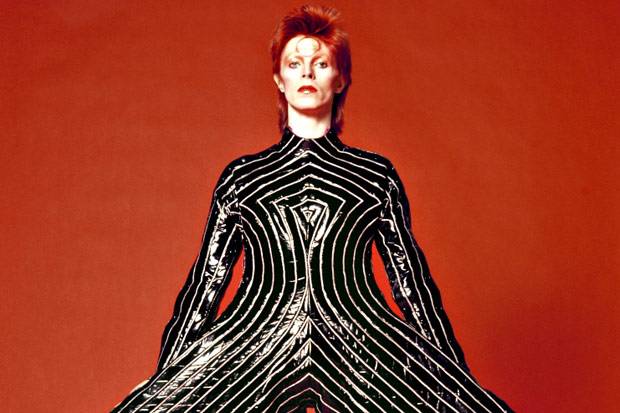
He's in the best-selling show: David Bowie is... at the V&A
When the brain starts wondering about the enormity of the cosmos there gets to a point that you have to give up. Because try as you might, the human brain is just rubbish when trying to figure stuff out like what existed before The Big Bang. And what started it. Or whom.
And as if that doesn't render you cross-eyed, scientists now hint that there may even be more than one universe, and that space and therefore everything we know about it has no boundary. Which only gets worse when you start to contemplate what - if anything - existed before the Big Bang and how we went from bugger all of anything to, well, all of this.
The idea that before The Big Bang there was nothing, some more nothing, lots more nothing, and then something, is a little like life up until January 8 this year, when the world encountered a space oddity of its own. For early in the morning of David Bowie's 66th birthday, an extended period of nothing and more nothing suddenly became:
That surprise was, of course, something arguably more important than the creation of all matter - the totally unexpected return of Bowie from almost a decade-long exclusion from public life, a period in which many had even contemplated the termination of one of the most talked about, analysed and theorized artistic careers in human history.
That may sound like hyperbole but, with the exception of The Beatles, there really has been no other artist to have been placed under the microscope quite as forensically. Which, I suspect, is partially what he wanted.
In the BBC's epic new documentary Five Years, which made its bow on Saturday night, Bowie is seen in the early 1970s castigating an interviewer for calling him a rock star: "I'm not - I'm not in rock'n'roll", describing elsewhere that "I feel like an actor when I’m on stage, rather than a rock artist." You could almost hear Keith Richards, somewhere, expectorating that bronchial cackle of his, mocking the apparent pretence of such a statement.
But, then, there has never been an artist with such a well-developed sense of identity and understanding of the value of evolving it. Madonna may have reinvented her image countless times, but these have been mere costume changes. Bowie, on the other hand, has repeatedly regenerated as and when the artistic whim has taken him, from frizzy-haired folkie to Ziggy, porcelain-skinned, emaciated cokehead to Philly soulboy, early pioneer of contemplative avant-garde ambience to inventor of New Romanticism - the list goes on.
Myriad books and the handful of Bowie documentaries may have captured these changes, and captured them well, but it has taken the David Bowie is... exhibition at London's Victoria & Albert Museum to curate them into a cohesive narrative.
From the moment you walk in you are presented with a soundbite of Bowie's own self-definition: "I could have been the Cockney Dylan", he is heard saying through the audio headset that accompanies your tour. It's actually some time before you see Bowie himself: at the entrance is a screen showing a black and white TV interview with Gilbert and George, talking opaquely about their art and looking more like a Vic and Bob piss-take than the feted artists themselves. Their appearance - and the lack of the exhibition's subject - is unnerving, but sets the scene that you are clearly not in for the usual rock memorabilia of a couple of cigarette-burned guitars, a knackered drum kit and the obligatory school report.
Instead, you get the story of this most complex of personalities, from his 1947 birthplace and initial childhood home in Stansfield Road, Brixton, to his formative years in leafy Bromley, through his teenage interests in American rock'n'roll, to his admission into the Mod world, hanging out in Soho with friend and fellow (or rival) Mod, Marc Bolan, before taking the obligatory art school path to full adulthood for almost every major British musician of the same generation.
But, as David Bowie is... richly illustrates, what happened next was anything but conventional, as he adhered himself to "using rock'n'roll as a medium", a platform for the characters he would embody as he transformed David Robert Jones into - as the BBC Nationwide reporter Bernard Falk disparagingly referred to him - a "bizarre, self-constructed freak".
Those characters - Ziggy Stardust and numerous variations on the detached alien theme - are all brought together by the V&A's Victoria Broackes and Geoffrey Marsh, who were given largely unrestricted access to the David Bowie Archive.
The resulting display is a fascinating array of more than 300 individual items, including original handwritten lyrics to songs like Rock'n'Roll Suicide, or the studio instrument hire order for the Space Oddity session. Though items like these are fairly typical of the music retrospective, the minutiae of detail across such smaller exhibits illustrates the exhaustive thought put in by the V&A team to telling the Bowie story.
The exhibition's highlights are, inevitably, those items most associated with Bowie's numerous images - the Ziggy Stardust bodysuits (including the one worn on Top of the Pops for the groundbreaking performance of Starman), the Union Jack frock coat by Alexander McQueen and worn by Bowie on the Earthling cover, and the Pierrot costume from the Ashes To Ashes video that pretty much launched New Romanticism.
Abstracted from their original context, be it live performances, television appearances or promotional films, they not only lack animation but also the colours that, on TV seemed so vibrant. Shoes and boots look larger than they should be (friends have commented on how relatively small Bowie's feet are). The freakiest show, if you will allow me.
David Bowie is... evolves as the artist himself has, moving through the obsessions and fascinations, concepts - good and bad, the evolution of video as a music medium, the inevitable development of an acting career, and the haircuts. The many, many haircuts.
As you reach its conclusion you arrive in a giant, video-walled chamber showing clips of Ziggy and the Spiders which argue the strong case that behind the performance artist has always been a performer of an inventiveness and charisma matched by few, and even then we're talking stage talents as rare as Jagger or Presley.
And, just as Bowie himself this year reminded us, as you think you've had your lot, there's one more section, a coda to the whole experience, which, via near-silent video footage of a photo session some years ago, shows Bowie strumming a vintage guitar, pulling Gene Vincent and Elvis poses. Singularly, and without costume or accompaniment, he ends the exhibition of his own career with a fascinatingly simple explanation of what the fuss is all about.
David Bowie is... continues at the Victoria & Albert Museum until August 11. Although all advance-booking online tickets have sold out, tickets can be bought at the V&A if you go in person to the ticket desk before 10am each morning. Full details of ticketing can be found on the V&A website.
David Bowie is... evolves as the artist himself has, moving through the obsessions and fascinations, concepts - good and bad, the evolution of video as a music medium, the inevitable development of an acting career, and the haircuts. The many, many haircuts.
As you reach its conclusion you arrive in a giant, video-walled chamber showing clips of Ziggy and the Spiders which argue the strong case that behind the performance artist has always been a performer of an inventiveness and charisma matched by few, and even then we're talking stage talents as rare as Jagger or Presley.
And, just as Bowie himself this year reminded us, as you think you've had your lot, there's one more section, a coda to the whole experience, which, via near-silent video footage of a photo session some years ago, shows Bowie strumming a vintage guitar, pulling Gene Vincent and Elvis poses. Singularly, and without costume or accompaniment, he ends the exhibition of his own career with a fascinatingly simple explanation of what the fuss is all about.
David Bowie is... continues at the Victoria & Albert Museum until August 11. Although all advance-booking online tickets have sold out, tickets can be bought at the V&A if you go in person to the ticket desk before 10am each morning. Full details of ticketing can be found on the V&A website.
Tuesday, December 18, 2012
It's great to be here, it's great to be anywhere - Keef turns 69
Britain's Daily Mail, a newspaper you can regard with varying degrees of editorial pointlessness, surmised in June that Keith Richards - the Human Riff, the Human Lab, and a dozen other nicknames reflecting both guitar prowess and indestructibility - was now so broken, so ravaged by arthritic hands and addled memory that he was finding it hard to perform.
Almost in unison, a section of the paper's permanently seething readership waded in with a barrage of reaction, some berating Keef for even being alive, others suggesting the Rolling Stones had ended their relevance a long time before and should now just give up.
This may go some way to explain why, when the band announced their four 50th anniversary shows, a nuclear mushroom cloud appeared above Middle England as concerned representatives of the Mail's readership turned apoplectic at news Richards, Jagger, Watts and Wood - with a combined age of 273 - were to roll once more.
Well, today we can make that 274, as Richards chalks up his 69th birthday. It's an unlikely milestone, even he'll admit. This apparent freak of nature, who only gave up hard drugs eight years ago, has, for the best part of adulthood, tested human pharmaceutical endurance to its limits while seeing so many contemporaries succumb to rock's lethal distractions. He is at a loss to explain how he has survived and others didn't. Perhaps he should just say "pleased to meet you - hope you guessed my name".
Much of Richards' homespun philosophy can be found in his brilliant book Life. A stupendously refreshing read, Life tells Keef's story with well managed honesty and little obvious attempt at embellishment, either of the hard truths or the apocryphal tales. It is an engagingly rich story of a boy emerging from London's bombsite-ridden suburbs to embrace the music of America's impoverished south, turning such an unlikely affection into the spiritual heart of the most famous - some maintain greatest - rock and roll band of the last 50 years.
That's an accolade that welcomes challenge: bands have come and bands have gone. "Every generation throws another hero up the pop charts", sang Paul Simon, and the Stones have faced plenty of competition. They've also faced plenty of challenges of their own, not least of which the sibling fractures between Richards and Jagger that have seen them fight, tussle and, seemingly, fall apart irreparably on regular occasions.
Something, however, has always brought them back together again. Richards has always maintained that he and Jagger share a true brotherly love, a bond that occasionally breaks. In his words, Richards has, though, tended to paint Jagger as the more nefarious Glimmer Twin, the posher of the two middle-class Dartford boys, the Stone with the business sense and, now, the knighthood.
Richards, on the other hand, has frequently played up his image as the Stones' pirate captain, the rock'and'roll rogue: unpredictable and possibly dangerous, like John Belushi's character Bluto in Animal House, but beneath it all, fundamentally a good guy.
For a while - particularly in the wake of John Lennon's murder - Richards regularly carried either a knife or a gun, or both. He's not the Stone to be messed with by any order. Just go to YouTube and find the memorable clip from their 1981 tour, when Keith sees a fan jump on stage and starts charging towards him and Jagger (who deftly takes a swerve), removes his Telecaster by the neck and hacks the fan to the ground before strapping the guitar back on to continue playing. "The cat was in my space," said Richards, matter-of-factly, "so I chopped the mother down". That's why you've got to love Keith. Liam Gallagher may have looked like he could do something like that, but you suspect only Keith Richards would.
Over the last few months I have been immersed in the Rolling Stones. Whatever commercial voodoo they performed around their 50th anniversary has clearly worked. I've bought their book and visited the Somerset House exhibition of the book's photographs; I've acquired Blu-ray Discs and DVDs of them in concert in the 70s, 80s and 90s, of them jamming with their great hero Muddy Waters, in the brilliant Stones In Exile documentary, and setting new records on the Bigger Bang tour. And I've spent a frustrating 30 minutes attempting to blow what's left of my life savings on a ticket to one of - any of - their London and New Jersey shows. Somewhere there is a bulldozer with a tongue logo on it shovelling cash into four or five large piles.
While this accumulation will be due in part to Sir Mick Jagger's assumed stewardship of Rolling Stones Inc. (actually, a Dutch-registered public limited company called Promotone BV which holds its annual company meetings in the curious-to-say-the-least location of Amsterdam), the company's Chief Riff Officer and CEO Jagger's fellow Wentworth Primary School, Dartford, alumnus, Richards, might be comfortable with his rewards, but remains at his happiest strumming a blues in an open D tuning.
These last few weeks, the more Stones material I've been exposed to, the more I've come to appreciate their music, especially its subtlety. That is not a word you associate with the Stones, who've often been regarded by music snobs as a Premier League Status Quo for the chugging, thumbs-in-belt-loops-ahoy boogie of Honky Tonk Woman, or the cringeworthy street patois of Miss You, and it's equally abhorrent disco beat.
But then listen carefully to Sympathy For The Devil, Paint It Black or Gimme Shelter, or some of the live standards like Monkey Man or Tumbling Dice or Midnight Rambler, along with lesser known gems hidden away on their 26-odd studio albums. Why, even more recent fare like Love Is Strong and Doom And Gloom - knocked out in a Paris studio over a couple of days - still deliver the goods as far as Rolling Stones songs go.
That endurance has come from tampering little with the brand: The Beatles started out as rock and rollers before discovering psychedelia and inventing progressive rock; The Who applied a rock edge to Tamla Motown; Led Zeppelin deconstructed and then reconstructed the blues; but the Stones are and have always been the Coca-Cola of rock.
Sure, like Coke (Classic anyone?) they've taken a few ill-advised diversions, but today the Stones remain, pretty much, the same thing enjoyed by each generation that has come across them. Snobs blame this absence of variety on a fairly limited musical spectrum, but much of this is down to Keith. It is, mostly, his songs and riffs that have dictated the Rolling Stones musically.
Richards might have willingly - and at times, to his patent regret - left the running of the band to Jagger, but the spirit of the Stones, the heart and soul of the Stones belongs to him. It was Keith, not Brian Jones who found the triangulation point between the Mississippi Delta, Chicago and London. It was Jagger who then took the concoction and turned it into something more exotic, more 5th Avenue than Dartford High Street, like Levi-Strauss turning workwear into the most enduring fashion item of modern history.
But that's why we love Keith. If he has pretensions and delusions of grandeur, he keeps them well hidden. He has amassed a fortune, and his properties display copious evidence of his wealth, but unlike the apparent airs and graces of his writing partner, Richards doesn't overplay the finer things in his life.
To see him on stage today, earnestly toiling away on his collection of Telecasters and other luthiered exotica, is to see a master craftsman at work. He may never be a virtuoso in the manner of a Clapton, a Beck or a Page, but I don't think he particularly cares. And nor should you. Happy Birthday Keith.
Wednesday, August 29, 2012
Knights out
“Be careful what you wish for!” is the finger-wagging threat oft-made by maiden aunts, crusty medieval crones and, the generally annoying.
Some years ago plain, vanilla Paul McCartney was ritually referred to in Smash Hits magazine as "Sir Fab Macca Wacky Thumbs Aloft". To this day I don't think anyone knows why he needed a nickname, but he certainly did (and does still) have a tendency to extend his thumbs skyward whenever adoring crowds are near. Anyway, in 1997 - long after the Hits first applied the moniker - Macca became a knight proper for "for services to music". Be careful what you wish for indeed.
Roll on another 15 years, and no sooner has Thumbs Aloft belted out his final "na-na-na-nah" to close the London 2012 opening ceremony, than the show's creative director is being installed by Twitter patrons as "Sir" Danny Boyle.
This was no flippant idea, but an earnest attempt to promote Boyle's investiture in recognition of his incredible tour de force on July 27. Such groundswell inevitably led to newspapers reporting that Boyle would be a shoe-in for a gong come the New Year's Honours list. Boyle himself - a dyed-in-the-wool member of the fraternity unlikely to support such things - has so far simply laughed it all off with a curt "I don’t think so".
Even if Boyle turns down a KBE, there will be no shortage of Olympic heroes and heroines queuing up at the Palace to be entitled. Indeed in the proud national glow that followed the London games, Twitter was "awash" (the modern equivalent of switchboards being "jammed") with suggestions that virtually anyone who pulled on a Team GB tracksuit this summer should get the nod for a meeting with James Bond's new parachuting partner, Her Majesty, The Queen. Fleet Street layout artists have no doubt already prepared their front page splashes for the final week of December to declare "Arise Sir Mo!" or "Arise Dame Jess!".
There have been past precedents for such populist clamour to actually succeed: Bruce Forsyth (for non-British readers of WWDBD?, the nation's pre-eminent octogenarian game show host, golfer and catchphrase merchant) endured years of humiliation with just a CBE to his name before HMTQ wiped the ceremonial cutlass on his newly-knighted shoulders and said "Nice to see you, Sir Brucie, to see you, nice!".
A similar, but less well supported campaign has been lurking in the shadows to have David Beckham knighted in recognition of his services to hairdressers and tattoo parlours.
Old Goldenballs is, I concede, a national icon. Like Mr Bean replacing Benny Hill, Beckham has replaced Bobby Charlton as a shorthand reference for Britain. You can find yourself in the remotest, far-flung corner of the earth untouched by the English language or modernity itself, and you will still - at the slightest hint of Britishness - be met with a smile and the collection of syllables that is "David Beckham! Yes. Very good!".
Beckham is, of course, more than just an underwear model with excellent ball skills - sorry, that should have read "excellent footballer who dabbles in underwear modeling" - and his charidee work, not to mention salesmanship to help land the 2012 Olympics for London, does mark him out as a worthy candidate for national honour. But I do struggle to see why we should be collectively preparing to welcome Sir David and Lady Posh into the pantheon of great Britons knighted or damed (not sure if that's correct, but it's only one letter short of a curse, so it will do).
There are those in the British establishment who've never quite got over the number of actors being knighted, let alone rock stars like messrs McCartney, Jagger and John (which would make an interesting firm of suburban solicitors), whose knighthoods placed dual stamps in the passport marked Sodom and Gomorrah.
So with this we read that the Public Administration Select Committee, the British parliamentary institution responsible for, er, public adminstration, has called for a change in the honours system. T'committee has called for an independent commission to ensure that any government obsessed with image and spin doesn't do anything ridiculous like awarding all five members of One Direction gongs for whatever it is they do.
More importantly, the committee has called for greater transparency and less influence by politicians and their civil servants in the selection process of honours candidates: "We believe that no-one should be honoured for simply 'doing the day job', no matter what that job is," t'committee states.
Well if that doesn't set the proverbial big cat amongst the Clacton pigeons, I don't know what will. Because beyond pop stars and Olympians getting rewarded for generally being excellent and putting a smile on people's faces, there are still too many gongs being handed out to senior civil servants and business leaders on the basis that they are due one.
The select committee's chairman, Bernard Jenkin MP, points out that many Britons struggle to understand why the bulk of honours are handed out, which doesn't help public confidence in the system. "In particular," says Jenkin, "honours should not be awarded to civil servants or businessmen unless it can be demonstrated that there has been service above and beyond the call of duty."
And, capturing the spirit of these beleaguered, austere times he adds: "It is distasteful and damaging for people who already command vast personal remuneration packages for doing their job, to also be honoured for simply being at the helm of large companies. This must stop."
However, a spokesman for the government has denied that establishment figures and celebs dominate the honours system, running the old yarn about three-quarters of awards go to "ordinary" people who do charity work.
That, of course, wouldn't rule out a Beckham knighthood, even if he is also at the helm of a large commercial enterprise - David Beckham....
Saturday, November 26, 2011
Topping up the pension plan
Frightening, as it may be, there is only a month to go until Christmas. However, take pity - if you can in these embittered, embattled, credit-downgraded, Wall Street-occupying times - on those who run any sort of enterprise, as they will be currently engaged in the annual freakout that is "Q4". If you are unfamiliar with - or simply don't care about - corporate jargon, this is the final 'quarter' of the financial year, in which Brer Loman and his kin pound the proverbial streets of commerce in a last-ditch push to load the corporate coffer before quill-and-ink monkeys close up the fiscal books on December 31.
Entertainment executives have traditionally pinned their hopes and, presumably, their following 12 months' narcotics budget on these final few weeks of the year. The 'holiday season' has traditionally been a bonanza opportunity to shift "units" (in English: CDs and DVDs), with record labels in particular banking on big releases from their most dependable acts to swell the cash flow.
To compensate for digital downloading cutting into profit margins, the music industry's suits have been increasingly turning to the 'mega package' to roll a coin. This has meant raiding the proverbial attics and basements of rock's dusty past to carton up classic albums replete with remastered CDs, vinyl LPs, Blu-ray Discs, DVDs, SACDs, live extras, outtakes, demos, bootlegs, postcards, badges, T-shirts and, probably, the pencil shavings from the original writing sessions. In the Champs-Élysées Virgin Megastore in Paris there is an entire island devoted to these box sets, each aiming to separate the nostalgic from their hard-earned Euros.
Along with U2's "über-deluxe" 20th anniversary package of Achtung Baby (a snip at 320 Euros!) I came across The Beach Boys' Smile Sessions. Though Brian Wilson only released a new version of the largely experimental Smile album three years ago, out comes a new and positively bulging box - as big as a board game - offering a cast array of CDs, different mixes and paraphernalia. There is even, in the US only, one suspects, a version available which includes a Beach Boys Smile-emblazoned surf board - for an eye-watering $5999.
For some artists, these repackages are exercises in loving detail. Jimmy Page personally oversaw the remastering of Led Zeppelin's back catalogue, and Pete Townshend - a feverish curator of The Who's archives - has now done the same with Quadrophenia, the band's legendary 1973 double-album.
It was, Townshend recently declared, the "last great album" the band produced. "I would say we only made three landmark records - Tommy, Who's Next and Quadrophenia," Townshend told fans at a recent question-and-answer session in London. "I've always felt Quadrophenia was the last definitive Who album. I've always regarded it as a very ambitious album, but what got away was the story."
That story, of course, was one of Townshend revisiting the Mod culture of early 60s Britain, and recalling many of the societal cues of his own youth in south-west London.
Unlike Tommy, which invariably got lost in the pretentiousness of trying to be a 'rock opera', Quadrophenia was indeed a tighter record, with a definite sense of The Who at their powerful peak, even despite the ever-present tensions between Townshend and Roger Daltrey, and drummer Keith Moon treading a thin line between eccentric lunacy and drug-addled rock casualty.
Now, in releasing Quadrophenia: The Director's Cut, Townshend has dived deeper into his art to package together the original double album remastered, along with two whole CDs of previously unreleased material.
While not cheap, the complete set puts into a wider context the Quadrophenia story as well as a band channeling its own individual personalities through their self-styled brand of "maximum R'n'B". The extras - especially the demos and rough cuts - demonstrate a story in development, a voice, a tone and an attitude trying to find an outlet. Sonically, the remastering is fantastic, and if you haven't heard the album for a while, you will experience a new depth to it all.
Digital remastering may have enabled bands to milk their back catalogues, but it has also enabled them to bring out nuances that clunky 1970s analogue technology lost. When the Rolling Stones reissued many of their early 60s ABKCO releases a few years ago with new digital technology applied, a remarkable new clarity came through.
The Stones have always had a very astute approach to business. Mick Jagger's recent endorsement of the EMI takeover by Universal was spoken as a businessman first, and artist a distant second. "Mick likes to run a pretty tight ship," Keith Richards once said of his fellow Glimmer Twin, and it is true that the London School of Economics-educated Jagger is as much the band's CEO as he is its lead singer.
With the Stones - like U2 - running their financial affairs out of the Netherlands, thanks to a generous corporate tax system (subsidized by the Dutch taxpayer, of course), each year they meet at the sumptuous Amstel hotel in Amsterdam for formal board meetings. Their business acumen has inevitably seen them mining their own musical archives for nuggets of green from their almost 50-year recording career.
Following last year's reissue of Exile On Main Street as a box set laden with extras and a price tag to match, their 1978 album Some Girls has now followed suit. Originally appearing at the tale end of punk and the height of the disco era, Some Girls projected much of the Stones' tax-exile, rock star playboys status, like a Jackie Collins novel with electric guitars, playing up their abandonment of gloomy, strike-bound, supertaxed Britain for the playgrounds of New York, Los Angeles and the Caribbean.
The Some Girls package contains the requisite goodies - remixed original CD and another disc of overmatter, a DVD of the album performed live in Texas, plus a vinyl single, hardback book, a set of postcards (surely the clincher...!), a poster and a set of Helmut Newton prints. Like Quadrophenia, it'll liberate around 70 quid from your wallet, which is a lot for what is essentially the double CD you're really buying.
Like most Stones albums, Some Girls lacks a centre, a groove to define the piece, but instead builds up a raft of blues riffs which extend into songs, and have lyrics added to them. Beast Of Burden is one such example, apparently representing a personal 'thank you' note from Richards to Jagger for putting up with him being out of it for much of the time due to being the original human laboratory.
The indulgence of the times frequently comes through Some Girls, channeling the prevalent louche behaviour into what is now regarded - rightfully - as the last great Rolling Stones album.
It's a sparky, tight album, and the first to feature Ronnie Wood as a permanent member of the band. Already, you can hear the empathetic guitar interplay between Keith Richards and Wood on the album, an understanding that, for all the headlines these two have generated (and still do), they are still ashamedly underestimated as guitarists.
The Some Girls sessions garnered a bountiful harvest of new songs - more than 50, apparently - which would later surface on the Emotional Rescue and Tattoo You albums. To make up the second CD of the box set are 12 of the unreleased tracks which are good enough to have been easily released as an album in their own right. Amongst them are gems like the country cover You Win Again, featuring some great slide guitar from Wood, and a clear nod to Richards' great hero Muddy Waters on the rocking blues When You're Gone.
There is no denying that these box sets are brazen, some might say, cynical attempts to bleed the music fan further. I'm sure the majority of baby boomers buying them will have little or no use for postcards, posters and all the other bundled bumph. As discretionary purchases go, there is probably little artistic interest in listening to a bunch of outtakes and demos, any more than watching the 'deleted scenes' section of a DVD will add anything the plot you've just seen unfold. But in the case of Some Girls at least, the two-CD 'deluxe' edition of the album's reissue, with the CD of unreleased tracks makes genuine sense to revive a great album 33 years on. And that might just be the reason the Rolling Stones are such astute businessmen.
Subscribe to:
Posts (Atom)