Showing posts with label The Beatles. Show all posts

Monday, December 30, 2013

Short but sweet: ZZ Top at Hard Rock Live, Hollywood, Florida

© Simon Poulter 2013
Before they retired from touring, a typical show by The Beatles lasted just 30 minutes. Famously, an American businessman, Charles O. Finley, paid Brian Epstein $150,000 to have them play an exclusive gig in Kansas City in 1964.

Having paid $100,000 more than his opening offer for their services, Finley then tried to persuade John Lennon to play for 35 minutes. Finley offered $5,000 (which, in 1964, would buy you two Ferrari 250 GTOs - one recently sold for $52 million). Finley raised his offer to $50,000. Lennon continued to reject his money. A 30-minute set it remained.

In contrast Bruce Springsteen played non-stop for almost four hours at the Stade De France this summer. Some have stupidly tried to explain this as blue collar ethic agenda. It’s not. It’s just what Bruce does.

Somewhere in between these extremes, though clearly closer to the former, are ZZ Top, who played for just over an hour and a quarter on Saturday night at Hard Rock Live, a school gym-sized arena within a Vegas-style casino "resort" 40-minutes' drive north of Miami.

For a band that's been going almost 45 years, and with a back catalogue voluminous enough to have generated 15 studio albums, a 75-minute performance comprising 17 songs - two of which were covers - seems a meagre return on the price of my ticket. Or maybe I’m just being greedy, after feasting so substantially on the super-sized bargain bucket that was Springsteen.

The thing about the Top is what you see is what you get. For a start, every song is played as if straight from the record. Little embellishment, a merciful lack of drum solos, bass solos, or meandering guitar solos. But then their album material is simple to begin with - three or four-minute songs constructed from the simplest of verse, verse, chorus, verse, chorus, bridge, chorus, chorus traditions.

© Simon Poulter
Thus, it would be totally fair to say that ZZ Top are a music brand as simple as their name, their Texas blues-boogie and, indeed, their compositions. "Same three guys…same three chords,” guitarist (and a much under-rated one, too) and principle songwriter Billy Gibbons deadpans midway through the show.

The stage setting is simple, too: the lighting is basic, the background comprised of two LED displays that look like the sort of portable projector screens salesmen used to hawk their slideshow pitches on.

With a pair of smallish amps either side of the screens, drummer Frank Beard in the middle (helpfully identified as “the one without the beard”), and rock’s most famous pair of hirsute gonks, bassist Dusty Hill to the left and Gibbons to his right.

With no bombastic showbiz introduction, and no support band either, the Top appear, Gibbons and Hill sporting matching purple outfits and matching purple guitars, launching straight into Got Me Under Pressure. 

It’s the start of a set that they whip through with military efficiency. The set list for this tour has been, more or less, the same every night. 17 songs, in the same order, with the same two encores. Inevitably it brings a few boos as it ends with a somewhat unspectacular cover of Jailhouse Rock, as it probably has done for every single performance.

But that appears to be how these tres hombres roll. It’s probably how they’ve rolled since the beginning, like every other bar room blues band: turn up, set up, perform, break down, back in the van, back on the road to the next town.

The set list meanders across their canon, from the deliciously southern blues-infused Waitin’ For The Bus and Jesus Just Left Chicago from their 1973 album Tres Hombres to the hits that made them MTV stalwarts in the mid-1980s. But it’s on the 40-year-old Waitin' that you see more than four decades as a trio have bonded Gibbons, Hill and Beard into an unrelentingly syncopated trio, guitarist and bassist perfectly synchronized as they simultaneously swing into their microphones to growl "Have mercy…".

For those who’ve only known ZZ Top as Muppet-like stars of of-their-era promos featuring babes and hot rods (a type of car, before you complain), the early blues material challenges any notion of ZZ Top being a rock novelty act, a rival to Kiss with long beards instead of long tongues. They have, for a long time, been jobbing blues-rockers, their early material testament to a more earnest era of American rock.

© Simon Poulter 2013
Not that their MTV heyday was necessarily bad: I bought the single of Gimme All Your Lovin’ purely on its opening drum riff after I heard Annie Nightingale play it on Radio 1. Singles aren’t generally bought on account of their opening bar. But then that’s how I roll. Subsequently, Gimme All Your Lovin’, shifts the gears somewhat in Hollywood, Florida, as the fourth track in, an early treat for those who’ve come for the hits. Perhaps due to lousy sound engineering, or perhaps as a way of masking Gibbons’ rasping voice, it comes across as more of an instrumental than an 80s pop hit, any recognisable lyrics obscured by over-exuberant bass and guitar levels.

As the beards and fluffy sheepskin guitars clearly underline, humour plays a big part in the ZZ Top oeuvre, as demonstrated by the more audible words to Pincushion, a chart hit from 1994’s Antenna: "I'm a pincushion, gotta face the facts, I'm just a pincushion, do everything she asks. I'm getting pricked around and punctureated. I let my ya ya down, I got penetrated." I’m not entirely sure what happens when you get "punctureated", but it sounds both painful and funny.

If you were to have seen, in advance, this show’s set list, and had missed the release of 2012’s Rick Rubin-produced album La Futura, you would have sworn I Gots'ta Get Paid would turn out to be an updated old Delta blues number. Instead it actually turns out to be based on an obscure, drugs trade-referencing song, 25 Lighters, by Houston rappers DJ DMD Feat Lil Keke & Fat Pat. Gibbons heard the line “I got 25 lighters on my dresser, yessir, I gotsta get paid” and it stuck, and ended up as the quirky, jolting opening track of an album that ended a near-nine-year dearth of new ZZ Top material.

Whether due to Rubin’s influence or not (which has recently been working its magic on Jake Bugg’s sophomore effort), La Futura reconnected the trio with the sort of creative sass that made Eliminator and Afterburner fertile hit albums almost 30 years ago, an entertaining cocktail of blues, infectious riffs and an unpretentious side salsa of Gibbons’ trademark, double entendre-infested humour. The album rendered ZZ Top, as one critic put it, finally sounding "like themselves again”.

© Simon Poulter 2013
After another track from La Futura, Flyin’ High, (to my disappointment, not the Stamford Bridge terrace favourite based on the socialist anthem Keep The Red Flag Flying High), ZZ Top head back in time, stopping first with the foot-twitching Certified Blues from 1971’s blissfully simply-titled ZZ Top’s First Album, before - indulging a riotous cover of Jimi Hendrix’s Foxy Lady, accompanied by a still image of Hendrix on the display screens.

It’s hard to tell whether this is knowing homage or an authentic hats off to the legend, but given that Moving Sidewalks, Gibbons’ band before forming ZZ Top, opened for Hendrix in 1968, the respect paid is genuine.

With that, another dip into La Futura with the bright Chartreuse (and a line open to all kinds of interpretation: "You got the colour that turns me loose - Chartreuse”) before setting off the '80s MTV heads in the audience with Sharp Dressed Man and Legs.

© Simon Poulter 2013
Political correctness, and the thankful retirement of David Lee Roth from promotional video making, have rendered such songs somewhat anachronistic. But no one’s complaining, thank goodness.

Questionable intent notwithstanding, this is prime ZZ Top hit territory, something not lost on the somewhat generously proportioned lady three rows in front of me, who manages to eclipse our stage view by persistently leaping from her seat to wave her hands enthusiastically in the air throughout both frug-friendly songs.

With that, the briefest of interludes before the trio return to delve into their history for two of their most popular classic rock radio hits, the John Lee Hooker-influenced La Grange and Tush, two songs that respectively and best represent the Texas blues and the lightly ribald humour that runs through ZZ Top’s entire career.

At this point I couldn’t have been the only member of the audience wondering what had happened to the likes of Cheap Sunglasses, the dodgy duo of Tube Steak Boogie and Pearl Necklace or even Viva Las Vegas. With a fifteen album catalogue to draw from their four and a half decades of material, a library of efficiently capped three and four minute marvels, I’m sure they could have gone on for another hour at least.

Instead, and to some disappointment (though not to my surprise, as I’d done my homework), the evening ends conveniently early for those with baby sitters, and that Jailhouse Rock cover. Unlike its origin as one of Elvis Presley’s signature songs and, indeed, the bouncing closing number of The Blues Brothers movie, ZZ Top’s treatment makes it a forced, almost parodic version, and somewhat anticlimactic, too, ending this breathless run through what could be politely termed a “selection” of the band’s history.

Gibbons, Hill and Beard - a trio of names that wouldn’t have been out of place in a Mad Men-style advertising agency - take care of the goodnights and traipse off stage, mostly to rapturous, appreciative applause, but a few booing dissenters feeling short changed.

I’m somewhere in the middle of this sentiment. Pre-gig due diligence had warned me of a short and, potentially, unsatisfying show. The Beatles played half-hour shows because that’s what you did in 1964 when you had thousands of screaming teenage girls drowning you out and, let’s face it, that’s about all they could manage before bladder control gave out. In 2013, a premium-priced arena show by one of rock’s most enduring bands should, probably, last longer than an episode of VH1’s Behind The Music.

Either way, this show has at least reached the inconsequential achievement of completing a unique personal ‘double’ for me. Because, you see, this was the first Saturday night of my latest visit to the United States. On the first Saturday night of my last visit I went to see The Eagles. These two utterly irrelevant facts are betrothed by the fact that I took both bands’ complete studio recordings sets on my Route 66 drive in August. And, it would seem, both bands are going through the same process of presenting somewhat dispassionate jukebox trawls through their back catalogues. That said - and not wishing to sound stoic - I can, at least, now tick ZZ Top off the bucket list of rock’s venerated hall of fame. And, to be fair, it was quite fun doing so.

Wednesday, October 16, 2013

The ten albums every man could own if they were so inclined

I've always vowed to turn down any invite from that venerated old lady of BBC Radio, Desert Island Discs, because it would just be impossible to reach any conclusion on either what items I could be stranded on the eponymous mound (e.g. which of four guitars, what from the collection of Goon Show CDs, iPad or MacBook, etc).

Harder still would be to arrive at a selection of music to be 'saved' from the hypothetical situation that had me stranded  there in the first place.

But today, thanks to Twitter, the collective dander of High Fidelity fans everywhere has been elevated by an article in the Daily Telegraph by Capital Radio breakfast DJ Dave Berry, in which he proffered his selection of the Ten Albums Every Man Should Own.

Of course, no man should be told what albums he should own, let alone ten anythings he should own. Which is why Twitter went nuts, ending with Berry writing an updated piece for the Telegraph - "Dave Berry's Ten Best Albums - a further thought" in which he explained away the rationale behind including the likes of the Rocky IV soundtrack, What's The Story Morning Glory, Ed Sheeran's - +, the Pulp Fiction soundtrack, The Best Of John Lee Hooker, Sgt Pepper's Lonely Hearts Club Band, The Arctic Monkeys' Whatever People Say I Am, That¹s What I'm Not and Quadrophenia.

"Dealing with the subject of musical taste," Berry wrote in an updated piece, "I always knew this list would provoke discussion. Showing the list to my friends and colleagues ahead of publication certainly helped me prepare for the colourful language." 

Well, hell may hath no fury as a woman scorned, but when it comes to writing lists about bloke stuff, run for the hills my friend. So, as I tighten the laces on the Nike Airs, here is What Would David Bowie Do?'s suggestions for the ten albums a man could own if he was so inclined:

The Stone Roses - I Am The Resurrection

Let's come to an understanding: a chap's record collection should serve a number of purposes, from projecting eclectic erudition to giving bored party guests something to pour over. Somewhere between the two should be an album that - as I discovered back in the summer when the Roses came to an intimate, sweaty theatre in Paris - just makes you want to go nuts for 50 minutes. This is that album.


Bruce Springsteen & The E Street Band - Born To Run

He's the bloke's bloke, and thus, Born To Run is the bloke's bloke's bloke album: a denim-clad, oil-stained paean to rock'n'roll, Saturday nights, cars, girls, New Jersey bars and the timeless joys of being, well, a bloke's bloke.


Marvin Gaye - What's Going On

In 1971, when this came out, white rock was immersed in gargantuan concept albums and double-gatefold epics. At 35 minutes, What's Going On is barely longer than some of the guitar solos being put down on vinyl by Brer Rock Star. But here was one of Motown's greatest stars, struggling with depression and other demons, making one of the greatest - and shortest - albums ever, and an impassioned kick-in-the-nuts about what was going on in the world - Gaye's included.


The Beastie Boys - Licensed To Ill

I recognise that, Marvin's album, above, not withstanding, this list is pretty white and male. So including the Beasties doesn't exactly move the needle of diversity. To men of a certain age - mine, actually - this was the album that left them stranded between their rock dependency and fading teenage decadence. It was clever, it was funny, it had loud guitars, it had hip-hop rhythms, and it was the result of three middle class New York smart-arses who revelled in extending their collective middle finger at everything that was good and holy in popular music. Punk started in New York and reactionary British types took it over. These three Yankee boys stole it right back and shook it up totally.


Blondie - Parallel Lines

In 1978, when this came out, the audience that embraced it the most didn't have a clue about political correctness, and probably wouldn't have cared either. All they got was that Debbie Harry was hotter than August in Arizona, that Blondie were cooler than August in Antarctica, and that punk didn't have to be about surfing oceans of phlegm in polytechnic refectories.


The Clash - London Calling

Arguably the best album cover ever (hats off, Pennie Smith), this was a double album - a double album! - something then associated with concept albums and rock operas. It embraced grown-up issues via a never-ceasingly enjoyable cauldron of rock, reggae, funk and rockabilly, with downbeat themes of urban decay, unemployment and social deprivation mixed in. And its title song features Joe Strummer cheekily starting to sing Marty Robbins' Singing The Blues in the outro, but stopping short to avoid paying a royalty.


The Rolling Stones - Exile On Main Street

You'll have noticed that this list hardly features anything made in the last 30 years. Deal with it. You'll also notice that it doesn't feature any Bowie, Hendrix, Steely Dan, Prince, Ian Dury, Sex Pistols, Paul Weller, John Martyn, The Smiths, Pink Floyd, Led Zeppelin and a million more I could mention. I'm dealing with it. Something had to give. What couldn't is this by The Other Greatest Rock Band In The World™ (a fence-sitting statement as I'm not even going to attempt to separate Beatles from Stones). But I digress. Exile is the album that anyone who cares about music, who has, even for the briefest moments of adolescent departure, imagined themselves in a band, would have wanted to recorded. You could argue whether it's a Keith record, or a Mick record, or a Glimmer Twins record, or whether Charlie and Bill ultimately tied it all together, with Mick Taylor providing the ribbon. But whatever came together in the South of France stands tall 42 years later. Blues, soul, country, rock - it's all here. Oh, and Keith singing Happy.


The Who - Who's Next

No, not a collection of CSI franchise theme songs, but a brilliantly efficient album, packed with hits that shouldn't have been - Won't Get Fooled Again, Behind Blue Eyes, Baba O'Reilly, Bargain...the list goes on. This was 1971, when the 60s were finally giving way to the sort of concept The Beatles had trailed with Sgt. Pepper. Except this was being written by a Pete Townshend dealing with his dark visions of a future run by machines, long before anyone had heard of the Web. A thrilling album from start to finish. And man, what a finish.


The Beatles - Revolver

I know. I know. More rock. But who cares, it's The Beatles. The B-E-A-T-L-E-S. They're on the list whether you like it or not. And Revolver - over any of their other great albums, which is most of them - is here because it's the album on which you can actually hear the 1960s jog on from asinine pop. This is the record on which pop finally left behind post-war manners and two-and-a-half-minute love songs, in which the producer was more schoolteacher than integral to the creative process. As a result, there's the wry cynicsm of Taxman, the melancholy of Eleanor Rigby and Here, There and Everywhere, the nursery school, English eccentric singalong of Yellow Submarine, the Britpop prototype of She Said She Said, the ebullience of Good Day Sunshine and Got To Get You Into My Life (do check out Joe Pesci's version...), and the moment that progressive rock was invented, Tomorrow Never Knows. There could be better Beatles albums, but the margins of difference are so thin, you may as well go with the one that feels right. Revolver is it.


Frank Sinatra - Songs For Swingin' Lovers!

I'm not even going to make an argument for this one. Just consider that, in 1956, probably the coolest gent to ever grace a recording studio committed to tape at LA's Capitol Records Studios 15 classics, including You Make Me Feel So Young, It Happened in Monterey, I've Got You Under My Skin and Swingin' Down the Lane, before heading off into Beverly Hills for some fine dining experience with a coterie of equally cool acquaintances. Short of being Steve McQueen in Bullitt, owning this album will bring the chap close enough. Cool enough to be found in the Walls Ice Cream chest in your local sweetshop. 

Tuesday, October 15, 2013

Sorry kids, but Uncle Macca's still got it: Paul McCartney - New

In the barmy world that was Smash Hits magazine, pop stars who were, in the 1980s, considered venerable then, were given nicknames of affection. 

Thus, David Bowie became 'The Dame' (a handle that has universally pursued him ever since), Freddie Mercury was known as 'Lord Frederick of Mercury' (and, on occasion, 'Lord Lucan of Mercury' on account of his resemblance to the absconding, moustachioed nobleman), and Kate Bush was regularly referred to as Kate 'Hello Trees, Hello Sky' Bush. Because she was nuts.

Paul McCartney, on the other hand - and before he was appropriately knighted by HRH - was simply Paul 'Sir Wacky Macca Thumbs Aloft' McCartney, thanks to his noticeable habit of raising one or both of his preaxial digits every time a camera came into proximity. Strangely, Ringo Starr, who has his own 'double peace sign' signature affectation, never received the honour of a Hits nickname. I mean, what could you do to a name like Ringo?

The point of all this was that back in the 80s, to a Smash Hits audience, SWMTA was already considered a tad on the crusty side, if you get my drift. To be in his 40s was beyond the comprehension of a readership who considered their 18th birthday the ultimate milestone in life.

On June 18 this year, Paul McCartney turned 71. A month later Mick Jagger celebrated his 70th birthday. On paper, you have to question what either of them are still doing being rock stars. But the truth of the matter is that, on recent evidence, they're both doing it quite well. You could even claim they're doing it better than much of the talent a quarter of their ages. OK, that's a dangerously middle-aged thing to say, but on the evidence of both the Stones' shows in the last 12 months, and McCartney continuing to tour more now than he ever did as a grown-up Beatle, there is certainly a case to answer that these national treasures are still putting the hours in.


Still, though, the cynics maintain that such artists are no longer relevant, that despite Jagger's annoyingly lithe frame, and despite McCartney's continued passion for making new music - as evidenced by the release this week of New - there's something of the embarrassing uncle about both of them. Indeed, most of the 60s and early 70s-era performers who are still performing - be they Beatles, Stones, Kinks, Daltrey and Townshend, Stewart, Plant, Page - are frequent targets of "give it up mate" trollery.

Odd, then, that BB King (88) and Chuck Berry (86) don't suffer such snarkiness, nor Britain's original rock stars, Sir Cliff Richard (known to Smash Hits readers as...er..."Sir" Cliff Richard, and 73) and Tommy Steele (76).

The Beatles are long gone. In the context of human history, they were a blink of the eye. 1957 - McCartney meets Lennon at Woolton village fête; 1963 - Love Me Do; 1966 - Revolver; 1967 - - Sgt. Pepper; 1969 - Abbey Road; 1970 - McCartney quits. 13 years between a teenage skiffle group and cynical, bearded, warring bandmates. Having, in between, turned the world - no exaggeration - on its head.


McCartney has been tilting at windmills ever since. Lennon was the radical, but cool, maverick; Ringo remained the jester; Harrison the serious and ever so slightly dull muso, right up until his death. But Macca?

Recent reissues of McCartney's Ram and Wings' Band On The Run have reminded us that post-Fabs, McCartney didn't lose any of his natural gift for writing brain-burrowing melodies, he just took it in different directions. 

Ignore the supposed follies of The Frog Chorus or Give My Regards To Broad Street, forget the winsome Mull Of Kintyre or the cheesy Say, Say, Say duet with "Jacko" (yes, the Hits again). When he walked out on The Beatles in 1970, aged 32, McCartney needn't have picked up a guitar or sat down at a piano ever again.

But to get back to the point of this rant, he's released an album at the age of 71 which is as vibrant and as enjoyable as anything he's put out in decades. And I mean that. His last four - Driving Rain, Chaos And Creation In The Backyard, Memory Almost Full and last year's standards covers album Kisses on the Bottom - have all been OK, but not thrilling. And while, of course, nothing could ever compare with anything he did with The You-Know-Whos, New is different. Plenty different. So new that it had to be called New, which I presume wasn't a holding title for something better.


There may also be some significance in the fact McCartney has gone from his 60s to his 70s in the period between an album called Memory Almost Full and an album called New, the 70s being the new 50s, or whatever ageist guff the Daily Mail has come up with recently. 

And while it could be tempting to suggest that, with a history of working with 'name' producers in the past, his choice of Mark Ronson, Ethan Johns, Paul Epworth and Giles (son of George) Martin for New is an attempt at hedging his bets with credibility, the foundation of any Paul McCartney album is going to be its songwriting. Which, on New, is easily his best in more than 30 years.

The album stomps to life with Save Us, an angry protest (well, as angry as Macca will ever get) which draws some comparison to the fuzzbox guitar of the Fabs' Revolution. Being A) a former Beatle and B) Paul McCartney, such comparisons with that little rock'n'roll band from Liverpool are inevitable. McCartney, however, has never tried shying away from his past, but not wishing to be ironic or cute, he embraces his heritage, even using it as a platform for broader reflection. Thus Early Days seeks to reset perceptions of who did what in the L&M partnership, both lyrically and melodically through the kind of acoustic balladry that made Fool On The Hill and Blackbird such fragrant entries to the Beatle body of work. 

It's here you become acutely aware that Paul McCartney may be the only living, working musician who can justifiably carry the tag Beatlesque' (sorry Liam), but that doesn't mean he feels compelled to slavishly follow the formula. True, Queenie Eye walks into the The Beatles' whimsy, and its rhythm track bears more than a passing resemblance to the Starr/McCartney forerunner of drum'n'bass, but here the listener starts thinking: "Am I listening to a Paul McCartney song that references The Beatles, or am I listening to a Paul McCartney song that I expect to reference The Beatles?"


Overall, there is a compelling energy about New, and none more so than on its title track, which dances through a pop sensibility that straddles both the old (Swinging Sixties) and the new (the not-so swinging...erm...whatever decade we're in now). Appreciate is a brave stab at modernity that might not work quite so well, but it is still a more present McCartney than some of the doe-eyed family-friendly fare of his recent musical history.

It can't be easy being Paul McCartney. It can't be easy being a living legend, a national treasure and one of the most famous human beings in the 20th century or indeed any century rolled into one. He is, or at least appears to be, normal, and if that is just act - as his critics have said it is - he's managed to maintain it for more than 50 years. He will maintain that it is down to his working class Liverpudlian roots, that he's just carrying on doing what he does because that's all he's known, and all he's known is to carry on doing what he does best. And while the earnest intent hasn't always been matched by the output, on New, it's there in spades.

Saturday, September 21, 2013

Just kidding: Liam Gallagher's greatest pearls of wisdom


A recent binge-watch of Simpsons episodes led to the sharp conclusion that Nelson Muntz, Springfield's teenage miscreant-in-chief, reminded me a bit of of Liam Gallagher.

Like Muntz, Liam has established himself as resident school playground thug, with his swagger, faux menace and daft proclamations about, well, anyone. All he lacks is the high-pitched mocking "Ha-ha!" of his cartoon prototype.

But as Gallagher Junior today celebrates his 41st birthday,dealing with being kicked out of the family home by wife Nathalie Appleton in the wake of allegations that he fathered a child with a Rolling Stone journalist, What Would David Bowie Do? thought it would cheer up the whole miserable mess by reminding you of why, like José Mourinho, Liam is immensely quotable. 

So, here's Our Kid on…

Pete Doherty: "Needs a slap, and the sooner he gets it, the better."

and: "What does the word Libertine mean? Freedom! He's in the corner doing smack with a helmet on his head. There's nothing free about that. It's nasty."

Coldplay's Chris Martin: "I don't hate him. I don't know him, know what I mean? I just think he's a bit giddy. He ought to calm down, he isn't going to save the world."

And [Chris Martin]: "Looks like a geography teacher."

Ageing: "I've mellowed, but not in the sense of liking Radiohead or Coldplay."

Coldplay & Radiohead: "I don't hate them, I don't wish they had accidents. I think their fans are boring and ugly and don't look like they're having a good time."

Radiohead: "Them writing a song about a fucking tree [The King of Limbs]? Give me a fucking break! A thousand year-old tree? Go fuck yourself!"

Robbie Williams: "I'd like to fucking hang Robbie Williams onstage. What's he done to me this time? Nothing. He's just somebody I'd like to hang."

And: "[Robbie Williams] "He's a fucking drama queen. You make a crap album then want everyone to feel sorry for you. Tosser!"

Bono: "You see pictures of Bono running around LA with his little white legs and a bottle of Volvic and he looks like a fanny."

Mumford & Sons: "Everyone looks like they’ve got fucking nits and eat lentil soup with their sleeves rolled up. They all look like they live on the heath. Maybe that’s where they record. Everyone’s fucking Don McLean — far too many acoustic guitars, no style. They look like they shop at Oxfam."

One Direction: "I like them. Fair play to them. Why not, man? They haven’t got a fucking clue either. I met them at the Olympics and their heads were up their ar*es, but they’re harmless."

Florence Welch: "I’m not having anyone with ginger hair making music. She sounds like someone has stood on her foot."

Gorillaz: "Like three-year-olds’ music — worse than Steps."

Victoria Beckham: "She can’t even chew gum and walk in a straight line, let alone write a book".

Kanye West: "If I ever win any more fucking awards I'd personally invite him to get up and fucking take my award of me. I fucking tell you that... That was rude when he did that to that girl, that Taylor Swift. So yeah, give me an award and see where it goes. It will roll out of his fucking arse."

Muse: "Muse fucking scare me. They're like fucking creepy shit. But people like 'em. They at least play guitars, but when I hear his voice I'm like, Ah, fuck him."

Scissor Sisters: "Bright colours and fucking weirdos on stilts? I'm more entertaining than that shit."

Franz Ferdinand: "You look at [Alex Kapranos] and the singer from Right Said Fred. It's the same person! he's just gone on the Atkins diet and grown his hair."

Billie Joe Armstrong (Green Day): "Fuck right off. I'm not having him. I just don't like his head."

La Roux: "No way, mate. She's got man hands."

On the Blur reunion: "I'm right into it, [because] it'll finish off the Kaiser Chiefs and put them to bed. There's nothing worse than a shit Blur."

Bloc Party: "They remind me of a band off University Challenge. Like they’re sitting on a panel."

Keith Richards & George Harrison (in 1997): "They're jealous and senile and not getting enough fucking meat pies".

Mick Jagger: "I don't think singers who start off singing should play guitar. It looks fucking stupid."

Amy Winehouse & Pete Doherty (as a couple): "I don’t give a fuck about her, I don’t give a fuck about the other dick and I don’t give a fuck about any of 'em".

Jack White: “The White Stripes? Fooking rubbish. School ties? At the age of 24? Fooking hell."

Ozzy Osbourne: "How come everyone thinks he’s great? He’s a bit of a fooking mong, if you ask me."

The Beatles-vs-God: "It's got to be being in The Beatles. When was the last time God made a decent record?"

Noel Gallagher: "Shitbag".

Tuesday, August 6, 2013

Two nations separated by dentistry


Well would you look at that. Barely two weeks after returning from a wedding in Atlanta, I'm back in the land of the free, the land where queuing for an hour to clear immigration is just what makes this great land of theirs so great and so free.

I have come to Chicago, America's 'Second City', "that toddlin' town", as Frank Sinatra eulogised.

It's my first time here, a long-held ambition to seek out where blues music went when it migrated north from the South, discovered amplification and became something which can trace its heritage in the soul, funk, house and hip-hop that came later out of the city. More of this in the days to come.

Chicago is my base camp for another long-held ambition, to drive Route 66 - Chicago to LA - 'the Mother Road', doing the diner'n'motel thing, and seeing the real America. And, no, I won't be doing it on a Harley-Davidson. This is not some mid-life crisis. Simply a trip to embrace the American heartland, a brief series of conjoined snapshots of a country that inspires such journeys like no other.

American culture fascinates me and always has. But the more I've embraced its musical heritage, the more I've wanted to explore the roots of popular music that became the dominant culture of the latter half of the 20th century, that came to Britain in the 1950s and 60s and inspired the British Invasion of bands who brought it all the way back to America. Even now I find it weird to see Americans citing The Beatles and the Stones as the epitome of rock'n'roll when it started here. But then that's what Americans do best: here success is to be cherished, to be hailed, to be encouraged.

It's what divides Britain and America. America is an overwhelmingly positive, can-do place. People seek out opportunity. Britain - and indeed Europe - at times feels like the glass is half-empty, that it is easier to find ten ways to say no to something than the one way to say yes.

Someone asked me the other day why I keep coming back to America when, living in Paris, I have a vast and beautiful country at my disposal, and beyond it countries like Italy, Spain and Greece, the cradles of modern civilisation, each with breathtaking vistas, real history by the bucketload, and the beaches of the Mediterranean. The answer - which took time to form - was that, yes, I could take holidays in those places and I do. But there are times when I need to breathe in America again to feel good. It's a drug, but a good one.

It truly is the land of possibility. Even in the depths of economic despair, Americans plough on. They work hard for their recognition. That "have a nice day!" waitress may be gratingly OTT to the foreign tourist - especially the Brits used to increasingly dismal customer service and can't-be-arsed attitudes back home - but she is part of the glass half full that I love to drink from in this country.

Attitude, then, clearly divides these two country cousins. And language. George Bernard Shaw famously described Britain and America as "two countries separated by a common language", something Eddie Izzard later explored with this forensic comparison:


However, I have only recently come to the conclusion that, if you really want to examine the differences between America and Britain, just ask an American and a Brit to stand next to each other and smile.

Yes, teeth. At risk of pandering to the cliché that all Brits have medievally poor dentistry,  Americans simply have better teeth (with the exception of the country's swolen community of meth-heads and anyone in rural Alabama, apparently).

Whenever I had my photograph taken at the Atlanta wedding, my smile resembled that of a bulldog chewing a wasp. This is because I am British and we don't show off our teeth, especially to Americans, for fear of sparking a panic that The Plague, boils and Victorian syphilis are all back in fashion. My American friends, however, routinely flashed their gnashers like smiling sharks (a concept the Discovery Channel really should look into for its next Shark Week).  You only had to produce a camera and row after row of pristine, pearl-white tombstones would be framed by a smile. Time after time, picture after picture.

If you have any American friends go now to Facebook and look up any group shots of them at weddings and social gatherings. You'd think the entire country was sponsored by Signal.


Dentistry is a part of the American way. Teeth - shining white teeth, perfect choppers for devouring 100% American-reared cows, hot dogs at ball games and shrimp at barbecues - should be included in the long list of American icons.

It is no surprise, then, to discover that the world's first dentistry association was formed in this country, and that the American Dental Association is located right here in Chicago. That's right - and you thought I'd veered off topic...?

Thursday, July 4, 2013

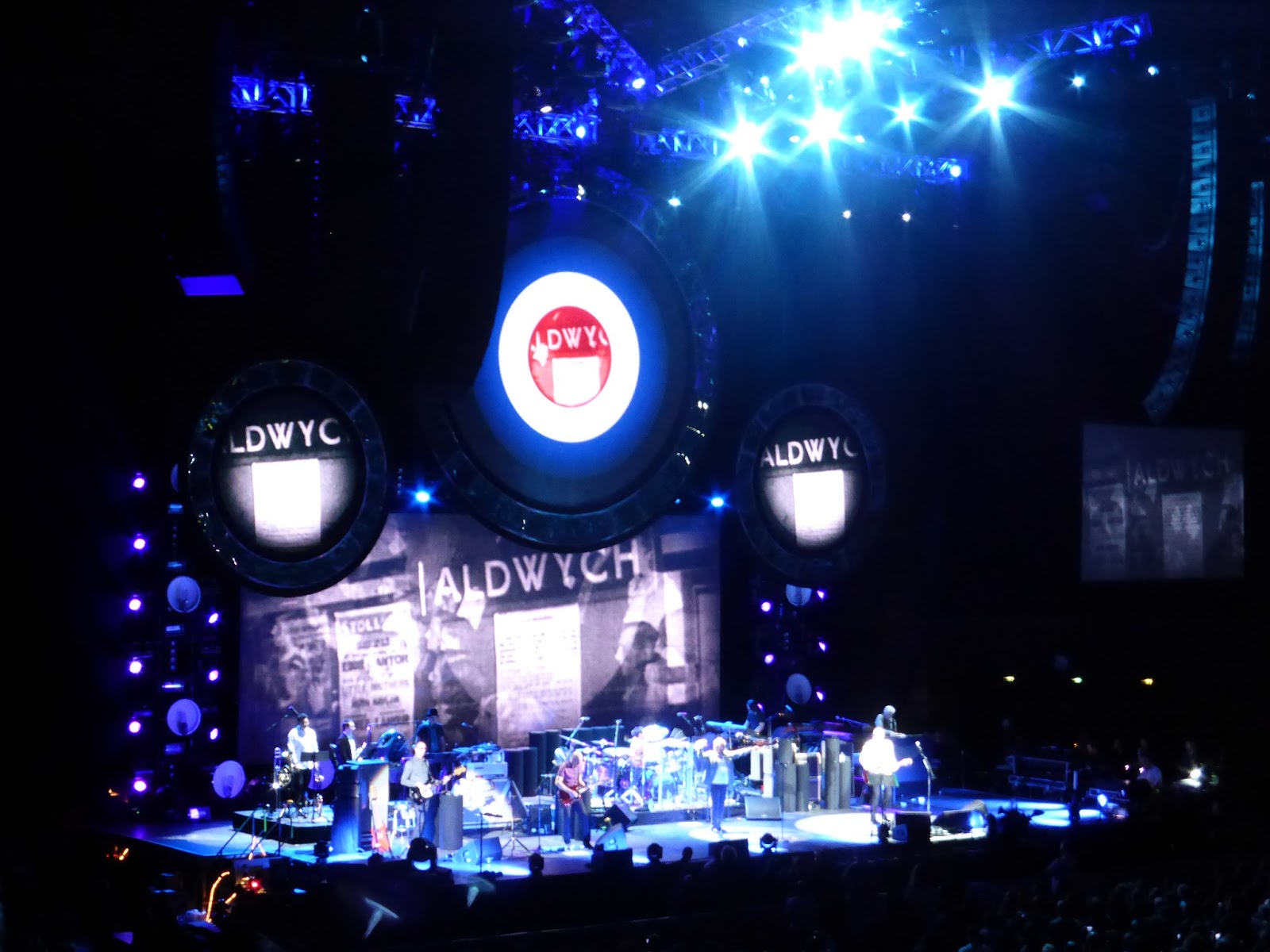
Modz still rool: The Who, Palais Ominsports de Paris Bercy

© Simon Poulter 2013
Remember the concept album? There was a time when you couldn't walk into a record shop without tripping over the latest elaborately illustrated, double gatefold-sleeved musical opus spread over four sides of vinyl.

Frank Sinatra is claimed to have started it with In The Wee Small Hours, The Beach Boys took it further with Pet Sounds and then The Beatles perfected it with Sgt. Pepper. From then on in everyone was at it - The Kinks, Bowie, the Floyd, Jethro Tull, Genesis...even the Stones' Exile On Main Street is built loosely around a concept, though good luck asking Keith Richards what it was.

Today, however, the idea of a concept album by a mainstream artist is unimaginable. For a start, today's musical tastes cater, it would seem, to people with the attention span of a goldfish with ADHD, which means getting anyone to listen to a single side of an album in one go is enough of a challenge, let alone asking them to follow a story spanning more than 80 minutes of music.

For The Who, this was never an issue. In 1966 Pete Townshend penned their "mini opera" A Quick One, While He's Away. Three years later he came along with the band's full-blown "rock opera" Tommy, before writing the aborted Lifehouse story that would eventually provide the thread to Who's Next in 1971.

In 1973 Townshend produced The Who's most ambitious concept, Quadrophenia. "It's not a story, more a series of impressions of memories," he told the NME's Charles Shaar Murray in November 1973. It's also an album of subtly dark recesses - it's title partly referring to the-then new-fangled quadraphonic audio and partly to the quartet of characters who made up The Who in 1973, but also to the schizophrenic personalities of the story's central figure, Jimmy.

From a writing standpoint it was and is Townshend's favourite Who album, but with a checkered live history. When the band first took it on the road, the live show was beset with problems as they tried to synchronise their performance with tapes, a four-piece band trying to replicate an album with extensive brass and synthesiser orchestration. Given that Keith Moon once took an elephant tranquilizer before a show and required an adrenalin shot administered by a roadie to get him back in time again, this approach was always going to be difficult.

© Simon Poulter 2013

Now, sadly The Who are just two - Townshend and Roger Daltrey. Always an odd couple, a more fractious fraternity than Mick and Keef, the diminutive singer Acton street fighter alongside the stroppy cerebral one from Chiswick. With Keith Moon lost to his own devices in 1978, and John Entwhistle lost to his vices in a Las Vegas hotel room in 2002, Daltrey and Townshend have been keeping The Who's flame flickering ever since, touring Tommy, their greatest hits and Quadrophenia, long before it became fashionable to perform a classic album in its entirety on the heritage trail.

Trotted out for its 40th anniversary, Daltrey - as the show's creative director - and Townshend have clearly breathed new life into the album. For a band whose surviving principal members are at the tail end of their 60s (Daltrey turns 70 next March, Townshend is now 68), there is energy in this performance, augmented by an excellent video show that, at various moments through the story, depicts scenes of recent British history that must prove baffling to a foreign audience like this one.

But then the biggest challenge in front of any audience is satisfying the inevitable expectation of mining the entire back catalogue. With a performing heritage just a year shy of the Rolling Stones and The Beatles, The Who have plenty of singles in their history to pull off an evening of hits: in performing an entire double album, with 17 tracks of varying topography like Quadrophenia, it takes something to retain the interest of an audience that might only be there to hear My Generation one last time. But, from I Am the Sea all the way through to Love, Reign O'er Me, the ensemble brilliantly maintains the original album's breadth and depth.

© Simon Poulter 2013
There is, though, little doubt that this is a Daltrey/Townshend show we've come to see.

But then there is still so much to see. Daltrey's voice is still strong, despite various health issues in recent years with his throat.

He is still one of rock's most enduring front men, still capable of swinging his microphone this way and that, like a circus performer instinctively hitting his mark each and every time.

© Simon Poulter 2013
And of Townshend, the sometimes troubled, angry young mod, who often gives the impression of sharp intellect conflicting with inner demons, he is still windmilling his way through elaborate guitar work of an intricacy few of his contemporaries have or will ever be able to match.

There is a noticeable softening of their relationship onstage. Their camaraderie, even their brotherly love - despite years of off/on differences - comes through as should schoolfriends of such lengthy acquaintance.

For all their genuine partnership, it's still difficult not to feel their loss of Moon, in 1978, and Entwhistle 11 years ago. As an impressive coda to 5.15, stand-in drummer Scott Devours (replacing the injured Zak Starkey, Ringo's boy) pounds the skins along to a video of The Ox performing the mazy bass runs he made his signature. In another band, this might be one of those head-to-the-bar moments - a drum and bass duet.

The sight of Entwhistle, often an unrecognised part of The Who, is genuinely moving. As, too, is the ghost of Keith Moon, resurrected via audio tapes played during Bell Boy, the song he sang on the album and, during the original tour, looned his way through each night. One of rock's greatest tragedies, Moonie was also one its greatest characters, as the hilariously manic photo montage of him demonstrated.

With Quadrophenia's finale, Love, Reign O'er Me, the show reaches a majestic, triumphal end. Every sinew in Daltrey's vocal apparatus is strained, Townshend's descending guitar riff played with visible passion  - or visible anger - representing the suicidal conundrum faced by the character of Jimmy in Quadrophenia's arc. It is a breathtaking end to a breathtaking performance.

© Simon Poulter 2013

However, we're not quite done: the chugga-chugga synth of Who Are You? - made universally famous by the CSI TV franchise - introduces a semi-surprise add-on to the evening, and a chance for Daltrey to apply more of that street swagger as gets to shout "Who the fuck are YOU!" in the chorus. Baba O'Reilly brings the audience to its feet, that bassy riff waking up a few air drummers in the audience, and the incongruous sound of 17,000 mostly late middle-aged punters singing "Teenage wasteland - it's only teenage wasteland".

Without any introduction needed, Townshend strums a guitar intro rivalled only by the Stones' Satisfaction - as Pinball Wizard sends Bercy into a flailing mass of invisible guitar playing. It is intoxicatingly good fun. As, of course, is Won't Get Fooled Again. I don't know who is currently retained as Roger Daltrey's throat doctor, but as the singer lets out that famous primal scream at the end of it, you imagined that one of Harley Street's finest must be being paid handsomely.

© Simon Poulter 2013
There is, though, no My Generation. Perhaps it has become something of a millstone around Daltrey and Townshend's necks to have a song released 48 years ago containing the line "Hope I die before I get old" still in the repertoire. Instead, with the band having evacuated the stage, it is left to the two old West London mods. the pugilist behind blue eyes and his loftier mate, to sing Tea And Theatre, the touching, bittersweet closing song on The Who's final concept album Endless Wire.

As Townshend picks out the song's chords on an acoustic guitar, Daltrey, theatrically holding a tea mug, concludes the evening with the age-catching-up reflection of "All of us sad/All of us free/Before we walk from the stage/Two of us/Will you have some tea?/Will you have some tea/At the theatre with me?".

You just about hear the collective 'gulp' underneath the applause. This may be a melancholy end to a performance by a band who were once rock's angriest young men. The anger may have faded, the volume may have been turned down, but The Who are still capable of giving it maximum R'n'B.


Monday, March 25, 2013

Over the Moon


Hanging on 
in quiet desperation 
is the English way


Along with the ubiquity of fast food drive-throughs, questionable road surfaces and sparring with trucks large enough to have their own electorate, the essence of the American road trip lies in wading through the alphabet soup of radio stations that blanket the country.

As you cruise along at genteel, radar-enforced speeds, you dial through the stations like a master safe cracker, frantically trying not to get stuck on a frequency offering country music, hellfire-and-damnation religion, or whack jobs spewing forth on the right to use uranium-tipped bullets when hunting small animals.

Eventually in this megahertz miasma you will come across something as familiar as your own face, and indeed as old as your face. It will be a riff, a chorus or a solo. You have found a classic rock station.

We Brits may have developed an awkwardness towards our own musical legacy, but Americans positively embrace those who led the British invasion of the 1960s and 70s. The likes of Led Zeppelin, The Who, Cream, the Stones and even The Beatles are often considered their own, part of the fabric that built the modern American culture. It is no accident that Tony Soprano, that icon of the American dream, drove - and frequently crashed - to the sound of New York's WAXQ, being of the generation of Americans who hold due reverence for the music that defined the rock era.

In the UK, classic rock artists - while still celebrated (as we saw during last summer's Olympic entertainment) - have been consigned to darkening corners of the radio spectrum. Although Stairway To Heaven was never released as a single, the idea of playing it in daylight hours is akin to walking naked down Oxford Street playing the German national anthem on a kazoo - somewhere between unfashionable, eccentric and arrestable.

But find yourself within 100 miles of any American conurbation between sea and shining sea and you will never be more than 20 minutes away from a station playing a track from Rumours or Frampton Comes Alive. Or a track from one of the most revered albums ever made, one that continues to draw superlative regard as it enters its fifth decade, and which, this week, celebrates its 40th anniversary: Pink Floyd's Dark Side Of The Moon.


With more than 50 million copies in circulation in the world and a cover that even those who've never listened to the record will recognise, Dark Side Of The Moon was a landmark record, full of landmarks. Musically, it is the definitive Pink Floyd album (although the surviving Floyd members still dispute this - Roger Waters citing The Wall, David Gilmour favouring Wish You Were Here).

It is also as musically accessible as anything in the Floyd canon. Breathe, the album's first musical track, is seemingly built out of an extended bluesy jams that were the band's hallmark in their early days in London's underground club scene, the only notable shift being Richard Wright's Miles Davis-influenced chord changes on the piano.

In principle, however, DSOTM is a concept album, lyrically owing much to bassist and lead writer Roger Waters' perennial obsessions with distance, separation (the loss of Syd Barrett) and death (the loss of his father at Anzio during World War II), and a growing cynicism towards the modern world.

Not that Dark Side Of The Moon is so starkly contrived. Like so many albums of its time, it's as much a collection of happy accidents as a narrative of conscious statements on these topics: death is covered more or less melodically by The Great Gig In The Sky, with Clare Torry's lyric-free, lung-rattling one-take vocal (for which she received the princely fee of £30 - later successfully contested in court), built over Wright's mournful piano. Happy it may not be, but by its end, few listeners have ever been anything other than exhilarated by one of the most memorable vocal performance in music history.

Lyrically DSOTM engenders some reasonable criticism. Even Waters himself has described lines like those on Breathe as "a bit Lower Sixth" ('Breathe, breathe in the air. Don't be afraid to care. Leave, don't leave me. Look around and choose your own ground), but such lack of erudition can be easily glossed over by the mammoth impact of the album's music.

Like most episodes of Monty Python's Flying Circus, the social commentary of Money, is dating, especially if you regard new cars and caviar the height of extravagance. Still, as prescient as references to LearJets and buying football teams may have been, reflecting Waters' underlying socialist bent, they're hardly in the same league of rock star awkwardness as We Didn't Start The Fire or Sting singing about the plight of Russian children.

While Money afforded a generation of gauche adolescents the opportunity to let rip with the "goody-good bullshit" line, it also became the first Floyd song to be a commercial hit. One of the most unlikely aspects of this is one of the song's least obvious aspects - its obscure 7/4 time signature providing the 1-2-3-4-1-2-3 cyclical bass figure, a walking blues with its roots in Booker T & The MGs' Green Onions. And, of course, it features that looped sound effect of a cash register and the splash of coins being thrown by Waters into one of his wife's pottery creations, with the loop then spliced into seven pieces and hooked around upturned chair legs to keep with the 7/4 time.

Money isn't the album's only taste of sound effects, of course: the ticking and ringing alarm clocks of Time and the pulsing heartbeat that heralds the opening track, Speak To Me and the album's first words: "I've been mad for fucking years, absolutely years, been over the edge for yonks". This and other excerpts of spoken voice throughout the album was the result of Waters using cue cards to ask stock questions to various hangers-on around Abbey Road Studios including (but never used) Paul McCartney, road manager Peter Watts (father of actress Naomi) and the cheerful studio doorman Gerry O'Driscoll ("I'm not afraid of dying. Any time will do").

And there's the mournful Us and Them, a song loosely about depression (another Waters theme), and built on a Rick Wright composition originally written for the 1970 film Zabriskie Point by Italian director Michelangelo Antonioni (and featuring a brief appearance by Harrison Ford, trivia fans). In place of a traditional middle eight, it features roadie Roger 'The Hat' Manifold, airing his wisdom on a road rage perpetrator.

I mean, they're not gonna kill ya. If you give 'em a quick short, sharp, shock, they won't do it again. Dig it? I mean he got off lightly, 'cause I would've given him a thrashing - I only hit him once! It was only a difference of opinion, but really...I mean good manners don't cost nothing do they, eh?


Dark Side Of The Moon has been hailed greatly and derided selectively. To the punk movement it was a convenient target, hippies going mad amid a barrage of bloated excess and overwrought self-examination that famously remained on the Billboard Hot 100 for decades after its release. Along with Emerson & Palmer's invention of the behemoth stadium tour, DSOTM is frequently suggested as one of the seeds of punk. It isn't, and shouldn't, and in some respects Money even predicts the coke-shoveling, overblown state that rock music found itself in during the mid-1970s, giving punk a platform to rail against.

At just over 42 minutes' long - constrained, of course, by the capacity of vinyl - DSOTM is short by comparison with some of the opuses of the day. And while it may well, as Waters ascertains, been the beginning of the end for Pink Floyd (or at least the album on which the creative tensions between Waters and Gilmour began to turn more dysfunctional), it is still, 40 years on, a remarkable record.

On March 24, 1973, when Dark Side Of The Moon was released, the concept album wasn't anything new. Pet Sounds, Sgt. Pepper, even Who's Next had all attempted some sort of narrative, musical theatre of the mind. But unlike Waters' deliberately more theatrical effort with The Wall, DSOTM presents a more subtle collage, the central theme being modern life and how rubbish it really is.

Gloriously melancholy, in a way only an English songwriter could write. Perfect, then, for driving on American roads.

Friday, February 22, 2013

Now would do nicely


It is, perhaps, not surprising that the 43-year-old Ethan Johns maintains a foot or even all ten toes in the era of music his father played such an instrumental, if not obvious, role in.

As the son of Glyn Johns, producer of such seminal rock-era albums as Who's Next, The Faces' A Nod's As Good As A Wink To A Blind Horse and Eric Clapton's Slowhand, Ethan has had some extraordinary influences around him. And just for good measure, his uncle, Andy, engineered Led Zeppelin's entire studio canon, along with the Rolling Stones' output during the early '70s.

Quite some pedigree. But today, Johns Jr. is, in his own right, a much-respected musical polymath, producing, mixing, engineering, writing and master of numerous instruments, with an amazing list of credits including work with Kings of Leon, Laura Marling, Rufus Wainwright, Ryan Adams, Crowded House and Crosby, Stills and Nash, and the Best British Producer award at last year's Brits.

You could claim that such is the quality of Johns' behind-the-scenes work that coming front-of-cloth might be considered a tad greedy. But such is the sheer richness of his debut solo album, If Not Now Then When, there should be no complaints at all.

For a lad born in the London Borough of Merton, Johns has the canyons and valleys of Los Angeles in his veins. If Not Now Then When is an ear-warming channeling of the era of easy-going folk rock, a time when singer-songwriter albums came about through mandatory beard growing, wearing head-to-toe denim, and gatherings of like-minded heads in secluded cottages somewhere between LA's Laurel Canyon and Mulholland Drive.

The result is a gentle, stroll through folk, blues and acoustic rock, steered by father Glyn at the mixing desk, and with encouragement in the early stages from Marling.

Initial tracks were written and tested while Johns was touring with Ray LaMontagne: "I just thought, 'Well, wow, maybe these things don't have to live on the shelf at my studio anymore," Johns explains. "Maybe I can roll these out. Because it's so much fun.'"

The outcome is a mellow melange of folk, rock, folk-rock and blues - or combinations thereof - that opens with the line "Goodbye cruel world, hello sunshine..." above the sparse entrance of the opening track, which builds from gentle acoustic to electric guitar, single to multi-track vocal, and from a tight intimacy to a cinematic roadtrip.

Morning Blues is a noirish swamp stomp, with much of the stomp provided by powerhouse drummer Jeremy Stacey (the Droog-attired go-to sticksman I last saw pounding the skins for Noel Gallagher). As Seasick Steve has proven, the beauty of blues music is often its simplicity. Likewise Red Rooster Blue, with its sunny and strummable bluegrass disposition, digging roots-deep into the folksy origin of music Americana.

If I were to describe Elijah as "Beatley" I would be committing one of the cardinal sins of music reviews. It is one of the most overworked descriptions of all, especially given that it refers to a band that began as greased-up rockers and ended as midwives to prog rock. But as a descriptor of anything with a melodic familiarity that your granny could hum or your four-year-old can wail along to from the backseat of the car, Beatley covers most of the Neil Finn oeuvre, that of Jeff Lynn (almost by default) and. now, John's Elijah, standing out for its delightful, perfectly formed Abbey Road-era piano, Ringo drum fills, and a vocal that could easily have found its way onto Let It Be.

This is an album of expressed freedom. If that sounds a little hippy-dippy, then it probably is. John's low, close-to-the-mic vocal (similar to that of Mark 'E' Everett of Eels) pulls you into his stripped-down domain, all acoustic guitars and bare feet on the floorboards. Thus the likes of Willow offer a personal, soul-bearing charm while The Turning finds a reflective Johns considering the march of time, something we all get to sooner or later after our 40th summer.

Mixed by dad Glyn, and with other collaborations from Danny Thompson (John Martyn's legendary bassist and - literally - sparring partner), Marling and Adams - all of whom turn up on the gloriously mellow Whip-Poor-Will, If Not Now Then When is a delight, a record you feel you've been listening to for years, but with more than enough about it to feel new. Yes, it harks back to a Californian lifestyle from over 40 years ago, but there's enough here to warm the most complicated of modern days.

Indeed, having recently spent a couple of days enjoying the top-down joys of that stretch of Pacific Coast Highway between Santa Monica and Malibu, this is the album I would like to have had while driving. Gentle, introspective, intimate and soulful all at once and individually.

Sunday, January 27, 2013

Northern songs: I Am Kloot's Let It All In

Viewers and listeners to the BBC's national and international services may have noticed recently a distinct reorientation of the accents delivering the news.

This is the result of the BBC, in its ridiculously ultra-orthdadox political correctness, moving all of its staff to Manchester owing to its output being, apparently, too London-centric, and its presenters too plummy to "connect" with the rest of the country.

Clearly, this lack of regional awareness was the root-cause of Britain's cultural fragmentation, urban dysfunction, family breakups, riots, crime spikes and the recession.

Anyway, as a result of this relocation, any BBC refuseniks who preferred to stay in London, have been replaced by Salford locals. Thus, the 10 O'Clock News now commences with "Eh-up, chuck, here's news 'eadlines, read by our kid".

Recentering Britain's cultural heart in Manchester probably does nothing for people living in Birmingham, Leeds, Glasgow, Plymouth or Newcastle, but you have to appreciate the gesture, futile as it truly is.

On the plus-side, though, the increased prevalence of Mancunian has added to the familiarity of Manchester bands singing in their natural accent. In the 1950s and 1960s, pop stars affected American accents. In the 50s it didn't matter if you were a gorblimey Cockernee knees-up merchant like Tommy Steele, the American accent represented everything shiny, new and aspirational about the country across the Atlantic. And if you consider it, Mick Jagger would have sounded absurd singing Little Red Rooster in his ever-so-slightly posh Dartford delivery.

More progressive performers didn't play that game, however. David Bowie has mostly sung in a voice that reflects his south-east London roots, from the prototype Mockney on the Anthony Newley-influenced novelty The Laughing Gnome right up to the surprise new single Where Are We Now?, varying only in pitch and tone.

Perhaps the best - and to be acclaimed the most - example of a refusal to adopt the Yankee twang is that of The Beatles. Despite the heavy influence of Elvis and the Glasgow-born Lonnie Donegan on their early repertoire, the Fabs became the voice of north-west England, spreading the region to the rest of Britain and, subsequently, the world.

So it's no great stretch that I make between John, Paul, George and Ringo and I Am Kloot's John Bramwell. On their superb, sixth album Let It All In, there is no question of the band's Manchester roots and the common denominator they share with all north-western bands - Oasis, James, The La's, The Smiths - an uncanny gift for melody.

It's nigh on impossible to avoid comparison between the Kloots and their Liverpudlian ancestors, in particular: Let It All In's sublime Masquerade really could have been on Revolver, Bramwell sounding eerily like John Lennon. Likewise the closing track Forgive Me These Reminders even sounds unintentionally, like Gilbert O'Sullivan's Alone Again (Naturally), though it should be noted that O'Sullivan was born in Swindon.

Let It All In is blessed with delightful breadth, depth and texture. The opener, Bullets, sets off with a Kurt Weill swing before ripping up a seering rockabilly guitar solo. The title track, with a gentle acoustic guitar lilt similar to Athlete's Wires, finds Bramwell unashamedly Manc-ing it up with "I can't hear the words for the sound of the information, I 'aven't got a job, or an 'obby or an occupation."

Hold Back The Night unveils more of the album's subtly varying topography, with a melodrama, ambience and progression reminiscent of Portishead's Glory Box, opening into a theatrically glorious string-based middle eight. It is here you also recognise the production skills of Elbow's Guy Garvey and Craig Potter, old friends of the band, who've helped craft one of the best records I suspect we'll hear this year.

Scallywag tales of teenage mischief in Mouth On Me, the romantic gentility of Shoeless (which closes with another Beatley conclusion) and the sparsity of Even The Stars, which could easily be from the Richard Hawley canon. There's a beautifully bittersweet nature to I Am Kloot's compositions, songs that sit on the softer edge of acerbic without become excessively wry.

Some Better Day fits this bill perfectly, a gentle song with a cut to it that you suspect must end up as the theme tune to a sitcom someday. Think of Half A World Away and The Royal Family.

The Elbow touch returns on the album's penultimate track, These Days Are Mine, the kind of building, bassline-thudding anthem that builds to a stadium-filling chorus. And just as Elbow have made it OK to like uplifting, arena-friendly music in these depressed, repressed times, I Am Kloot have made a record of glorious warmth and comfort.

Releasing it in January, at the outbreak of a fearsome blast of winter, was an inspired choice. Forget buying a onesie - just buy Let It All In and curl up on the sofa with a cheeky bottle of rich red wine.