Showing posts with label David Gilmour. Show all posts

Monday, October 14, 2013

Deep In The Motherlode: John Martyn - The Island Years

The Greatest Hits collection: for some, the perfect Christmas gift. To others, the ideal introduction to a grander canon. And to another category - let's call them The Suits - an opportunity to plunder a back catalogue.

But what if there were no Top 40 singles, and barely any meaningful flickering of attention beyond a faithful cognoscenti? What justification, then, the release of a compilation of 'hits'?

Logic, presumably, doesn't even enter the equation when considering John Martyn - The Island Years, a truly lavish package weighing in at a chunky couple of kilos, and containing 17 CDs, a DVD, 120 rarities, four songs never even heard before, a press kit from 1973, and a lovingly curated book by longtime biographer John Hillarby.

No one is expecting anyone other than the deepest fan to part company with close to £150 for such a weighty tome, especially one containing a lot of material the fan might already possess. But that is part of the tragedy of John Martyn and, oddly, his appeal.

It's singularly impossible to imagine that 40 years hence Justin Bieber will be regarded with the same reverence for the heart-stripping depths to which he would descend with his songwriting, his utterly unique guitar virtuosity, and even the depravity to which his tour jinks would reach. Because, quite frankly, they don't make 'em like Martyn any more, and that's what makes The Island Years more than just a fan's treasure trove.

It charts Martyn's most formidable period, when Chris Blackwell made him Island's first white signing in 1967, taking him from Surrey-born, Glasgow-raised gauche exponent of finger-in-ear bucolic folk to ethereal classics like Solid Air and the beautiful woozefest of Go Down Easy (with its opening line "You curl around me like a fern in the spring" and the intonation of "...eazzzy" that perfectly harmonises Martyn's voice and Danny Thompson's upright bass).


Picture: Island Records

There will be no shortage of people, I'm sure (and I'm not going to put this to the test, either) who will say that What Would David Bowie Do? bangs on a tad too much about Martyn. But like so many - and there are many - who love his work, we all share the same adoration and the same frustration. Adoration for a body of work that gouged open the human condition and frustration at the way Martyn's talents were largely ignored by the mainstream and came close to being wasted by Martyn himself.
Picture: Island Records

The former Iain David McGeachy, born on September 11, 1948 in a street in New Malden, Surrey, not far from the one I arrived in 19 years later, was often regarded as "a musician's musician". This is a term I always consider to be the musical equivalent of patronisingly describing someone not blessed with much beauty as having a great personality.

Martyn, however, was - and remains, posthumously - a musician whom those who know their music, and especially their singer-songwriters, will hold considerable reverence for. True, I wouldn't be able to throw any hit singles at you for reference, but to a certain generation, Solid Air remains a stoner's choice.

Clapton's cover of May You Never kept Martyn in Guinness during a career whose critical success was rarely matched by commercial success. Eclectic collaborations with David Gilmour, Phil Collins and Sister Bliss, plus the collection of artists like Beck, The Cure's Robert Smith, Paolo Nutini, Morcheeba, Beth Orton, Joe Bonamassa, Lisa Hannigan, David Gray, Snow Patrol and Collins (again) who contributed to the 2011 tribute album Johnny Boy Would Love This were the tip of the iceberg as far as Martyn's standing in the business was concerned.

"I'd never heard anything like him," Orton recently recalled. "Like all good music, it scared me a little, but it was so tender as well, wise and mysterious. He opened a door to another world of beauty and sensuality that until that moment I knew little of. To this day I still love the tenderness of his words and delivery."


Picture: Island Records
When he died, in January 2009, aged 60 and just after being awarded an OBE in the New Year's Honour's List, the tributes came from right across the industry. He was one of music's loveable rogues, a once whip-thin folkie with an angelic voice who ended his life a vast bear of a man, with a whiskey-soured Gorbals rasp, one leg missing below the knee, and the sort of history a rascally old cove in a dockside pub might retell.

That he survived his sixth decade was a surprise to some, but a blessing to all who continued to enjoy new material right up until his death. The Island Years comes to represent Martyn at his most creatively fertile and his most technically inventive in the studio (and out of it - One World's wigout Small Hours was recorded at three in the morning next to a Berkshire lake, just to capture ambient sounds like a flight of geese taking to the air).

The package includes all 12 studio albums recorded for Island and although most - and especially Bless The Weather, Solid Air, Inside Out, One World and Grace And Danger should be nailed-on fixtures of any existing Martyn collection - the additional CDs containing outtakes and complete live recordings (such as one from Richmond-upon-Thames' Hanging Lamp, as well as the Live From Leeds album) provide more than just a completist's satisfaction.


Picture: Island Records
The inclusion of a DVD featuring Martyn's various TV appearances - including seminal performances with partner-in-crime Danny Thompson on The Old Grey Whistle Test - chart his evolution from genius of a folk, rock, blues and even reggae hybrid with an acoustic guitar and EchoPlex delay, to besuited electric guitarist trying to fit the mid-80s effete with over-produced AOR gloss that seemed intended to turn Martyn into the next Chris De Burgh.

But even there, amid echoey sax solos and the battered Martin acoustic replaced by Stratocasters and Les Pauls, the essence of John Martyn can be seen for all its fragility, the raw, heart-on-sleeve (in fact heart as sleeve) emotion. Even a cover version of Somewhere Over The Rainbow turns into a song of wrought honesty only Martyn could have made.

The Island Years is a sumptuous Aladdin's Cave of John Martyn's music. The stuff you know too well bear repeated listening; the stuff you've heard in different forms will provide a fascinating glimpse of the creative process of a consummate innovator; and the absolute rarities - the demos, the previously unreleased, the obscure BBC sessions, even a cover version of Hi-Heel Sneakers by (the first record Martyn ever bought) - conspire to put one of the most event-filled, colourful and tragic careers into one mighty, postman-challenging box of never ending delight.


Monday, September 23, 2013

Anger management: Roger Waters - The Wall at Stade de France

© Simon Poulter 2013
To see the English at their most English, after you've read this post, of course, slide on over to YouTube for a priceless excerpt of Anglo-Saxon awkwardness, featuring Roger Waters and his onetime Pink Floyd cohort David Gilmour.

In a 110-second clip from 2006, you will see these once bitterest of bandmates meeting in the car park of Bray Film Studios where, by pure coincidence, Gilmour was rehearsing for his On An Island tour in Studio 1, and Waters was rehearsing for his tour in Studio 2.

Given the years of post-Floyd animosity between the Floyd's own Mick and Keith, the meeting is understandably edgy.

Rarely raising their eyes up from the car park's ashphalt, they appear to small talk about this and that. Waters kisses Gilmour's wife, the writer Polly Samson, Gilmour and Waters awkwardly hug, and they return to their respective sound-stages.

The lack of eye contact adds depth to a history of repressed rage, buried recrimination and still-simmering resentment. "Hanging on in quiet desperation is the English way," you could say. Thankfully, the detergent powers of therapy have helped thaw the relationship between the two.

The Wall, the Pink Floyd album Waters largely devised and wrote amid crumbling relationships with the rest of the band (Gilmour in particular, as the two vied for creative control), was an outlet for his rage. Rage against the fame that had increasingly encroached on him in the wake of Dark Side Of The Moon's global success; rage against the injustice of having lost his father, Eric Fletcher Waters, to the brutality of World War Two when Roger was still a baby; and rage against totalitarianism, capitalism, communism, fundamentalism, fanaticism, consumerism - any 'ism you like.

© Simon Poulter 2013
Waters turned 70 earlier this month. And he's still angry. Like an ageing activist at Speaker's Corner, he continues to rail against a long list of the world's 'isms and, for the last three years has used a truly epic restaging of The Wall live show as a platform to make his  point(s).

Of course, with the Floyd going their separate ways, reuniting only for a terse performance at Live 8 in 2005, the patrons who filled the Stade de France in Paris on Saturday night may have been there expecting a Pink Floyd show more than a 'solo' performance by one disproportionate quadrant of the band. Whatever they were there for, they got their money's worth. And then some.

Some will say The Wall was overblown, overwrought, self-indulgent rock bombast. And from some angles, it was. But others will say - quite rightly - that it was a double album on a totally different scale of narrative ambition to anything then - and certainly anything since.

Released on the cusp of the 1980s, The Wall's epic, theatrical expanse appeared, thematically, to mark the end of the rock era, an era that had seen similar concept projects, be it Sgt. Pepper or the The Who's Tommy, which explored a similar thesis.

In 1980 the Floyd took The Wall on the road as an elaborate arena stage show for 29 dates. Part rock concert, part rock opera, part theatrical outlet for the neuroses Waters had written about, it opened with a 'fake' Pink Floyd wearing face masks of the real band, featured a giant wall across stage with the real Floyd initially performing behind it, and made liberal use of Gerald Scarfe's clearly Nazi-inspired animations of marching hammers.


© Simon Poulter 2013
Updated with the latest staging technology, including an enormous wall spanning the entire stadium width and high definition projection, the updated Wall show is a breathtaking spectacle.

Given the number of acts now touring classic albums as tidy pension contributions, it would be easy to accuse Waters of also plundering the pot. But that would be a great disservice to this who. And, as he explained in 2010 when announcing the three-year tour, there was another motive for restaging The Wall show now: "30 years ago when I wrote The Wall I was a frightened young man," Waters explained on his website.

"In the intervening years," he added, "it has occurred to me that maybe the story of my fear and loss with it’s concomitant inevitable residue of ridicule, shame and punishment, provides an allegory for broader concerns.: Nationalism, racism, sexism, religion, Whatever! All these issues and ‘isms are driven by the same fears that drove my young life".

© Simon Poulter 2013
"This new production of The Wall is an attempt to draw some comparisons, to illuminate our current predicament, and is dedicated to all the innocent lost in the intervening years," Waters explained.


Thus, in this reimagining of The Wall stage show, he tackles the war on terror and war in general. From the very beginning, with its pyrotechnics punctuating In The Flesh? and a miniature Stuka flying the length of the stadium before crashing in flames, Waters remains without compromise.

Another Brick In The Wall, Part 2 - being the album's fifth track - provides an early highlight to the evening, and its first singalong moment. On the album it was a breezy, faux-disco 4/4 novelty. Released as a single in November 1979, it became the final No.1 of the 1970s in 17 countries - a Christmas No.1 taking a swipe at Thatcher's Britain and school brutality, with a chorus of London schoolchildren declaring "we don't need no educashun"!

Here, it is updated with a newly-written coda: an animated London Underground train arrives on the wall, muzzle flashes are seen, pistol shots are heard, and Waters launches into The Ballad of Jean Charles de Menezes, about the Brazilian mistakenly killed by police at Stockwell tube station in the aftermath of the July 2005 terror attacks. It ends with Waters enunciating the caustic final lines: "Just one man dead and nothing is gained, nothing at all. And Jean Charles de Menezes remains just another brick in the wall". On the day of the Nairobi atrocity, it adds a moment of poignant reflection.


Picture courtesy of Guino Patrice
http://rockerparis.blogspot.fr/
Waters' attempts to raise the mood a little by introducing Mother, playing acoustic guitar and ambitiously syncing his vocal to footage of him performing the song at Earls Court in 1980 (the "fucked up Roger", he declares, self-depreciatingly).

Coming halfway through the show's first half, Mother starts to unlock The Wall's undercurrent menace, a gentle foothill to the onslaught to come as it tells the story of the fatherless Pink character as mollycoddled recipient of an overbearing mother trying to keep "baby cosy and warm", building a protective wall around him and sealing in his alienation.

Bluesy, even gospel-infused, Mother is another early peak in the show, coming before The Wall crawls further to the dark side with Goodbye, Blue Sky. Controversially, Waters uses the impressive HD projection system to full the stage wall with an animated collage of B-52s drop bombs of corporate logos, swastikas, hammer and sickles, the Star of David and other icons of those 'isms' he gets worked up about.

At the interval - The Wall was a four-sided vinyl album after all - images of people who've lost their lives to war are projected on the wall, another reminder of what inspired the record to begin with. Waters' father was a schoolteacher, Labour Party activist, devout Christian who, at the outbreak of World War 2, was a conscientious objector. As the war dragged on, he changed position and joined up, becoming an officer in the Fusiliers. In the battle for Anzio in 1944, Eric Waters was killed. His son Roger was only a few months old. His death would resonate for the rest of Roger Waters' life and career, drawing on his father's beliefs, fuelled by his father's slaughter.

Picture courtesy of Guino Patrice
http://rockerparis.blogspot.fr/

Opening with another Floyd classic, Hey You - an anthem of bricked-in repression - the band are hidden completely behind the wall. Only the continuing stage lighting gives away the fact someone's back there, and that Waters and his sizeable ensemble are still in the dressing room quaffing eau gazeuse and cheesy nibbles.

© Simon Poulter 2013

The Wall's profound theatrically is exploited to the full during the second half, as it makes sinister progress through the story with Nobody Home, the nostalgic Vera and the choral Bring The Boys Back Home, before piling in to the opening power chord of Comfortably Numb. a song that has taken on the mantle of Pink Floyd's opus, a highlight of both Waters and Gilmour solo shows, and even part of the Scissor Sisters' camp schtick.

On the album Comfortably Numb was a cut-and-shunt of a song by Waters and another by Gilmour (the former providing the manic vocals of the verses, Gilmour adding his gentler voice and 12-string guitar to the countering chorus). Compromising entente it may have been, but it produced one of rock's greatest epics - and greatest guitar solos.

Performed with longtime Waters sideman Snowy White recreating Gilmour's original fretwork with such vigorous attack you'd hardly believe he'd been playing it night after night for three years, it provides a solid reminder of just how well written The Wall was. For a concept album, producing even one hit single was an anomaly. Producing so many outstanding contributions to the Floyd legacy was an even bigger achievement.

Picture courtesy of Guino Patrice
http://rockerparis.blogspot.fr/
Of course, the second half of The Wall is also well known for the emergence of the Pink character as a fascist nutjob. Waters, sporting de rigeur dictator Aviators, leather greatcoat and the marching hammers armband drawing obvious visual reference to the Nuremberg rally of 1938, struts about declaring The Show Must Go On.

As his fascist ranting in In The Flesh (never to be confused with the opening track, In The Flesh?....) gets underway, a giant inflatable pig is released into the crowd. It's a moment that causes thousands of smartphones, which had previously been trained on the stage to such effect that the Stade de France floor looked like a twinkling carpet of LCD screens, point upwards, catching sight of a gimmick that has been causing quite a stir. Especially in Israel.

For alongside a crucifix, the dollar sign, a hammer and sickle and other graphics, is the Star Of David. Waters has, as a result, been accused of being anti-Semitic, a stance not helped by his previous criticism of Israel over its treatment of Palestinians, nor by his clear commentary on the war on terror in the Muslim world. Waters has defended the pig as "satire", but has added that it would be wrong "to pretend these problems in the Middle East don't exist".

For, I suspect, much of the audience, it's a moment of light relief. The political symbolism is lost in a Saturday night stadium party. And, as the inflatable pig is gradually lowered into the crowd, where it appears to undergo some form of inflatable porcinecide, Waters continues to strut about, the jangly familiarity of Run Like Hell building the backdrop of autocratic mayhem as he screams "If they catch you in the back seat trying to pick her locks/They're gonna send you back to Mother in a cardboard box - you'd better run!".


The Trial, with its orchestral backing, was, on the album, something between a Gilbert and Sullivan operetta and Lionel Bart show tune. Live, Waters retains this camp theatricality and embellishes it with more of cartoonist Gerald Scarfe's vivid imagery, as used by Alan Parker in his so-so film adaptation of The Wall.

Waters is now in his element, seemingly effortlessly pushing his 70-year-old voice to deliver the show's most demanding number, one that takes you even further away from your notion of being at a rock concert, as it builds to a crescendo and the collapse of the wall.

Few rock shows, few rock albums for that matter, have or ever will end this way. Traditional rock concerts end with a finale, an encore of hits (plus the annoying unknown new one). But this is no rock concert. It ends with Outside The Wall, Waters playing a lament on his trumpet, the accompanying band assembling around him with rustic instrumentation - mandolins, acoustic guitars, accordion and vocal harmonies to - as they bring this epic to an end.

For all the rage, for all the anger, Waters declares that this is probably the last time he will ever stage The Wall. He's got another solo album to finish and then...and then we'll see. He's the last member of rock's great circus I'd ever give over to sentimentalism, but there are tears on his cheek and a crack in his throat as he brings the invisible curtain down on his three-year adventure.

"And when they've given you their all," that final song had chimed, "Some stagger and fall, after all it's  not easy - banging your heart against some mad bugger's wall." Indeed.

Thursday, April 18, 2013

Art For Art's Sake - a tribute to Storm Thorgerson: 1944-2013

If you were to ask me to make a list of the greatest albums of all time, I could start now and probably never finish. Magazines and radio stations regularly try to give it a go, but rarely come up with a top 10, top 100 or even top 100 that will truly cover things adequately.

You might, however, stand a chance of coming up with a decent list of the greatest albums based on their cover art.

From Sgt. Pepper's Lonely Hearts Club Band to London Calling, album covers were an integral part of the record buying experience in the pre-CD era.

With the 2013 Record Store Day taking place throughout the world tomorrow, you won't have to go far to hear old heads - like me - ruing the disappearance of gatefold sleeves, of liner notes and lyrics, and the whole tactility of buying music in a physical format.

As a schoolboy, album art meant as much to me as the music contained within. Dull geography lessons on Upper Volta would pass more meaningfully while recreating band logos in biro on the cover of an exercise book. Entire band back catalogues could be filed and discussed according to their sleeve art, while no adolescent male could resist a sneaky peak at Roxy Music's Country Life while perusing the record racks on a Saturday afternoon.

Some covers - and more pertinently, their designers - became synonymous with the impact of the album's musical content. Barney Bubbles was the creative force behind Stiff Records during the New Wave, while further back, Roger Dean's elaborate fantasyscapes will be forever associated with Yes.

But, perhaps, the most inventive and iconic cover art designer of them all was Storm Thorgerson, who died yesterday from cancer at the age of 69.

He is mostly associated with Pink Floyd, but together with Hipgnosis, the design collective he co-founded in 1968, Thorgerson was responsible for designing covers for 10CC, Muse, Led Zeppelin, Audioslave, The Cranberries, Peter Gabriel, Black Sabbath, Ian Dury, Steve Miller and Genesis.

Growing up in Cambridge, Thorgerson was a childhood friend of eventual Floyd members Syd Barrett, Roger Waters and David Gilmour. "We first met in our early teens," Gilmour wrote yesterday on his website. "We would gather at Sheep's Green, a spot by the river in Cambridge and Storm would always be there holding forth, making the most noise, bursting with ideas and enthusiasm. Nothing has ever really changed. He has been a constant force in my life, both at work and in private, a shoulder to cry on and a great friend."

In 1968 Thorgerson and fellow Cambridge designer Aubrey Powell were asked by the Floyd to design the cover for A Saucer Full Of Secrets. It was to seal Thorgerson's association with the band forever: "The artworks that [Storm] created for Pink Floyd from 1968 to the present day have been an inseparable part of our work," Gilmour added in his online tribute.


In 1973 the band released Dark Side Of The Moon, for which Thorgerson came up with a cover design as iconic as the record itself. It's origins were pretty functional: the band's Rick Wright had suggested Thorgerson produce something simple and straightforward. The outcome is something so straightforward and simple that it has adorned T-shirts and posters for the last 40 years

"No amount of cajoling would get them to consider any other contender, nor endure further explanation of the prism, or how exactly it might look," Thorgerson has explained. "'That's it', they said in unison, we got to get back to real work, and returned forthwith to the [Abbey Road] studio upstairs."

"The refracting glass prism referred to Floyd light shows - consummate use of light in the concert setting. Its outline is triangular and triangles are symbols of ambition, and are redolent of pyramids, both cosmic and mad in equal measure, all these ideas touching on themes in the lyrics. The joining of the spectrum extending round the back cover and across the gatefold inside was seamless like the seguing tracks on the album, whilst the opening heartbeat was represented by a repeating blip in one of the colours."

Throughout Thorgerson's work, artistic influences can be easily identified, from Picasso to Magritte, but also plenty of humour. With the Floyd's Animals, Thorgerson created another icon, with a pig famously flying over Battersea Power Station.

The shot has now passed into lore thanks to the inflatable pig used for the photograph slipping its mooring and drifting off into the incoming flight path for Heathrow Airport.

As the 1970s unfolded, and conceptual cover art became increasingly intertwined with musical narrative, Hipgnosis expanded their client roster to include other bands, and notably those on the artier side of rock, like Genesis and 10CC.


The studio also picked up Black Sabbath's Technical Ecstasy, the cover of which was once described eloquently by Ozzy Osbourne as "two robots screwing on an escalator"


More often than not covers were conceptual interpretations rather than literal representations, eschewing the pop notion that albums should be adverts for the bands, featuring the members themselves.


Through Thorgerson's work with Pink Floyd, however, notable design cues emerged that would appear in his work for other acts. Anonymity played a major part. Even with albums like Floyd's Wish You Were Here, ...And Then There Were Three by Genesis, and jazz-rockers Brand-X's Moroccan Roll (my favourite album title ever), which feature photography of people, they are never in close-up. Faces are never clear and in several cases feature figures with their backs to the camera.

Distance is always significant, something Thorgerson's work shared with Floyd's Roger Waters, who became increasingly obsessed with absence and separation, culminating in the entire narrative of The Wall. Thorgerson returned to Water's feelings with the cover for Is There Anybody Out There?, the box set of the live Wall show, which simply features the four face masks worn by the fake Waters, Gilmour, Wright and Mason at the beginning of the ambitious show.

One dominant cue throughout Thorgerson's projects has been the prominence of flat, green grassy fields in the lower half of the cover, blue sky in the upper half, and a prominent object or objects in the immediate foreground.

Perhaps inspired by Grantchester Meadows in Cambridge (immortalised by Floyd on Ummagumma), Thorgerson returned to this device again and again, on everything from Floyd's Atom Heart Mother and The Division Bell through to Biffy Clyro's single God & Satan and Synrise by obscure Belgian electro band Goose. Along with the setting, Thorgerson's photography would often have an unreal reality about it - rich greens in the grass, bold blues in the skyscapes, and an unnerving clarity of objects in the fore.


"I listen to the music, read the lyrics, speak to the musicians as much as possible," Thorgerson has explained. "I see myself as a kind of translator, translating an audio event – the music – into a visual event – the cover. I like to explore ambiguity and contradiction, to be upsetting but gently so. I use real elements in unreal ways."

As albums have become reduced to bitstreams, and music consumption shifts from having the patience to listen to two or even four sides of vinyl to downloaded singles or Spotify mixes, Thorgerson's artistry is, sadly, diminishing. 

There are still, thankfully, champions of the art of record design, who regard the packaging and presentation of their music as more than just a marketing exercise, and who look to today's multiple formats as an opportunity for renewed design creativity. 

But with Storm Thorgerson's passing, we should mourn the death of an era when the album cover meant more than just the thing that stops your record from getting scratched.


Saturday, October 20, 2012

CP company - Keane, live in Paris:

Picture: Keane/Facebook
Let's face it, as rock music instruments go, the piano just isn't sexy.

Sorry if you were put through hell as a child to achieve your Grade 6 piano certificate, but it really is just a piece of noisy furniture.

No attempt to make it more interesting has ever worked. Chris Martin dawbing his Sunday school upright in right-on graffiti didn't do it either.

And, as for bone-domed Jan Hammer, poncing about on TV with a keyboard strapped to him like a guitar while performing the Miami Vice theme, this was about as far removed "rock god" as it is possible to be.

The guitar, on the other hand, is rock and roll itself; for its leading practitioners, it's an appendage, an extension and in some cases the distinction of themselves. BB King's vibrato is the most recognisable guitar technique in guitar history, and I would wager that most people would identify Eric Clapton, Keith Richards, Jimi Hendrix, Jimmy Page, Jeff Beck, David Gilmour and U2’s The Edge simply from a snippet of their guitar sound.

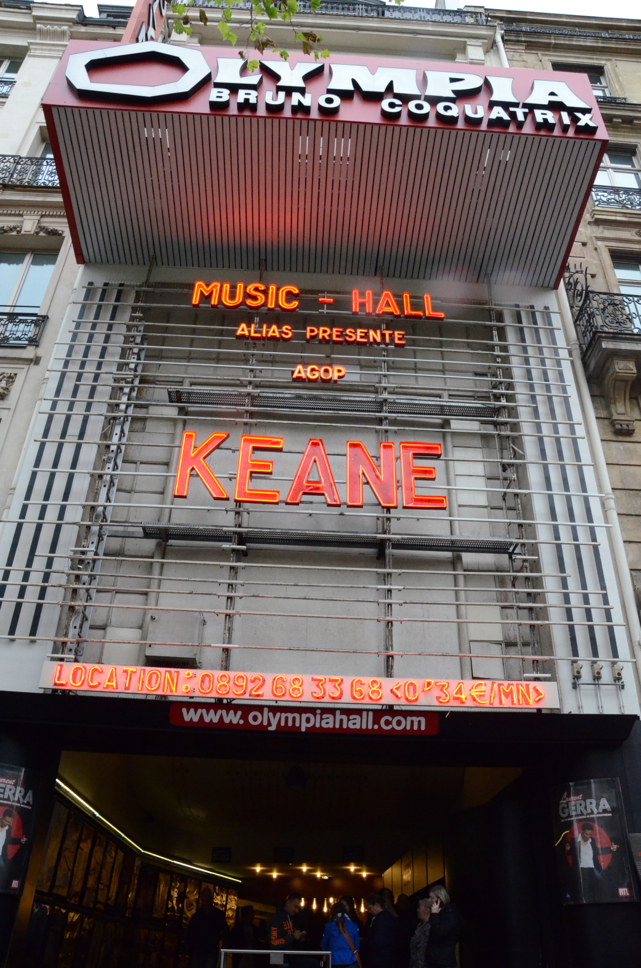
Keane, however have quite stubbornly ignored all of this. At the elegant but cavernous L'Olympia in Paris on Wednesday night, the only appearance of a guitar was the red Telecaster singer Tom Chaplin strummed along to Neon River, off their latest album Strangeland.

From the outset of their career, Keane have built their entire musical proposition around the piano of principal songwriter and keyboard player Tim Rice-Oxley, and one piano in particular. And here, forgive me a brief diversion into the realms of trivia. For, I strongly suspect, there is another band, who also started out in the somewhat blue-blooded environs of southern England, to thank for the Keane signature sound.

Banks of keyboards. Ho and, indeed, ho.
In the middle of their transformation from progressive rock giants to American FM radio-friendly...er....giants, Genesis made an album called Duke. Marking the acquisition of a more pop-rock sensibility than their former extensive forays into the ethereal, Duke - released in 1980 also marked the abandonment by keyboard player Tony Banks of the grand pianos, Moogs synths, Mellotrons and Hammond organs that had marked their territory and, essentially, defined prog rock in the 1970s.

On an album of notably shorter, poppier songs, Banks made liberal use of the Yamaha CP70 electric piano. You may not know or even care about the CP70. But it became one of the most important tools of the trade in the 1980s, it's distinctive "tinkly" sound turning up everywhere (think Alive & Kicking by Simple Minds or Peter Gabriel's In Your Eyes).

With this change of tone, Genesis started noticing women at their concerts. And hit singles. Their albums sold in the millions, and then in the multi-millions, the result of adopting bright, breezy English pop-rock. Rice-Oxley was clearly listening. Because the CP70 has been Rice-Oxley's - and, therefore, Keane's - principal instrument and defining sound.

Traces of Duke-era Genesis DNA can be found throughout their earlier albums, including Hopes & Fears, widely hailed as one of the best debut albums by a British band in decades and containing the likes of Somewhere Only We Know and Bedshaped.

Picture: Keane/Facebook
Live, Keane are a pleasant anomaly. The somewhat gauche, public schoolboyish intensity that characterised their public emergence when Hopes & Fears took off in 2004 is still there.

The lanky Rice-Oxley is hunched over his CP70, stabbing away at its keys like Lucy's brother Schroeder in the Peanuts cartoons. "Cherubic" (contractually-obliged description) vocalist Tom Chaplin is still a mixture of polite choirboy and energetic rocker. Drummer Richard Hughes just gets on with drumming without superfluous percussive pyrotechnics, and bass player Jesse Quin does what most bass players do - keep pace at the back and try not to draw too much attention to themselves.

Keane are still in a hard to define area of rock. Or pop. Or pop-rock. Warming the audience up with Bruce Springsteen's Dancing In the Dark unfortunately conditioned the expectation. Springsteen has, on occasion, veered away from his trademark time card-punchin' denim-clad rock'n'prole with songs like that. With Keane you sometimes wish they veer away from songs like that and grow a pair. I mean that kindly.

They could rockout, but I suspect they don't because their audience just adores the rock-pop/pop-rock they stick to. Their live show isn't a great deal more raucous than their album work, but whereas their albums make perfectly pleasant living room listening, their relatively sparse, drums-bass-piano-vocals structure fills out the space of a venue as spacious as L'Olympia.


Neither anthemic Coldplay pomp nor vacuous Euro clapalong pop, Keane more than satisfied the enthusiastic French audience with a string of energetic renderings of You Are Young, Meet Me In The Morning, and Is it Any Wonder, the latter building around its circuitous rhythm, with Chaplin adopting that theatrical semi-lunge into the mic stand of his, giving him the appearance of a slightly fey-looking Damon Albarn from a distance.


Picture: Keane/Facebook
At various moments of the evening Chaplin declared Keane's love for France, which was inevitably rewarded enthusiastically by the partisan crowd, which included a set of parents with toddler in toe. You can interpret this either as a sign of Keane's unthreatening nature, or an apparent dearth of babysitters in the Paris area. She seemed to enjoy herself, nevertheless.

It's unlikely that you'll find Keane stretching into extended live versions of their hits. The likes of Everybody's Changing, This Is The Last Time, Bedshaped and Somewhere Only We Know lasted the length of the album version, albeit with passionate audience participation. Some bands, when they stick resolutely to recreating their album versions, do so with sterility.

Keane could easily just phone in their hits - and with a set of some 16 songs, you realise just how much they've produced in the 15 years since their formation, but live they put heart and soul into every note. And yet you still get the feeling that this is a band that is just getting going. Coldplay, the band to which Keane probably get compared to more than most, came together just a year before, and yet have already given us the impression that they've outlasted their welcome. On this evidence, Keane have got plenty left in the tank.


Friday, August 19, 2011

What will David Bowie do now?

In a recent posting to this whoopee cushion of laughs I call What Would David Bowie Do? I begged allowance for the regularity with which dead musicians get laid out on the mortuary slab of editorial examination.

So to change the mood a little, let's discuss retirement: earlier this week it was reported that the man who lends his name to this very blog "may" have reached for the pipe and slippers.

This isn't, generally, in the script. Rock stars are meant to die before they get old, or rock on until they drop.

Nowhere does it say that they should, at a certain moment, chuck it all in for a gold carriage clock and the chance to work on their allotments, or to take up Crown Green Bowls.

However, it can't be ignored that our rock stars are getting on a bit. The Rolling Stones now have a combined age of 264. Mick Jagger, at 68, is still prancing around like someone a third his age (or, roughly speaking, the same age as Ronnie Wood's latest girlfriend), while Keith Richards (67) continues to defy all known terrestrial medical science by simply being alive. There have been rumours for a while that the Stones might be planning one last hurrah of a tour to celebrate their 50th anniversary, but so far nothing.

Retirement was, nevertheless, an option pursued by 60-year-old Phil Collins, who announced earlier this year that he’d hung up his drumsticks for good. This was partly because of a chronic back problem which meant he could no longer hold his drumsticks without having them taped to his fingers (which probably means he's off Chinese food now too). Collins also wanted to focus on bringing up his two young sons, while at the same time spending more time with his model trains and bizarre obsession with the Alamo (the battle, not the car rental company). All fine, I suppose, but it shouldn't be forgotten that drummers generally don't retire. As Spinal Tap once explained, drummers expire in bizarre gardening accidents or on-stage explosions. Or in the case of Keith Moon and John Bonham, caning it.

So what about David Bowie? According to Paul Trynka, author of this year's excellent biography Starman, The Dame might not record again. “My heart says he’ll come back,” Trynka told Spinner, “but my head says he’s likely not to.  I think he would only come back if he thinks he could deliver something that will be seismic. It would be a bit of a miracle if he comes back, but miracles do happen."

Bowie certainly hasn’t released any new material since Reality in 2003, with the exception of an unofficial 'lost' album, Toy, which was leaked on the Internet earlier this year. At the end of Bowie's 2004 tour he underwent an emergency angioplasty for a blocked artery. While hardly a career-ending procedure, his public appearances have been sporadic and few ever since, and there has been no sign of his Thin White Dukeness visiting a recording studio.

If, at 64, Bowie has scaled things down, he will certainly be living comfortably off the royalties of his considerable back catalogue. This is the rock star's pension plan. Long after you've decided to leave behind the touring, the 48-hour studio sessions and the cocaine lifestyle, you can at least be assured of royalty cheques dropping through the letter box from record sales and radio airplay in far-flung places.

Perhaps ironically, one of the few public performances David Bowie has made since 2004 was to join David Gilmour on stage at London's Royal Albert Hall in 2007 for a performance of Pink Floyd's Arnold Layne. It was a tribute to Syd Barrett, who'd written the song and had passed away the previous year. Long after the madcap Barrett's sad reclusion from society, Gilmour - who had replaced him in Pink Floyd - continued to ensure he received his royalty cheques at his semi-detached suburban Cambridge home. Legend has it that they had gone uncashed for a number of years.

For the rest of us, unfortunately, we don't have such a lucrative legacy to draw from in our dotage. Indeed, the idea of retirement is an increasingly distant one, thanks to the global financial turmoil which is squeezing private and national pension plans. Inevitably, many of us from the baby boom and post-baby boom will be expected to work, like seaside donkeys, well beyond current statutory retirement age. Unless we are lucky enough to have 43 years of albums to sustain us - which pretty easily answers the question: what would David Bowie do?