Showing posts with label Keith Richards. Show all posts

Saturday, September 21, 2013

Just kidding: Liam Gallagher's greatest pearls of wisdom


A recent binge-watch of Simpsons episodes led to the sharp conclusion that Nelson Muntz, Springfield's teenage miscreant-in-chief, reminded me a bit of of Liam Gallagher.

Like Muntz, Liam has established himself as resident school playground thug, with his swagger, faux menace and daft proclamations about, well, anyone. All he lacks is the high-pitched mocking "Ha-ha!" of his cartoon prototype.

But as Gallagher Junior today celebrates his 41st birthday,dealing with being kicked out of the family home by wife Nathalie Appleton in the wake of allegations that he fathered a child with a Rolling Stone journalist, What Would David Bowie Do? thought it would cheer up the whole miserable mess by reminding you of why, like José Mourinho, Liam is immensely quotable. 

So, here's Our Kid on…

Pete Doherty: "Needs a slap, and the sooner he gets it, the better."

and: "What does the word Libertine mean? Freedom! He's in the corner doing smack with a helmet on his head. There's nothing free about that. It's nasty."

Coldplay's Chris Martin: "I don't hate him. I don't know him, know what I mean? I just think he's a bit giddy. He ought to calm down, he isn't going to save the world."

And [Chris Martin]: "Looks like a geography teacher."

Ageing: "I've mellowed, but not in the sense of liking Radiohead or Coldplay."

Coldplay & Radiohead: "I don't hate them, I don't wish they had accidents. I think their fans are boring and ugly and don't look like they're having a good time."

Radiohead: "Them writing a song about a fucking tree [The King of Limbs]? Give me a fucking break! A thousand year-old tree? Go fuck yourself!"

Robbie Williams: "I'd like to fucking hang Robbie Williams onstage. What's he done to me this time? Nothing. He's just somebody I'd like to hang."

And: "[Robbie Williams] "He's a fucking drama queen. You make a crap album then want everyone to feel sorry for you. Tosser!"

Bono: "You see pictures of Bono running around LA with his little white legs and a bottle of Volvic and he looks like a fanny."

Mumford & Sons: "Everyone looks like they’ve got fucking nits and eat lentil soup with their sleeves rolled up. They all look like they live on the heath. Maybe that’s where they record. Everyone’s fucking Don McLean — far too many acoustic guitars, no style. They look like they shop at Oxfam."

One Direction: "I like them. Fair play to them. Why not, man? They haven’t got a fucking clue either. I met them at the Olympics and their heads were up their ar*es, but they’re harmless."

Florence Welch: "I’m not having anyone with ginger hair making music. She sounds like someone has stood on her foot."

Gorillaz: "Like three-year-olds’ music — worse than Steps."

Victoria Beckham: "She can’t even chew gum and walk in a straight line, let alone write a book".

Kanye West: "If I ever win any more fucking awards I'd personally invite him to get up and fucking take my award of me. I fucking tell you that... That was rude when he did that to that girl, that Taylor Swift. So yeah, give me an award and see where it goes. It will roll out of his fucking arse."

Muse: "Muse fucking scare me. They're like fucking creepy shit. But people like 'em. They at least play guitars, but when I hear his voice I'm like, Ah, fuck him."

Scissor Sisters: "Bright colours and fucking weirdos on stilts? I'm more entertaining than that shit."

Franz Ferdinand: "You look at [Alex Kapranos] and the singer from Right Said Fred. It's the same person! he's just gone on the Atkins diet and grown his hair."

Billie Joe Armstrong (Green Day): "Fuck right off. I'm not having him. I just don't like his head."

La Roux: "No way, mate. She's got man hands."

On the Blur reunion: "I'm right into it, [because] it'll finish off the Kaiser Chiefs and put them to bed. There's nothing worse than a shit Blur."

Bloc Party: "They remind me of a band off University Challenge. Like they’re sitting on a panel."

Keith Richards & George Harrison (in 1997): "They're jealous and senile and not getting enough fucking meat pies".

Mick Jagger: "I don't think singers who start off singing should play guitar. It looks fucking stupid."

Amy Winehouse & Pete Doherty (as a couple): "I don’t give a fuck about her, I don’t give a fuck about the other dick and I don’t give a fuck about any of 'em".

Jack White: “The White Stripes? Fooking rubbish. School ties? At the age of 24? Fooking hell."

Ozzy Osbourne: "How come everyone thinks he’s great? He’s a bit of a fooking mong, if you ask me."

The Beatles-vs-God: "It's got to be being in The Beatles. When was the last time God made a decent record?"

Noel Gallagher: "Shitbag".

Thursday, August 8, 2013

If the blues was money, I'd be the richest man in town

Well, my mother told my father, just before I was born,
"I got a boy child comin', he's gonna be a rollin' stone"

Some call it an urban myth, others a lie, and a few more simply a colourful tale.

But the legend that the Rolling Stones turned up at 2120 South Michigan Avenue, Chicago - the Chess Records studio - in June 1964 to pay homage to their musical godfather, Muddy Waters, only to find him outside painting the exterior, is bunk. So says Buddy Guy, one of the last of the "original" Chicago bluesmen, who countered the tale in his autobiography When I Left Home last year: 

"When the Rolling Stones came to Chess Records in 1964, they started telling everyone — and even wrote it up in books — that they saw Muddy Waters standing on a ladder where he was whitewashing the walls. They said the Mud had whitewash all over his face. For years Keith Richards repeated this story. His point was that Leonard Chess was using poor Muddy as a handyman. Leonard and Muddy are long gone, but I was there — and so was Marshall Chess — and we both know know this ain't true . . . Muddy had put Chess on the map."

Waters has, sadly long gone. As has Chess Records, now just a famous record label within the 'catalogue' of some entertainment conglomerate or other. But their collective legacy lives on. The Stones are still rolling, of course, and rolling in it, too (estimates suggest their recent tour plus the five shows they staged last November and December will have grossed around $150 million).


The Chess studio, where the Stones recorded their first UK No.1, It's All Over Now, is still there, but is now home to the Willie Dixon Blues Heaven foundation, a charity established by Dixon's family to maintain a link to the role 2120 South Michigan Avenue played in the evolution of modern music.

The studio has become a presentation theatre, where an introductory video featuring interviews with Buddy Guy, John Lee Hooker, Mick Jagger, Marshall Chess (son of the Polish immigrants Leonard and Phil Chess who co-founded the label) and others put context around the blues, its migration from the South and its influence, especially on suburban Englishmen growing up many hundreds of miles away.


Kevin, the tour guide, somewhat rolls his eyes when I bring up the so-called British invasion. "It was something they just latched on to," he says. Trying to understand what it was that invaded the teenage lives of Jagger and Richards, Eric Clapton, Ray Davies, Steve Winwood, Jimmy Page and countless more is like trying to trace the source of the Nile.

He's polite about it, but you get the hint of an understandable frustration that these nice, mainly middle class white guys from Kent, Surrey and the London suburbs have coined it in by exploiting a form of music, and those who spawned it, which began in the poverty of the rural south, and moved north to Chicago to find a living.

As an example, Kevin commences his introduction to the presentation by asking if we'd heard of a 1962 Muddy Waters song, written by Willie Dixon, called You Need Love. Embarrassingly, blank faces all around. So perhaps its opening lines might jog the memory:

You've got yearnin' and I got burnin'
Baby you look so sweet and cunning
Baby way down inside, woman you need love
Woman you need love, you've got to have some love
I'm gonna give you some love, I know you need love
Charge it up a tad, add a Fender Telecaster and fuzzbox riff played by Jimmy Page, and you've got Led Zeppelin's Whole Lotta Love. In 1985 a court agreed, and ruled in Dixon's favour. Robert Plant has since 'fessed up: "I just thought, 'well, what am I going to sing?' That was it, a nick. Now happily paid for. At the time, there was a lot of conversation about what to do. It was decided that it was so far away in time and influence that...well, you only get caught when you're successful. That's the game."

Led Zeppelin weren't the first British band to rework Dixon's original song: in 1966 the Small Faces recorded it as You Need Loving. Perhaps, then, Kevin's coolness towards my mention of the British Invasion is quite understandable. For 50 years, white Englishmen have been coining it on the back of music that hardly paid its originators a cent.

Musical plagiarism is, however, not only a thorny issue, but in the blues it is also highly grey. Even Waters' Rollin' Stone has its origins in the even earlier Catfish Blues. When the blues travelled north to Chicago during the 'Great Migration', Waters, John Lee Hooker, Big Bill Broonzy and all the others brought with them notes and riffs blended from folk, gospel and traditional spiritual. Blues and its more refined cousin jazz, has always been derivative. But then isn't that the case of all music?

The politics of exploitation notwithstanding, standing in what was the Chess studio is, like my visit to the Sun Studios in Memphis, something of a religious experience. The sound baffles and control room electronics have long gone, but the pictures of Waters and other memorabilia, together with Kevin's story, are essential elements in keeping alive the heritage of a musical evolution that led not only to rock music, but by turns, R&B, funk, rap and Chicago's other musical speciality, house.


I was born in the Royal Borough of Kingston-upon-Thames. As a 15-year-old, Eric Clapton would come to Kingston's riverside pubs to play Broonzy songs like Key To The Highway, and Robert Johnson's Crossroads Blues. In neighbouring Richmond, the Stones made their name at the Crawdaddy Club at the Station Hotel. Down the road in Kew were The Yardbirds - with the slightly older Clapton and, later, Jimmy Page from nearby Epsom and Jeff Beck from Carshalton.

To these leafy districts of south-west London on its border with Surrey, the music that Broonzy, Johnson, Waters, Hooker, Dixon and so many more dragged to Chicago from the sweat of the South found a home, giving birth to legends that would turn this simple and, at its best, primitive guitar music into a worldwide industry.

Chicago, to some, might be as much today about deep-dish pizza, the Cubs and the new corporate headquarters of Boeing, but to me it's about one thing. And while the tour of 2120 South Michigan Avenue may not be as rich a museum experience as Sun Studios or Graceland, its simplicity and sparsity, and its role in telling the story of Chess, Waters and Dixon, make it as culturally important as anything the Windy City has to offer. That one thing - blues music, and what it gave to the world.

Tuesday, May 28, 2013

He's in the best-selling show: David Bowie is... at the V&A


When the brain starts wondering about the enormity of the cosmos there gets to a point that you have to give up. Because try as you might, the human brain is just rubbish when trying to figure stuff out like what existed before The Big Bang. And what started it. Or whom.

And as if that doesn't render you cross-eyed, scientists now hint that there may even be more than one universe, and that space and therefore everything we know about it has no boundary. Which only gets worse when you start to contemplate what - if anything - existed before the Big Bang and how we went from bugger all of anything to, well, all of this.

The idea that before The Big Bang there was nothing, some more nothing, lots more nothing, and then something, is a little like life up until January 8 this year, when the world encountered a space oddity of its own. For early in the morning of David Bowie's 66th birthday, an extended period of nothing and more nothing suddenly became:


That surprise was, of course, something arguably more important than the creation of all matter - the totally  unexpected return of Bowie from almost a decade-long exclusion from public life, a period in which many had even contemplated the termination of one of the most talked about, analysed and theorized artistic careers in human history.

That may sound like hyperbole but, with the exception of The Beatles, there really has been no other artist to have been placed under the microscope quite as forensically. Which, I suspect, is partially what he wanted.

In the BBC's epic new documentary Five Years, which made its bow on Saturday night, Bowie is seen in the early 1970s castigating an interviewer for calling him a rock star: "I'm not - I'm not in rock'n'roll", describing elsewhere that "I feel like an actor when I’m on stage, rather than a rock artist." You could almost hear Keith Richards, somewhere, expectorating that bronchial cackle of his, mocking the apparent pretence of such a statement.

But, then, there has never been an artist with such a well-developed sense of identity and understanding of the value of evolving it. Madonna may have reinvented her image countless times, but these have been mere costume changes. Bowie, on the other hand, has repeatedly regenerated as and when the artistic whim has taken him, from frizzy-haired folkie to Ziggy, porcelain-skinned, emaciated cokehead to Philly soulboy, early pioneer of contemplative avant-garde ambience to inventor of New Romanticism - the list goes on.

Myriad books and the handful of Bowie documentaries may have captured these changes, and captured them well, but it has taken the David Bowie is... exhibition at London's Victoria & Albert Museum to curate them into a cohesive narrative.


From the moment you walk in you are presented with a soundbite of Bowie's own self-definition: "I could have been the Cockney Dylan", he is heard saying through the audio headset that accompanies your tour. It's actually some time before you see Bowie himself: at the entrance is a screen showing a black and white TV interview with Gilbert and George, talking opaquely about their art and looking more like a Vic and Bob piss-take than the feted artists themselves. Their appearance - and the lack of the exhibition's subject - is unnerving, but sets the scene that you are clearly not in for the usual rock memorabilia of a couple of cigarette-burned guitars, a knackered drum kit and the obligatory school report.

Instead, you get the story of this most complex of personalities, from his 1947 birthplace and initial childhood home in Stansfield Road, Brixton, to his formative years in leafy Bromley, through his teenage interests in American rock'n'roll, to his admission into the Mod world, hanging out in Soho with friend and fellow (or rival) Mod, Marc Bolan, before taking the obligatory art school path to full adulthood for almost every major British musician of the same generation.

But, as David Bowie is... richly illustrates, what happened next was anything but conventional, as he adhered himself to "using rock'n'roll as a medium", a platform for the characters he would embody as he transformed David Robert Jones into - as the BBC Nationwide reporter Bernard Falk disparagingly referred to him - a "bizarre, self-constructed freak".

Those characters - Ziggy Stardust and numerous variations on the detached alien theme - are all brought together by the V&A's Victoria Broackes and Geoffrey Marsh, who were given largely unrestricted access to the David Bowie Archive. 

The resulting display is a fascinating array of more than 300 individual items, including original handwritten lyrics to songs like Rock'n'Roll Suicide, or the studio instrument hire order for the Space Oddity session. Though items like these are fairly typical of the music retrospective, the minutiae of detail across such smaller exhibits illustrates the exhaustive thought put in by the V&A team to telling the Bowie story.

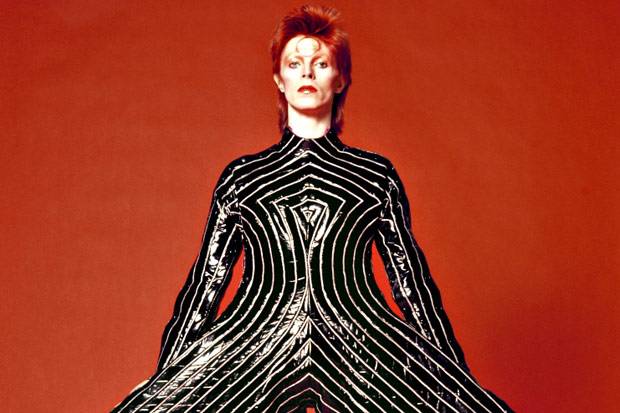
The exhibition's highlights are, inevitably, those items most associated with Bowie's numerous images - the Ziggy Stardust bodysuits (including the one worn on Top of the Pops for the groundbreaking performance of Starman), the Union Jack frock coat by Alexander McQueen and worn by Bowie on the Earthling cover, and the Pierrot costume from the Ashes To Ashes video that pretty much launched New Romanticism.

Abstracted from their original context, be it live performances, television appearances or promotional films, they not only lack animation but also the colours that, on TV seemed so vibrant. Shoes and boots look larger than they should be (friends have commented on how relatively small Bowie's feet are). The freakiest show, if you will allow me.

David Bowie is... evolves as the artist himself has, moving through the obsessions and fascinations, concepts - good and bad, the evolution of video as a music medium, the inevitable development of an acting career, and the haircuts. The many, many haircuts.

As you reach its conclusion you arrive in a giant, video-walled chamber showing clips of Ziggy and the Spiders which argue the strong case that behind the performance artist has always been a performer of an inventiveness and charisma matched by few, and even then we're talking stage talents as rare as Jagger or Presley.

And, just as Bowie himself this year reminded us, as you think you've had your lot, there's one more section, a coda to the whole experience, which, via near-silent video footage of a photo session some years ago, shows Bowie strumming a vintage guitar, pulling Gene Vincent and Elvis poses. Singularly, and without costume or accompaniment, he ends the exhibition of his own career with a fascinatingly simple explanation of what the fuss is all about.


David Bowie is... continues at the Victoria & Albert Museum until August 11. Although all advance-booking online tickets have sold out, tickets can be bought at the V&A if you go in person to the ticket desk before 10am each morning. Full details of ticketing can be found on the V&A website.

    Sunday, March 31, 2013

    One foot in the grave

    If the arrival of David Bowie's new album seemed unlikely, given concerns he was in the throes of terminal illness, the release of a new album from Jimi Hendrix is even more improbable, seeing as he's actually been dead since 1970.

    Still, it being Easter Sunday and all, it seems slightly fitting to draw attention to the fact that the ephemeral guitar legend has in fact released a brand new record, more or less.

    People, Hell & Angels is, clearly, posthumous. I have seen Hendrix's memorial slab in a suburban Seattle cemetery and was pretty convinced he was lying beneath it.

    It is, though a collection of 12 tracks 'rescued' from the vast vaults of material curated over by the Hendrix family corporation, and the latest of several albums and films that have been released in recent years to further mine the guitarist's brief but extraordinarily prolific career.

    Thus, this isn't the first album Hendrix rarities to be released and I doubt it will be the last, either, considering that he shuffled off this mortal coil with hundreds of hours of material in the vaults, some of it experiments and most of it even now yet to see the light of day.

    The trouble with posthumous releases is that often don't quite deliver on what they promise. When The Beatles released Free As A Bird in 1995 there was a certain disappointment at the development of an old Lennon home demo into a latter day Beatles single, over-produced by Jeff Lynne, no to mention the thought that it was a somewhat cynical attempt to shift more copies of the Anthology box set.

    People, Hell & Angels is, thankfully, nothing like that. It does, inevitably, sound like a collection of offcuts, but that doesn't make it bad - this is still Jimi Hendrix. But after four decades, you can't help wondering if these tracks had been unreleased for a reason.

    It should also be pointed out that many of the tracks on the album have appeared in some form previously: Earth Blues was included on a posthumous 1997 release, having been originally recorded for a planned fourth album by the Experience; Somewhere was on the sumptuous purple box set, The Jimi Hendrix Experience, 13 years ago;  and Bleeding Heart, Izabella, Easy Blues, Crash Landing and Gypsy Boy have all appeared on other posthumous albums. Indeed, only Let Me Move You is actually properly 'new',

    So that's the 'picky' bit. The fact remains, this is a Jimi Hendrix record and is therefore very good, with pristine production that belies the 45 years most of the tracks have been sitting in storage somewhere.

    Released to sort of coincide with what would have been Hendrix's 70th birthday last November, People, Hell & Angels' recordings all date back to an experimental phase in the guitarist's career between 1968 and 1969 when he was experimenting with different musicians and musical textures.

    Having released Electric Ladyland, Hendrix was itching to get a fourth album under his belt, in particular breaking some of the restraints he'd felt the Experience format had placed on him. The restless culture of the time was also encroaching on his own restlessness, and the wider circle of musicians playing on these sessions brought about a noticeably broader sound.

    Organ, brass, even Harlem funk, such as Mojo Man (with Albert Allen on vocals) indicate a magpie-like Hendrix picking away at the shiniest baubles of the scenes he engaged with in New York. There are nods, too, to Stax, with the jam Let Me Love You featuring legendary bandleader Lonnie Youngblood on vocals and Mar-Kays-style sax workouts, so much so that Hendrix's guitar is almost reduced to a supporting player.

    With so much of Hendrix's career, life and, of course, demise, pegged to London, there's also a taste of the influences the British capital was bringing to bear on the guitarist, with echoes of Cream and Eric Clapton's next project, Blind Faith, coming through on Earth Blues.

    There is no shortage, either, of the blues that drew so much initial attention to Hendrix. Izabella chops about at a frenetic pace, while Easy Blues finds Hendrix swinging along, cabaret style, with his Stratocaster playfully sparring with the jazzy backing. Here My Train A Comin' is a looping, near-six-minute blues stomp, while Somewhere - featuring Stephen Stills on bass - takes the guitarist into woozy, pleasantly sleazy territory, his wah-wah pedal providing distinct Hendrix phrasing to a sweaty, club-like workout.

    Hendrix may have been trying to go in different directions with the tracks on this album, but in truth doesn't stray too far. There is plenty of value and enjoyment to be had, however. It might feel like you've stumbled in on an extended jam session (which, let's face it, didn't bother Neil Young's Psychedelic Pill last year), but that is what makes listening to Hendrix - posthumously and 40 years on - still such an unbridled fun.

    And a little frustrating. To think that, prior to these sessions, it had only been two years before that Keith Richards' then-girlfriend, Linda Keith, had heard Hendrix playing in a New York club, and, eventually via Richards and Rolling Stones manager Andrew Loog Oldham, the guitarist found his way into Chas Chandler's management, that the Jimi Hendrix we have come to revere came into being.

    People, Hell & Angels, then, performs a somewhat superfluous task in perpetuating the Hendrix legend.  He was, simply, the most gifted guitarist in history, and few people would ever challenge that assessment. This is an album for completists, for sure, but do not dismiss it as a curious snapshot of what Jimi Hendrix was trying to do next before he died at the age of 27 in a Notting Hill flat, having overdosed on barbiturates.


    When I visited Hendrix's grave in Renton, Washington, in 1998, it was a simple slab, lying next to his father's plot, and featuring the outline of a Stratocaster and a simple inscription. I believe there's a more elaborate gazebo-type construction there now, to which Japanese tourists flock by the busload, but when I was there that drizzly Sunday morning, the only other person in the cemetery was a solitary widow tending the grave of her husband.

    The point is, that simple inscription reminded me how mercurial Hendrix was in life, but what an incredible body of work he crammed into the three years he was a recording artist. The fact that thousands of hours lie somewhere is mind boggling.

    Having stood graveside that Sunday, it is weird to be able to go into a record shop today and buy a new album from Jimi Hendrix. But is is also a privilege.

    Tuesday, December 18, 2012

    It's great to be here, it's great to be anywhere - Keef turns 69


    Britain's Daily Mail, a newspaper you can regard with varying degrees of editorial pointlessness, surmised in June that Keith Richards - the Human Riff, the Human Lab, and a dozen other nicknames reflecting both guitar prowess and indestructibility - was now so broken, so ravaged by arthritic hands and addled memory that he was finding it hard to perform.

    Almost in unison, a section of the paper's permanently seething readership waded in with a barrage of reaction, some berating Keef for even being alive, others suggesting the Rolling Stones had ended their relevance a long time before and should now just give up.

    This may go some way to explain why, when the band announced their four 50th anniversary shows, a nuclear mushroom cloud appeared above Middle England as concerned representatives of the Mail's readership turned apoplectic at news Richards, Jagger, Watts and Wood - with a combined age of 273 - were to roll once more.

    Well, today we can make that 274, as Richards chalks up his 69th birthday. It's an unlikely milestone, even he'll admit. This apparent freak of nature, who only gave up hard drugs eight years ago, has, for the best part of adulthood, tested human pharmaceutical endurance to its limits while seeing so many contemporaries succumb to rock's lethal distractions. He is at a loss to explain how he has survived and others didn't. Perhaps he should just say "pleased to meet you - hope you guessed my name".

    Much of Richards' homespun philosophy can be found in his brilliant book Life. A stupendously refreshing read, Life tells Keef's story with well managed honesty and  little obvious  attempt at embellishment, either of the hard truths or the apocryphal tales. It is an engagingly rich story of a boy emerging from London's bombsite-ridden suburbs to embrace the music of America's impoverished south, turning such an unlikely affection into the spiritual heart of the most famous - some maintain greatest - rock and roll band of the last 50 years.

    That's an accolade that welcomes challenge: bands have come and bands have gone. "Every generation throws another hero up the pop charts", sang Paul Simon, and the Stones have faced plenty of competition. They've also faced plenty of challenges of their own, not least of which the sibling fractures between Richards and Jagger that have seen them fight, tussle and, seemingly, fall apart irreparably on regular occasions.

    Something, however, has always brought them back together again. Richards has always maintained that he and Jagger share a true brotherly love, a bond that occasionally breaks. In his words, Richards has, though, tended to paint Jagger as the more nefarious Glimmer Twin, the posher of the two middle-class Dartford boys, the Stone with the business sense and, now, the knighthood.

    Richards, on the other hand, has frequently played up his image as the Stones' pirate captain, the rock'and'roll rogue: unpredictable and possibly dangerous, like John Belushi's character Bluto in Animal House, but beneath it all, fundamentally a good guy.

    For a while - particularly in the wake of John Lennon's murder - Richards regularly carried either a knife or a gun, or both. He's not the Stone to be messed with by any order. Just go to YouTube and find the memorable clip from their 1981 tour, when Keith sees a fan jump on stage and starts charging towards him and Jagger (who deftly takes a swerve), removes his Telecaster by the neck and hacks the fan to the ground before strapping the guitar back on to continue playing. "The cat was in my space," said Richards, matter-of-factly, "so I chopped the mother down". That's why you've got to love Keith. Liam Gallagher may have looked like he could do something like that, but you suspect only Keith Richards would.

    Over the last few months I have been immersed in the Rolling Stones. Whatever commercial voodoo they performed around their 50th anniversary has clearly worked. I've bought their book and visited the Somerset House exhibition of the book's photographs; I've acquired Blu-ray Discs and DVDs of them in concert in the 70s, 80s and 90s, of them jamming with their great hero Muddy Waters, in the brilliant Stones In Exile documentary, and setting new records on the Bigger Bang tour. And I've spent a frustrating 30 minutes attempting to blow what's left of my life savings on a ticket to one of - any of - their London and New Jersey shows. Somewhere there is a bulldozer with a tongue logo on it shovelling cash into four or five large piles.


    While this accumulation will be due in part to Sir Mick Jagger's assumed stewardship of Rolling Stones Inc. (actually, a Dutch-registered public limited company called Promotone BV which holds its annual company meetings in the curious-to-say-the-least location of Amsterdam), the company's Chief Riff Officer and CEO Jagger's fellow Wentworth Primary School, Dartford, alumnus, Richards, might be comfortable with his rewards, but remains at his happiest strumming a blues in an open D tuning.

    These last few weeks, the more Stones material I've been exposed to, the more I've come to appreciate their music, especially its subtlety. That is not a word you associate with the Stones, who've often been regarded by music snobs as a Premier League Status Quo for the chugging, thumbs-in-belt-loops-ahoy boogie of Honky Tonk Woman, or the cringeworthy street patois of Miss You, and it's equally abhorrent disco beat.

    But then listen carefully to Sympathy For The Devil, Paint It Black or Gimme Shelter, or some of the live standards like Monkey Man or Tumbling Dice or Midnight Rambler, along with lesser known gems hidden away on their 26-odd studio albums. Why, even more recent fare like Love Is Strong and Doom And Gloom - knocked out in a Paris studio over a couple of days - still deliver the goods as far as Rolling Stones songs go.


    You could say that for half their careers, the Rolling Stones have faced calls to quit on the grounds that they're too old. Keith Richards, at 69, may be today a more avuncular version of his former self, with his clean living and throaty, bronchial laugh (not to mention his parodic turn as Captain Jack Sparrow's father in the Pirates of the Caribbean franchise - with Johnny Depp happy to admit Sparrow was based on Richards), but he and his ageing band have endured.

    That endurance has come from tampering little with the brand: The Beatles started out as rock and rollers before discovering psychedelia and inventing progressive rock; The Who applied a rock edge to Tamla Motown; Led Zeppelin deconstructed and then reconstructed the blues; but the Stones are and have always been the Coca-Cola of rock.

    Sure, like Coke (Classic anyone?) they've taken a few ill-advised diversions, but today the Stones remain, pretty much, the same thing enjoyed by each generation that has come across them. Snobs blame this absence of variety on a fairly limited musical spectrum, but much of this is down to Keith. It is, mostly, his songs and riffs that have dictated the Rolling Stones musically.

    Richards might have willingly - and at times, to his patent regret - left the running of the band to Jagger, but the spirit of the Stones, the heart and soul of the Stones belongs to him. It was Keith, not Brian Jones who found the triangulation point between the Mississippi Delta, Chicago and London. It was Jagger who then took the concoction and turned it into something more exotic, more 5th Avenue than Dartford High Street, like Levi-Strauss turning workwear into the most enduring fashion item of modern history.


    But that's why we love Keith. If he has pretensions and delusions of grandeur, he keeps them well hidden. He has amassed a fortune, and his properties display copious evidence of his wealth, but unlike the apparent airs and graces of his writing partner, Richards doesn't overplay the finer things in his life.

    To see him on stage today, earnestly toiling away on his collection of Telecasters and other luthiered exotica, is to see a master craftsman at work. He may never be a virtuoso in the manner of a Clapton, a Beck or a Page, but I don't think he particularly cares. And nor should you. Happy Birthday Keith.


    Tuesday, December 11, 2012

    Remembering Mr. Pitiful


    Early one May morning in 1965, Keith Richards woke up in his St. John's Wood flat with a three-note riff in his head. He grabbed a cassette recorder and an acoustic guitar and quickly committed the riff to tape before going back to sleep. Or so he thought.

    "Thank God for that little Philips cassette player," Richards recalled in his autobiography, Life. He knew he'd put a brand new tape in the night before, but on inspection, saw that the tape was at its end. "Then I pushed rewind and there was [I Can't Get No] Satisfaction," and, he explains, 45 minutes of snoring.

    "It was just a rough idea," Richards remembered, "the bare bones of the song, and it didn't have that noise." That noise being the demonic Gibson fuzzbox-fed sequence of notes that would become the Rolling Stones' signature song.

    Mick Jagger recalls that his Glimmer Twin's original sounded more country on the original acoustic guitar-played tape. "It didn't sound like rock. But [Keith] didn't really like it, he thought it was a joke... He really didn't think it was single material, and we all said 'You're off your head.' Which he was, of course."

    Richards' dissatisfaction with Satisfaction was that he felt the riff should, in fact, have been performed by horns rather than a guitar. Two months after a horns-free Satisfaction was recorded for posterity - and acclaim as one of the greatest pop songs ever - Georgia-born soul and blues singer Otis Redding walked into Stax Studios in Memphis to record, over the weekend of July 9, 1965, his third album, Otis Blue.

    Amongst the songs - and at the suggestion of Booker T & The MGs guitarist Steve Cropper - Redding took a stab at Satisfaction Richards' guitar riff was replaced by a more upbeat brass fusillade by Wayne Jackson and the Memphis Horns. The song, dreamed up thousands of miles away in a North-West London apartment, was finally recorded as Keith Richards had imagined it.

    With a collection of Redding originals like Respect and I've Been Loving You Too Long and covers like Satisfaction, Sam Cooke's Change Gonna Come, Solomon Burke's Down in the Valley, and B.B. King's Rock Me Baby, Otis Blue established Redding as the undisputed King of Soul.

    It was, however, a throne he would continue to occupy for just two more years before - until December 10, 1967 - 45 years ago this week - when he tragically joined Buddy Holly, Jim Reeves, the Big Bopper and Ritchie Valens in a tragic line-up of early pop stars to die in plane crashes.

    Redding's Beechcraft Twin Beech plane - which he often co-piloted - was a symbol of his rapidly acquired business acumen.

    Unlike many of his blues and R'n'B contemporaries, who invariably had found themselves ripped off contractually and perpetually touring to pay off divorces and paternity suits, Redding had, by the time he died at just 26, built a portfolio of good investments, such as the plane and his beloved 'Big-O' ranch in Round Oak, Georgia.

    Born in the small Georgia town of Dawson (Pop. 5500) on September 9, 1941, the Redding family moved to the 'big' city of Macon, 100 miles away. At school, Otis discovered a talent for music, repeatedly entering a local talent show, winning its five-dollar prize 15 times before being barred from entering the contest further.

    By the age of 21, Redding had become a member of a local Macon band, Johnny Jenkins and the Pinetoppers. When they landed a recording session at Stax Records in Memphis, the tall, striking Redding managed to secure a solo recording for himself - which produced the ballad These Arms of Mine.

    Like the hits that followed - Try A Little Tenderness, My Girl, Mr Pitiful and I Can't Turn You Loose (later adopted by The Blues Brothers) - These Arms of Mine instantly captured Redding's strength: a formidable voice, seeped in the South's gospel, blues and even country music, that was both hopelessly romantic and rebelliously sexual at the same time.

    Satisfaction and Otis Blue catapulted Redding into another level of superstardom, notably a black performer challenging the pop charts at a time of continued segregation in America.

    As the '60s progressed - in all meanings of the word - so did Redding's career as he established his leadership of the soul movement, leading packaged tours of Stax artists throughout North America and Europe, touring along with protogées like Eddie Floyd, Carla Thomas and Arthur Conley.

    Redding made worshippers out of young British blues performers, like Eric Burdon of The Animals who became a close friend, and Pete Townshend of The Who, whose 'maximum R'n'B' maxim fitted perfectly with the sweaty soul that the elegant Redding had crafted in Memphis and exported across the northern hemisphere. Another disciple was schoolboy Peter Gabriel who, in 1967, travelled up from his outrageously exclusive public school, Charterhouse in deepest Surrey, to see Redding play in London.

    "I was extremely lucky, when I was 17 years old, to go and see Otis Redding perform at the Ram Jam Club in Brixton," Gabriel told ABC's Nightline in 2010. "When he came on, it was like the sun coming out. It was just this amazing voice, totally in command, great band, great grooves and passion that permeated everything." 19 years later, Gabriel repaid the impact Redding had had on him by releasing Sledgehammer, an unexpurgated tribute that even included Wayne Jackson and the Memphis Horns on the track.

    When The Beatles released Sgt. Pepper’s Lonely Hearts Club Band, on June 1, 1967, barely five years had lapsed since them recording the sugary I Wanna Hold Your Hand. And yet here they were with an opus of free-thinking psychedelia, that opened up and expanded people's minds in a way few recordings had done before. Otis Redding listened to it constantly as he took temporary accomodation on a houseboat on the other side of the San Francisco Bay in the hippy commune of Sausalito while playing a week's residency at the Fillmore West. Inspired by Sgt. Pepper and the body of water between him and San Francisco, he wrote his own signature song, (Sittin’ On) The Dock Of The Bay.


    Compared with the energetic oomph of much of his other songs, Dock Of The Bay was a gentle, simple song, musically and lyrically. A strummed guitar motif, which seemed to copy the gentle lapping of the cold bay's water against the houseboat, was married to the down-home story of Otis's life so far - "I left my home in Georgia, Headed for the 'Frisco bay". It became his biggest hit. And the last song he ever recorded.

    On the night of Sunday, December 10, 1967, while at the pinnacle of his career, Otis Redding's Beechcraft crashed into a lake in Madison, Wisconsin, while attempting to land at the nearby municipal airport. The crash killed Redding and four members of the Bar-Kays, his backing band. He was just 26-years-old and left behind his wife, Zelma and their three children Dexter, Carla and Otis III.


    "The irony of Otis Redding was his personal ambition to fill the gap left in the soul world by the shooting in 1964 of Sam Cooke," wrote Soul Music Monthly magazine in a tribute published soon after Redding's death. "In an all-too-short career he achieved that ambition — and achieved it so decisively that in the last four years no one has filled the even larger gap left by his own death."

    "His loss was all the greater because he was the man who turned soul from a minority interest in Britain into a major explosion," SMM added.

    There have been plenty of soul singers since - singers cut from the same southern traditions, white singers like Janis Joplin who have channeled the same vocal passion. But not even contemporaries like Wilson Pickett, James Brown, Eddie Floyd, Isaac Hayes, Ike and Tina Turner, Al Green, Marvin Gaye or Sly Stone came close to the lethal cocktail that Otis Redding perfected for the five short years of his career.

    "His death was a loss to the whole world," said Steve Cropper at the time, reflecting the sentiment of the entire 'Memphis Brotherhood'. "Nobody will ever know what he had in store for them. He was just starting to get into something. He was starting to get out of hard rhythm and blues. He went beyond that. He was hitting everybody all over the world."

    Redding's influence found its way far and wide: Peter Gabriel may have been hiding it while performing Supper's Ready in Genesis, but as a former drummer stimulated by 'groove', there was a frustrated soul boy fighting to get out of that prog rock titan. You could say much the same about Robert Plant - a blues singer performing heavy rock - he, too, was channeling the boy from Macon, Georgia.


    Otis Redding may have been a soul performer, but the southern blues were within him. The irony, however, of him covering the Rolling Stones' most famous song is that he helped turn them into an even bigger R'n'B band, still going 45 years after that fateful night in 1967.

    Saturday, October 20, 2012

    CP company - Keane, live in Paris:

    Picture: Keane/Facebook
    Let's face it, as rock music instruments go, the piano just isn't sexy.

    Sorry if you were put through hell as a child to achieve your Grade 6 piano certificate, but it really is just a piece of noisy furniture.

    No attempt to make it more interesting has ever worked. Chris Martin dawbing his Sunday school upright in right-on graffiti didn't do it either.

    And, as for bone-domed Jan Hammer, poncing about on TV with a keyboard strapped to him like a guitar while performing the Miami Vice theme, this was about as far removed "rock god" as it is possible to be.

    The guitar, on the other hand, is rock and roll itself; for its leading practitioners, it's an appendage, an extension and in some cases the distinction of themselves. BB King's vibrato is the most recognisable guitar technique in guitar history, and I would wager that most people would identify Eric Clapton, Keith Richards, Jimi Hendrix, Jimmy Page, Jeff Beck, David Gilmour and U2’s The Edge simply from a snippet of their guitar sound.

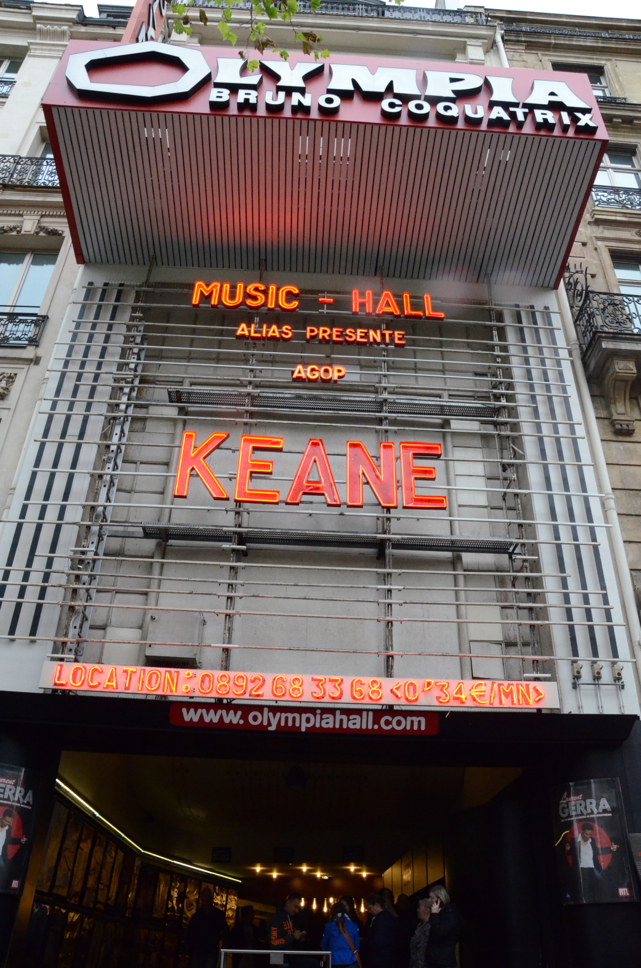
    Keane, however have quite stubbornly ignored all of this. At the elegant but cavernous L'Olympia in Paris on Wednesday night, the only appearance of a guitar was the red Telecaster singer Tom Chaplin strummed along to Neon River, off their latest album Strangeland.

    From the outset of their career, Keane have built their entire musical proposition around the piano of principal songwriter and keyboard player Tim Rice-Oxley, and one piano in particular. And here, forgive me a brief diversion into the realms of trivia. For, I strongly suspect, there is another band, who also started out in the somewhat blue-blooded environs of southern England, to thank for the Keane signature sound.

    Banks of keyboards. Ho and, indeed, ho.
    In the middle of their transformation from progressive rock giants to American FM radio-friendly...er....giants, Genesis made an album called Duke. Marking the acquisition of a more pop-rock sensibility than their former extensive forays into the ethereal, Duke - released in 1980 also marked the abandonment by keyboard player Tony Banks of the grand pianos, Moogs synths, Mellotrons and Hammond organs that had marked their territory and, essentially, defined prog rock in the 1970s.

    On an album of notably shorter, poppier songs, Banks made liberal use of the Yamaha CP70 electric piano. You may not know or even care about the CP70. But it became one of the most important tools of the trade in the 1980s, it's distinctive "tinkly" sound turning up everywhere (think Alive & Kicking by Simple Minds or Peter Gabriel's In Your Eyes).

    With this change of tone, Genesis started noticing women at their concerts. And hit singles. Their albums sold in the millions, and then in the multi-millions, the result of adopting bright, breezy English pop-rock. Rice-Oxley was clearly listening. Because the CP70 has been Rice-Oxley's - and, therefore, Keane's - principal instrument and defining sound.

    Traces of Duke-era Genesis DNA can be found throughout their earlier albums, including Hopes & Fears, widely hailed as one of the best debut albums by a British band in decades and containing the likes of Somewhere Only We Know and Bedshaped.

    Picture: Keane/Facebook
    Live, Keane are a pleasant anomaly. The somewhat gauche, public schoolboyish intensity that characterised their public emergence when Hopes & Fears took off in 2004 is still there.

    The lanky Rice-Oxley is hunched over his CP70, stabbing away at its keys like Lucy's brother Schroeder in the Peanuts cartoons. "Cherubic" (contractually-obliged description) vocalist Tom Chaplin is still a mixture of polite choirboy and energetic rocker. Drummer Richard Hughes just gets on with drumming without superfluous percussive pyrotechnics, and bass player Jesse Quin does what most bass players do - keep pace at the back and try not to draw too much attention to themselves.

    Keane are still in a hard to define area of rock. Or pop. Or pop-rock. Warming the audience up with Bruce Springsteen's Dancing In the Dark unfortunately conditioned the expectation. Springsteen has, on occasion, veered away from his trademark time card-punchin' denim-clad rock'n'prole with songs like that. With Keane you sometimes wish they veer away from songs like that and grow a pair. I mean that kindly.

    They could rockout, but I suspect they don't because their audience just adores the rock-pop/pop-rock they stick to. Their live show isn't a great deal more raucous than their album work, but whereas their albums make perfectly pleasant living room listening, their relatively sparse, drums-bass-piano-vocals structure fills out the space of a venue as spacious as L'Olympia.


    Neither anthemic Coldplay pomp nor vacuous Euro clapalong pop, Keane more than satisfied the enthusiastic French audience with a string of energetic renderings of You Are Young, Meet Me In The Morning, and Is it Any Wonder, the latter building around its circuitous rhythm, with Chaplin adopting that theatrical semi-lunge into the mic stand of his, giving him the appearance of a slightly fey-looking Damon Albarn from a distance.


    Picture: Keane/Facebook
    At various moments of the evening Chaplin declared Keane's love for France, which was inevitably rewarded enthusiastically by the partisan crowd, which included a set of parents with toddler in toe. You can interpret this either as a sign of Keane's unthreatening nature, or an apparent dearth of babysitters in the Paris area. She seemed to enjoy herself, nevertheless.

    It's unlikely that you'll find Keane stretching into extended live versions of their hits. The likes of Everybody's Changing, This Is The Last Time, Bedshaped and Somewhere Only We Know lasted the length of the album version, albeit with passionate audience participation. Some bands, when they stick resolutely to recreating their album versions, do so with sterility.

    Keane could easily just phone in their hits - and with a set of some 16 songs, you realise just how much they've produced in the 15 years since their formation, but live they put heart and soul into every note. And yet you still get the feeling that this is a band that is just getting going. Coldplay, the band to which Keane probably get compared to more than most, came together just a year before, and yet have already given us the impression that they've outlasted their welcome. On this evidence, Keane have got plenty left in the tank.


    Wednesday, August 22, 2012

    And in the end...


    A tweet caught my eye in the aftermath of the London Olympics closing ceremony. It raised the point: "What will organisers of events like this do a few years from now when they can't wheel out acts like The Who?".

    It was an interesting question. We're all very proud of our musical heritage in Britain, but the surviving members of the 60s beat and blues movements - half of the Beatles, half of The Who, four of the original Rolling Stones, as well as the likes of The Kinks, Eric Clapton, The Animals and others - can't go on forever. Not even Keith Richards.

    Still, they are around and, if The Who's performance at the Olympic Stadium was anything to go by, still a force. And Sir Paul McCartney's finale appearance at the opening ceremony may have suffered sound problems, but those who saw him on tour this summer have said that the 70-year-old gave some of his best performances as a solo act.

    50 years after the Rolling Stones made their debut at London's Marquee, there is still speculation that they have one more tour in them. Not bad considering their marathon, two-year Bigger Bang Tour - the last time they were all out on the road together - ended just five years ago.

    Having seen them twice at various times of that run, I can vouch that they were as impressive an actas at any time over the 30-odd years I've seen them live. Despite a dubious story in the Daily Mail a few weeks back claiming that Richards struggles to remember chords, I could imagine the Stones would still cause most other touring bands to swallow something hard and jagged with a show if they were to go out on the road again now.

    But at serious risk of writing the most middle-aged words I'm ever going to come out with, it's unlikely that any of today's X Factor-generation acts will be still in the public eye, let alone performing, 50 years from now. Jessie J may have been more ubiquitous at the Olympic closing ceremony than the stadium seating, but it says something that more was written about her performance of We Will Rock You with Queen than the three songs of her own she sang.

    Try as some might, there is no escaping the longevity of that brotherhood of artists who, inspired by Elvis and liberated by the ending of post-war gloom, finally, made American rock and roll, blues, soul and R&B their own and, in the process, made Britain center of the musical world for much of the 1960s.

    1962, in particular, was a significant year: little more than a month after that Stones gig at the Marquee, Ringo Starr took over from Pete Best as the drummer in The Beatles. Four days later - 50 years ago tonight - they made their own debut at Liverpool's Cavern Club.


    The irony is that today, August 22, represents something of a bookend for The Beatles. Because it was on this day in 1969 that the band held their very last photo session, at Tittenhurst Park, the Berkshire mansion that John Lennon and Yoko Ono had moved into just 11 days before. It's the same house in which Lennon would later record his Imagine film, which made a tearful appearance in the Olympic closing ceremony.

    Roger Waters has said that Dark Side Of The Moon was the beginning of the end for Pink Floyd. Its success and critical acclaim led to the demons that increasingly beset the band as they recorded Wish You Were Here, more intensively on Animals and then their denouement with The Wall. For The Beatles, the success and acclaim of Sgt. Pepper's Lonely Hearts Club band seemed to have the same effect.

    Cracks were appearing during the 1968 sessions for the ambitious double 'White Album' (The Beatles). By the start of 1969 the cracks were becoming even more pronounced. The cheeky, yet innocent fun the Fab Four had exuded when they first broke through with Please Please Me in 1963, and then took to America at the spearhead of the British Invasion, had ebbed away.

    In the January they started rehearsals for what would eventually be the Let It Be album. For a band that had given up touring in 1965, their public visibility had become limited. An idea was hatched for Michael Lindsay-Hogg - who had made early promotional films for both The Beatles and the Rolling Stones - to film the rehearsal process on a soundstage at Twickenham Film Studios.

    The cavernous studio in south-west London was cold in January, and the scrutiny of a staged environment for what was supposed to be a creative process became a miserable experience for the band. "The lowest of all lows", is Harrison's later description.

    So, recording of Let It Be - then to be called Get Back - moved to The Beatles' new studio at 3 Savile Row in London's West End, the headquarters of their Apple record label and entertainment empire. Unhappy with the album's recording, it and its summer release, was put on hold. At the end of the month the band took to the roof of the Apple building to stage their famous concert - the last time they'd all perform together. Even taking the time of year into account, there was little more warmth on show than had been seen at Twickenham, and certainly none of the bonhomie that had characterised the lovable mop tops' early career - which was still only a handful of years earlier.

    George Martin is said to have been surprised that The Beatles wanted to record another album after  the Let It Be/Get Back disaster, but at the beginning of July 1969 they started work on what would be Abbey Road. Sessions for the album ran through to August 20 - two days before they assembled at Lennon's country pile for their final photoshoot.

    The Tittenhurst gathering was the last time the four Beatles would be 'on show' together, and came just 15 years after the teenage Lennon invited McCartney to join The Quarrymen. By September, Lennon had announced he was leaving, only to be persuaded to hang on until a reworked version of Let It Be by Phil Spector could be released.


    Incredibly, just seven years separate Starr's August defection, from Rory Storm & The Hurricanes to The Beatles, and this somewhat morose-looking group of hippies reluctantly posing for pictures. The sharp suits Brian Epstein had dressed them in had gone, and instead weird beards and weirder hats had taken over. But the body of work they were to leave behind could not - and is still not - to be touched.

    With so many artists from that era continuing to be in business, it's easy to think what might have been, even if The Beatles had continued into the 1970s, even if John Lennon had still been shot in 1980. Lennon went on to enjoy hits, but rarely the same acclaim; McCartney has endured as a national treasure; Harrison recorded brilliant albums like All Things Must Pass, demonstrating that Something and While My Guitar Gently Weeps weren't random examples of genius; and Ringo, bless him, has continued to live the dream, underpinned by a reputation as a truly talented drummer - which is how he came to be poached from Rory Storm in the first place.

    The memories, however, are of a long time ago. The Rolling Stones have kept their legacy burning bright by staying, mostly, together. Their creativity has never matched the peak of the period between Beggars Banquet and Exile On Main Street, but that's not to say Steel Wheels or Voodoo Lounge didn't have their moments. And as a touring entity, they can still justify being the greatest rock'n'roll band in the world.

    The Who have maintained themselves as a creditable heritage act - with Roger Daltrey's 68-year-old lungs showing little evidence of age at the Olympic Park, as he ironically belted out the immortal words "I hope I die before I get old", while Pete Townshend windmilled furiously next to him, as if Woodstock and Live At Leeds had only taken place days previously.

    McCartney's appearance on the opening night of the Olympics drew plenty of snarkiness. For some, I'm sure, the realisation that the boyish Beatle was now a 70-year-old with a questionable dye-job makes it hard to countenance that all of our rockers from the 60s and early 70s are now dealing with old age.

    Why they still do it, however, shouldn't be in question. Sir Paul McCartney is one of the world's wealthiest individuals. He could have stopped making albums - stopped doing anything, for that matter - a long time ago. So why does he?

    Let his onetime rival Keith Richards answer that: "People say 'why don't you give it up?', opined Richards in his acclaimed autobiography, Life. "I don't think they understand. I'm not doing it just for the money, or for you. I'm doing it for me."

    And in the end, that's why they'll keep going - until they "can't no more".

    Saturday, November 26, 2011

    Topping up the pension plan


    Frightening, as it may be, there is only a month to go until Christmas. However, take pity - if you can in these embittered, embattled, credit-downgraded, Wall Street-occupying times - on those who run any sort of enterprise, as they will be currently engaged in the annual freakout that is "Q4". If you are unfamiliar with - or simply don't care about - corporate jargon, this is the final 'quarter' of the financial year, in which Brer Loman and his kin pound the proverbial streets of commerce in a last-ditch push to load the corporate coffer before quill-and-ink monkeys close up the fiscal books on December 31.

    Entertainment executives have traditionally pinned their hopes and, presumably, their following 12 months' narcotics budget on these final few weeks of the year. The 'holiday season' has traditionally been a bonanza opportunity to shift "units" (in English: CDs and DVDs), with record labels in particular banking on big releases from their most dependable acts to swell the cash flow.

    To compensate for digital downloading cutting into profit margins, the music industry's suits have been increasingly turning to the 'mega package' to roll a coin. This has meant raiding the proverbial attics and basements of rock's dusty past to carton up classic albums replete with remastered CDs, vinyl LPs, Blu-ray Discs, DVDs, SACDs, live extras, outtakes, demos, bootlegs, postcards, badges, T-shirts and, probably, the pencil shavings from the original writing sessions. In the Champs-Élysées Virgin Megastore in Paris there is an entire island devoted to these box sets, each aiming to separate the nostalgic from their hard-earned Euros.

    Along with U2's "über-deluxe" 20th anniversary package of Achtung Baby (a snip at 320 Euros!) I came across The Beach Boys' Smile Sessions. Though Brian Wilson only released a new version of the largely experimental Smile album three years ago, out comes a new and positively bulging box - as big as a board game - offering a cast array of CDs, different mixes and paraphernalia. There is even, in the US only, one suspects, a version available which includes a Beach Boys Smile-emblazoned surf board - for an eye-watering $5999.


    For some artists, these repackages are exercises in loving detail. Jimmy Page personally oversaw the remastering of Led Zeppelin's back catalogue, and Pete Townshend - a feverish curator of The Who's archives - has now done the same with Quadrophenia, the band's legendary 1973 double-album.

    It was, Townshend recently declared, the "last great album" the band produced. "I would say we only made three landmark records - Tommy, Who's Next and Quadrophenia," Townshend told fans at a recent question-and-answer session in London. "I've always felt Quadrophenia was the last definitive Who album. I've always regarded it as a very ambitious album, but what got away was the story."

    That story, of course, was one of Townshend revisiting the Mod culture of early 60s Britain, and recalling many of the societal cues of his own youth in south-west London.

    Unlike Tommy, which invariably got lost in the pretentiousness of trying to be a 'rock opera', Quadrophenia was indeed a tighter record, with a definite sense of The Who at their powerful peak, even despite the ever-present tensions between Townshend and Roger Daltrey, and drummer Keith Moon treading a thin line between eccentric lunacy and drug-addled rock casualty.

    Now, in releasing Quadrophenia: The Director's Cut, Townshend has dived deeper into his art to package together the original double album remastered, along with  two whole CDs of previously unreleased material.

    While not cheap, the complete set puts into a wider context the Quadrophenia story as well as a band channeling its own individual personalities through their self-styled brand of "maximum R'n'B". The extras - especially the demos and rough cuts - demonstrate a story in development, a voice, a tone and an attitude trying to find an outlet. Sonically, the remastering is fantastic, and if you haven't heard the album for a while, you will experience a new depth to it all.

    Digital remastering may have enabled bands to milk their back catalogues, but it has also enabled them to bring out nuances that clunky 1970s analogue technology lost. When the Rolling Stones reissued many of their early 60s ABKCO releases a few years ago with new digital technology applied, a remarkable new clarity came through.

    The Stones have always had a very astute approach to business. Mick Jagger's recent endorsement of the EMI takeover by Universal was spoken as a businessman first, and artist a distant second. "Mick likes to run a pretty tight ship," Keith Richards once said of his fellow Glimmer Twin, and it is true that the London School of Economics-educated Jagger is as much the band's CEO as he is its lead singer.

    With the Stones - like U2 - running their financial affairs out of the Netherlands, thanks to a generous corporate tax system (subsidized by the Dutch taxpayer, of course), each year they meet at the sumptuous Amstel hotel in Amsterdam for formal board meetings. Their business acumen has inevitably seen them mining their own musical archives for nuggets of green from their almost 50-year recording career.

    Following last year's reissue of Exile On Main Street as a box set laden with extras and a price tag to match, their 1978 album Some Girls has now followed suit. Originally appearing at the tale end of punk and the height of the disco era, Some Girls projected much of the Stones' tax-exile, rock star playboys status, like a Jackie Collins novel with electric guitars, playing up their abandonment of gloomy, strike-bound, supertaxed Britain for the playgrounds of New York, Los Angeles and the Caribbean.
    The Some Girls package contains the requisite goodies - remixed original CD and another disc of overmatter, a DVD of the album performed live in Texas, plus a vinyl single, hardback book, a set of postcards (surely the clincher...!), a poster and a set of Helmut Newton prints. Like Quadrophenia, it'll liberate around 70 quid from your wallet, which is a lot for what is essentially the double CD you're really buying.

    Like most Stones albums, Some Girls lacks a centre, a groove to define the piece, but instead builds up a raft of blues riffs which extend into songs, and have lyrics added to them. Beast Of Burden is one such example, apparently representing a personal 'thank you' note from Richards to Jagger for putting up with him being out of it for much of the time due to being the original human laboratory.

    The indulgence of the times frequently comes through Some Girls, channeling the prevalent louche behaviour into what is now regarded - rightfully - as the last great Rolling Stones album.

    It's a sparky, tight album, and the first to feature Ronnie Wood as a permanent member of the band. Already, you can hear the empathetic guitar interplay between Keith Richards and Wood on the album, an understanding that, for all the headlines these two have generated (and still do), they are still ashamedly underestimated as guitarists.

    On the downside, there is Miss You, which opens the album. A worthy hit, I'll grudgingly accept (though I'll never forgive any breakfast time DJ for playing it as its refrain will not leave your head all day), even if it does feature the embarrassing cod-disco feel Rod Stewart was also striving for around the same time. It also features Jagger's ear-grinding appropriation of Harlem patois: "What's the matter wich yo' boy?". Jagger, it is worth remembering, comes from Dartford in Kent.

    The Some Girls sessions garnered a bountiful harvest of new songs - more than 50, apparently - which would later surface on the Emotional Rescue and Tattoo You albums. To make up the second CD of the box set are 12 of the unreleased tracks which are good enough to have been easily released as an album in their own right. Amongst them are gems like the country cover You Win Again, featuring some great slide guitar from Wood, and a clear nod to Richards' great hero Muddy Waters on the rocking blues When You're Gone.

    There is no denying that these box sets are brazen, some might say, cynical attempts to bleed the music fan further. I'm sure the majority of baby boomers buying them will have little or no use for postcards, posters and all the other bundled bumph. As discretionary purchases go, there is probably little artistic interest in listening to a bunch of outtakes and demos, any more than watching the 'deleted scenes' section of a DVD will add anything the plot you've just seen unfold. But in the case of Some Girls at least, the two-CD 'deluxe' edition of the album's reissue, with the CD of unreleased tracks makes genuine sense to revive a great album 33 years on. And that might just be the reason the Rolling Stones are such astute businessmen.