Monday, August 12, 2013

From St. Louis to Tulsa: three states and five dead armadillos


Quite frankly, the last thing you need, when you're still adjusting to a new timezone and you've got a 400-mile drive ahead of you, is the hotel fire alarm going off at 5am. Especially when nothing actually happens.

First, there's a slightly creepy recorded message pumped through the hotel's speaker system: "An alarm has been detected. We are investigating. Please remain calm and standby for further announcements. Thank you." Throughout the hotel you hear the noise of toilets being flushed. The collective bladder of an entire building has been prematurely woken.

The promised further announcement doesn't come. Instead, a steady PARP-PARP-PARP-PARP. Neither alarming nor piercing. Just annoying. PARP-PARP-PARP-PARP. Consulting, for the first time ever in a hotel, the 'What To Do In An Emergency' instructions on the back of the door, I am informed that in the event of a fire, we'll get a WHOOP-WHOOP, which could turn out to be Arsenio Hall with a megaphone. But no, we are instead forced to endure the PARP-PARP-PARP-PARP with no announcement, and no clue whatsoever what's going on.

If the hotel is to be burned to a cinder, with everyone of us with it, no-one appears in a rush to get out. Every few minutes you hear the sound of flip-flops slapping past the door, another sleepy, curious guest on the hunt for news. And then the all-clear.

© Simon Poulter 2013
Dawn is breaking rather attractively over St. Louis. A normal person would just go grumpily back to bed, but with a long drive ahead, I decide to go for an early morning swim before checking out and, after a brief detour to photograph the Gateway Arch on the banks of the Mississippi, this road warrior sets course for Oklahoma.

I know precisely four things about Tulsa:

1) Burt Bacharach and Hal David's Twenty Four Hours From Tulsa made an international superstar out of Gene Pitney, and has prompted endless pub debates as to where Pitney was when a day's travel from Tulsa, and who made him give in to temptation and having it away in a motel room.

2) Eric Clapton has covered a Hank Williams song called Tulsa Time, in which he sings "Well, I left Oklahoma, drriving in a Pontiac, just about to lose my mind. I was going to Arizona, maybe on to California, where people all live so fine." Clearly he was driving on Route 66.

3) Clapton's great friend, JJ Cale, who died three weeks ago, was the driving force behind the Tulsa Sound, a blend of country, blues and rock which was adopted by Clapton himself when he covered Cale's After Midnight and Cocaine, and defined the Dire Straits sound.

4) In an episode of Friends, Chandler falls asleep in a meeting and gets relocated to Tulsa. In trying to get out of the appointment, he pleads with his boss: "Here's the thing. I went home and told my wife about Tulsa and she won't go. Me, I love Tulsa. Tulsa is heaven. Tulsa is Italy. Please don't make me go there."

Getting to Tulsa on Route 66 provides another solid reason why getting anywhere on Route 66 is proving to be a delight. You could do the journey in an uninspiring, 396-mile straight dash down I-44 in just under six hours. 

Or you can follow "Main Street America" or "The Will Rogers Highway" - two alternative names for 66 I've yet to hear anyone use - and add almost 50 miles and three hours to your journey.

Thanks to the St. Louis hotel shenanigans, I have to confess right here and now that I have cheated a bit on this stretch, and for the first hour or so have followed the interstate to make up some time. It's at this point that I glance at the sat-nav and realise that I am on a long, straight and apparently featureless road.

© Simon Poulter 2013
So, at Stanton I find myself on 66 again, and the rewards for doing so become instantly apparent. Astonishingly green fields, thick, wooded vegetation, vineyards and a never-ending parade of small communities which all seem to have, as their common denominator, atrociously-named hair salons, such as 'Kay's Kut And Kurl'. I wonder whether the initials KKK were intentional?

As 66 rolls up and down like the gentlest of rollercoasters through Missouri, the interstate is - like that in Illinois - never far away. 

But even when it is running parallel, the pace of 66 and the fact you're not locked in mortal combat with everyone else bombing along the freeway's three lanes does genuinely relax.

Drives like this are a holiday for the senses. The smell of fresh cut grass is everywhere. At an estimate, I would say that every household in rural Missouri can claim to have 2.5 vehicles, those being two cars and the 0.5 a lawn mower with a seat. Being Sunday, everyone is out on them, laboriously tending to the substantial amount of lawn most of the houses alongside 66 appear to have.

Not far ahead I come to the town of Bourbon. Evidently Bourbon is a popular tourist stop owing to its giant water tower with 'Bourbon' painted on the side. While most people see this as a photo gag, I'm hungry and the name Bourbon only makes me think of the double-layer chocolate biscuits back in the UK. Wisely, I drive on.

© Simon Poulter 2013
Further on down the road, past more random wax museums, reptile ranches and other tourist ephemera, the town of Cuba declares itself "Route 66 Mural City" and doesn't disappoint with the walls of shops covered in what appears to be highly artistic graffiti depicting things like soldiers going off to war.

Then it's back out into open countryside, where 66 takes you through Fanning and, for reasons best known to itself, the world's largest rocking chair.  

Quite what took someone to achieve this feat is beyond me, and I am left wondering who  lost the record to Fanning and by what margin. And is there, like the current race to outbuild the largest skyscrapers in London, someone already at work on building a new world record winner?

The superlatives continue. The word "giant" appears frequently in the tourist attractions. After the giant rocking chair, Waynesville offers a giant frog. Thankfully, this is not the Godzilla of the frog species (though nearby Rolla does contain the first ever nuclear reactor in the state of Missouri...), but in fact a large boulder on the side of a hill painted like a giant frog. Paint and geology can be a dangerous combination.

© Simon Poulter 2013
After a brief reconnection for convenience with I-44 through yet another Springfield, at Paris Springs I rejoin Route 66 for the remainder of the drive into Tulsa. Near Baxter Springs I leave Missouri and enter the state of Kansas, and at a stroke start to notice the alarming number of dead armadillos in the road. 

It is not clear why there hadn't been any expired armadillos in Missouri, and no one was around to tell me whether Kansas armadillos are barred from travelling out of state to be killed by speeding motorists. 

But in the short amount of time Route 66 takes you through Kansas, I counted five of the suckers, bloated and lying on their armoured backs, legs up in the air. 

These scenes, dear reader, are too shocking to show you, but the picture to your left will give you some idea of what it looked like. Oh, the humanity.

With the temperature now north of 90F (32C in Euros), it's time to switch off the AC, wind down the windows and get rural. For all its agricultural functionality, there is a timeless beauty to this part of the drive. But there is also a reminder that this is a part of America struggling. 

The opening of the interstate highways may have provided a straighter line to get from A to B, but the dilapidated, paint-peeling towns along Route 66 aren't there to show the tourists the America of another era, they're there because they are stuck, decaying from another era.

Across the Oklahoma state line, and I'm into Indian territory. I respect that's not the politically-correct term, but even the guidebooks don't know whether to call the indigenous tribes "American Indians" or "Native Americans". Either way, Oklahoma is home to more tribal headquarters than any other state, such as the Quapaw, whose town is one of the first you encounter on 66.

© Simon Poulter 2013
Three or four miles later you reach Miami, and a town as starkly contrasting with the pastel-coloured pleasure pit 1400 miles away in Florida. Being a Sunday there is little sign of life, but one wonders what life on a Monday might be like here. Like many of the towns I've encountered, economic hardship is visible. 

Once thriving storefronts are dimmed, just empty carcasses. Named after the Miami (pronounced "my-am-uh") tribe that settled at the juncture of the Neosho and Spring Rivers, 66 drives a straight line through the town, passing the recently refurbished Coleman Theater, which was built in 1929 and today shows classic films as well as silent movies, complete with traditional organist.

© Simon Poulter 2013
For real Route 66 authenticity, however, the road takes a bumpy detour south of Miami. Here the relatively smooth surface gives way to lose gravel and potholes galore, as you take the "9-foot Highway", so named for being very narrow, with a concrete strip up the middle. This fragile section of 66 is partly there as a monument to the road before 1937.

© Simon Poulter 2013
At first you think you've taken a wrong turn, and will end up in someone's private property, or worse, with a toothless kid playing banjo sitting on a wall, until you emerge at the southern end of this zig-zagging diversion where a monument explains it all.

The 9-foot Highway lasts just a mile or so, and then it's back out on the open road to Tulsa. More rolling farmland, more Indian relics, more one-stoplight towns like Chelsea (had to mention that...), until the rustic charm gives way to the outskirts of the big city.

Oklahoma has more miles of the original Route 66 than any other state, so before I cross into Texas tomorrow, there will be more of the farmland, relics and single red light towns. But, noticeably, no dead armadillos.

Since crossing from Kansas, there hasn't been one lying by the side of the road. You've got to hand it to the little fellas - they may have absolutely no sense of road safety, but they do respect state boundaries.

Tomorrow: Go West, young man

Sunday, August 11, 2013

From Springfield to St. Louis: 24 hours from Tulsa

Some traditions can never be extinguished. Being a Saturday, and with the football season returning (and I'm talking about the spherical-ball variety, played by 22 people with the minimum of padding), I have journeyed south-west on Route 66 to St. Louis with the intention of finally figuring out what on Earth baseball is all about.

However, the last thing I expect to see in the very heart of the Mid-West is people walking down the main street of one of its biggest cities wearing Ronaldo No.7 replica shirts.

Because, as soon as I turn off the highway, I encounter a 'tailgate' - the social pre-amble to a major sports event (as opposed to a Belgian motorist sitting on your rear bumper) - at the Edward Jones Dome, normally home to the St. Louis Rams "football" team, ahead of Real Madrid and Milan's Internazionale meeting in a pre-season "soccer" friendly. The area is crawling with homegrown fans, eager to see two titans of Europe fall over a lot and admire each others choice of hair product.

Undeterred, I wisely stick to the plan. Today's drive has been relatively short - just 100 miles or so from Springfield - taking me through lush green farmland, towering fields of corn and acres of grain silos, with Route 66 emerging outside the town of Edwardsville to an incredible view of the St. Louis skyline in the distance.

That vista is dominated by the Gateway Arch, the 630-foot high monument built on the banks of the Mississippi to symbolise the city's position as the gateway to America's western expansion.

Founded by the Frenchmen Pierre Laclède and Auguste Chouteau in 1764 and named after King Louis IX, St. Louis began as a small town on what was then the frontier. Pioneers like Lewis and Clark used the city as the starting point for their journeys up and over the Rocky Mountains and into the west.

Today, St. Louis is the largest city on Route 66 between Chicago and LA, and is a city used to being forever in flux.

A lively entrance to the West with an architecturally strident downtown, a staggering proportion of St. Louis' native population can claim German ancestry. Confusingly, one neighbourhood is called 'Dutchtown', but only because its original settlers were German ("Deutsche"). The American sense of geography has never really improved since.

© Simon Poulter 2013

However, it is here that Anhauser-Busch, the beer brewer was founded, which neatly brings me to Busch Stadium and baseball. I have previously seen two baseball games and understood neither of them. The last - the San Francisco Giants versus the Atlanta Braves at in San Francisco - was more than a decade ago and during Barry Bonds' legendary record run of scoring goals, slam dunks, touchdowns, home runs, or whatever it was that had everyone exceedingly excited at the time.

As I recall, not a lot happened during the game, although that didn't seem to dampen the wild approval of those leaving Pac-Bell Park claiming they'd just seen the most tactically brilliant game of their lives. If I leave a football (see above) game after a goalless draw, I am predisposed to boo both teams in the strongest manner possible. But this, apparently, was the Mona Lisa of baseball tactical brilliance.

© Simon Poulter 2013

So, my convenient coincidence, on the night I come through "Saint Loo-wee", is that the Chicago Cubs are playing "at" the St. Louis Cardinals. That, right there, is the first American sports convention to baffle me: in British football (ditto), your team plays at home and the visitors are the away team. Thus, Chelsea kick off their 2013-14 season in a couple of weeks' time at home to Hull City. Hull, therefore, will be away to Chelsea. Clearly not here. Perhaps it's a testament to America's openness to visitors that visiting teams are given such prominence.

But that's the least of my concerns. I'm told that baseball is a distant descendent of cricket, which I just about understand. This, however, is like coming across a librarian who can trace his lineage back to Henry VIII. Very little to connect the two points in history. True, both sports involve a lot of standing around, hitting balls with bats and occasional outbreaks of running, but there any similarities end with a dull thud. Well, maybe one exception.

Both sports go on for interminable lengths of time, are divided into "innings", and are watched by innumerate obsessives wearing hats and drinking beer. Thus, I'm beginning to appreciate that American sports viewing is a much about the social engagement as the sport itself.

© Simon Poulter 2013

The Busch Stadium is a mass of red and pink: red being the home team colors, with the predominance of pink due to the fact that almost everyone is wearing shorts. Kneecaps are everywhere. Throughout the game, people chat loudly to each other about everything and anything including, sometimes, what's happening out on the diamond. It's clear that Saturday night at the ballpark is a social convergence, a trip to a local sports bar only with reality replacing big screens.

And then there is the copious consumption of sodium and fat. Baseball helmets filled with popcorn, peanut shells carpeting the floor, hot dogs, burgers and fries, and bottles of "COLD BEE-YAR!!" brought to your row by vendors lugging around giant cool boxes. It's as loud and as colourful as any football match played at the San Siro, the commercialism as abundant as that which runs the Premier League, and the family vibe much the same as you'll experience at the Bernabéu.

There is theatre to the All-American baseball experience: from the children's choir singing America The Beautiful and the school orchestra performing The Star Spangled Banner at the beginning (OK, the FA Cup Final kicks off with Abide With Me and God Save The Queen), to the parade of Cadillacs during an innings change (something to do with Cadillac being one of the Cardinals' millions of commercial partners, to the goofball antics of spectators caught on the big screen, there are traditions to be honoured.

© Simon Poulter 2013

And of the game itself? Appropriately, I was successful on my third strike, and actually understood what was going on. Chicago won 6-5 thanks to runs scored in the eighth inning, with "the Cards" getting two spectacular home runs. I now know what the expression "bottom of the ninth" means: time to head for the exit.

Which is what I'm about to do. More than 400 miles of Route 66 lies before me in the direction of Tulsa.

Tomorrow:  From St. Louis to Tulsa

Saturday, August 10, 2013

From Chicago to Springfield - America's everytown

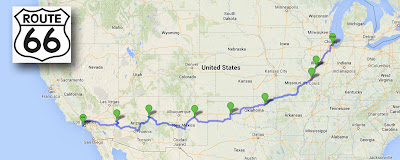
And so the journey begins. Almost two-and-a-half thousand miles (or 40000km) of the American heartland, from the south-western shore of Lake Michigan to the Pacific Ocean as it laps beneath the uprights of Santa Monica Pier.

Along the way I will pass through eight states and three timezones, driving along a road that, though decommissioned in 1985, remains intact for 85% of its original route.

Today, despite being signposted, Route 66 is more of an ideal than a practical means of getting from one place to another.

After all, if you wanted to drive from Chicago to LA in a mindless dash along the I-55, 44, 40, 15 and 10 interstates, you could do it, without stopping, in 31 hours.

This, on the other hand, provides a totally different experience. Driving Route 66 might sound like a cliché of bandana-wearing fiftysomethings on newly-bought Harley-Davidsons - and that's OK if that's you - but to this traveller, it's about seeing a bygone America still embodied by milkshake drive-ins, wholesome, home-grown fare-serving restaurants, churches and schoolhouses that still line the road.

© Simon Poulter 2013
The first leg has been a gentle, 200-mile stroll out of the Windy City and onto Main Street USA where it separates away from I-55 and starts snaking through rural Illinois. Like a mother not wishing to stray too far from a child on its first day at school, 66 checks in with 55 at various points.

The flat, sprawling hinterlands below Chicago are largely unspectacular. They're not meant to be anything else. But, as you trundle alongside the freeway at a modest 45 miles an hour, the clapboard houses, lawned frontages and cute little communities remind you that there's a reason you've chosen old over new.

It does, however, feel a little like walking through Business Class to take your seat in Economy. That was, of course, the main intention of President Eisenhower's interstate highway system, an upgrade to America's motoring arteries, but as with most modernities, there's always a tradeoff.

© Simon Poulter 2013
As you head south, farming and various forms of light industry dominate the land, further reminders that Route 66 isn't a theme park. Soon you find yourself in Joliet. I mention this only because, having watched The Blues Brothers a zillion times over the last 30 years, I am familiar with the fact that, until recently, here functioned the Illinois State Correctional Center where John Belushi's 'Joliet' Jake Blues was picked up in an old Mount Prospect city police car by his brother Elwood (named after the nearby town thereof).

Before you know it, you're out the other side, cruising through cute, lawned communities where ordinary life goes on within -"moms" ferrying children to "soccer" practice, workmen nailing stuff, mechanics fixing cars. Normality breeds further normality.

Which makes it entirely appropriate that the first leg of my drive on Route 66 should end in Springfield, the Illinois state capitol. It is as American heartland as it is possible to be. Indeed, it is one of 29 Springfields across the United States. 30, if you include the fictional setting of The Simpsons.


Creator Matt Groening grew up in Portland, 100 miles north of Oregon's own Springfield. But, he told Smithsonian magazine last year, after 25 years of speculation, the real inspiration was the sitcom Father Knows Best, which took place in a place called Springfield. "When I grew up, I realised it was just a fictitious name," Groening said. "I also figured out that Springfield was one of the most common names for a city in the U.S. "In anticipation of [The Simpsons'] success, I thought, 'This will be cool: everyone will think it's their Springfield.' And they do.

Actually, if I were to be very picky, America's founding fathers didn't exactly stretch the grey matter when it comes to naming places. You have, for example New Amsterdam, which became New York, and most of the north-eastern seaboard is named after Old England. Furthermore, I began the Route 66 journey on East Adams Street in Chicago and have ended up at a hotel in Springfield located at 700 East Adams Street.

You can't, by the way, miss this particular hotel. At 30 inexplicable stories high, the Hilton Springfied is the tallest skyscraper in Illinois outside of Chicago and the tallest in Springfield itself. Which is not a difficult achievement as it is the only skyscraper in Springfield. You can trust me on this one, you won't need sat-nav to find it.

To say this is an incongruous feature of Springfield is an understatement. It actually looks like something dark and evil erected by Monty Burns in the fictional, cartoon Springfield. To add to the menace, on arrival, the hotel is crawling with cops. Literally.

I am later relieved to learn that they're not actual police officers, but members of the Illinois Law Enforcement Explorer program, a kind of cop cadet force of teenagers who may, when they turn 21, apply for jobs with the local police departments they represent. They're in Springfield for their bi-annual conference, learning about how to deal with traffic stops, bomb threats and hostage negotiations, the sort of typical day, really, in the life of the American cop.

But I digress. My visit to Springfield isn't to feel uncomfortable under the collar by having soon-to-be gun-toting teenagers swarming about the place, but to visit this particular Springfield's place in American history. And in that respect, the Hilton - despite its disfiguring presence on the city's skyline (in fact, it is the city's skyline) - is ideally located to visit all of the main landmarks in one go.

© Simon Poulter 2013

Springfield, IL, trades quite openly off both its location on Route 66 and its association with "America's favourite president" (sorry Bill), Abraham Lincoln. Abe lived here from 1837 until 1861, when he became the country's 16th president and, as Steven Spielberg's Oscar-winning, but buttock-challenging film retells, leading the US through the Civil War, maintaining the Union, abolishing slavery and transforming the national economy. All before he was shot at the theatre four years later.

Lincoln is everywhere. You can't walk past a storefront without seeing that jutting, bearded jawline and famous top hat. Springfield's official tourist blah promises that "...you’ll feel as though you’ve stepped back in time…experiencing Springfield as Lincoln knew it.", which is not really that accurate: I'm fairly sure that in Lincoln's day there were considerably fewer hotels, especially those cluttering up the view, not as many branches of Starbucks, and considerably more horse manure and other unpleasantries clogging up the streets.

There is, though, plenty to indulge the historian, from Lincoln's family home to his tomb at Oak Ridge Cemetery, along with the Old Illinois State Capitol building and the Abraham Lincoln Presidential Library and Museum, containing the world’s largest collection of documentary material related to the life of Abraham Lincoln, including an original hand-written copy of the Gettysburg Address and the pen he used to sign the Emancipation Proclamation.

Just 60 years after Lincoln became president, another American milestone took place: the first drive-through burger bar, the Maid Rite Sandwich Shop, opened in Springfield, launching an ever-lasting national obsession with motor-borne convenience, from drive-through coffee shops and pharmacies, to drive-through ATMs which include instructions in Braille. Think about that for a second.


And while you're indulging in nostalgia, another must is Shea's gas station, Bill Shea's museum of life alongside Route 66 featuring more than 50 years of, well, gas station memorabilia. Even if a little hokey, it's another reminder of what Route 66 represents. A more innocent time, before the world was swallowed up by omnipresent corporations and brands, the time that this journey is already doing a great job in connecting me with. On to "Saint Looey".

Tomorrow: WWDBD? is only 24 hours from Tulsa


Friday, August 9, 2013

Key To The Highway

© Simon Poulter 2013
The trouble with everywhere that isn't the US of A is that everywhere else is absolutely crap at being mentioned in song.

It is notable that Frank Sinatra never waxed about Norwich, and Tony Bennett is yet to bemoan leaving a love behind in Frankfurt.

Only American place names seem to fit effortlessly into songs: New York, San Francisco, LA and, of course, Chicago - on a certain level, just collections of bricks and steel, and people and cars hurriedly going about their business. But mentioned in song they take on romance, excitement and melodrama, and often all three.

The rest of the world? Moscow? Berlin? Even the classical cities of Paris, Rome or Madrid, don't cut it (and I'm not going to count Barcelona - one camp, overblown production by Freddie Mercury and Montserrat Caballe does not make a city classic).

Only in America can everyday mundanities be made to be interesting. Springsteen can make the "screen door slammin'" sound like poetry, whereas - with the exception of Ray Davies, Paul Weller and, more recently, Richard Hawley and Jake Bugg - few British songwriters can make ordinary sound cool.

Write a song mentioning Birmingham, Alabama, and you'll find yourself as cool as Birmingham, Alabama, is steaming hot. Write a song about Birmingham in the West Midlands of England, and you'll disappear from trace.

In blues music, in particular, place names are as much a staple as tales of woe, mostly involving women, and invariably involving travel to be either reunited with or escape from a lover. You could probably draw a map of the United States just on cities mentioned in the American Songbook, from Robert Johnson's original Sweet Home Chicago to Chuck Berry's Johnny B. Goode (New Orleans, in case you were wondering) and all points in between - Memphis (which holds the distinction for being mentioned in more songs than any other city), San Antonio, Tulsa, Detroit, Phoenix, Albuquerque, El Paso, Jackson, La Grange, Reno, Santa Fe, Tucson...

Even American roads - just strips of tarmac when you think about them - hold an intrinsic cool that their foreign cousins cannot match. It would be exceedingly brave of a musician to try and make driving the A30 down to Cornwall sound exotic; but drive Route 66 from Chicago to LA - as I'm about to do - and you're already following the advice of Bobby Troup's 1946 song, famously covered by Nat King Cole, the Rolling Stones and Chuck Berry. Cool, cool, cool.

© ChooseChicago
But before I do, what of Chicago? America's third most populated city is, like so many others in this nation, defined by the richness and diversity of its population. The city which evolved on the south-west corner of Lake Michigan, had - as recently as 1833 - just 200 citizens. Today, its population of 2.7 million is drawn from the waves of Irish, Italians, Poles, Czechs, European Jews from various backgrounds, African-Americans from the South, Mexicans, Chinese and 16 other listed ethnicities.

Perhaps due to its location - which gets whipped by icy blasts coming off the lake during winter - you expect Chicago, like its near-neighbour Detroit, to be a gritty, non-nonsene northern industrial city. Nothing could be further from the truth. Certainly, in their heritage, Chicagoans have escaped from hardship, and not always found relief, either, but there is a restrained friendliness about the city. This is not New York - a city I love, by the way, but whose self-absorption can sometimes grate - but a city getting on with what it has to do.

© Simon Poulter 2013
Not having been here before, and with only movies like The Blues Brothers and Christopher Nolan's Batman trilogy as earthy visual references, the expectation is of a city equally as bleak. The reality is anything but: from the lakefront Grant Park, with its lush gardens, fountains and views of old and new Chicago alike, to the likeable campus neighbourhood of Lincoln Park, Chicago is a wide open city. Unlike Manhattan, which threatens claustrophobia due to the imposing canyons created by the high-rise buildings, there is a feeling of openness and light.

Unsurprisingly, Chicago has a very European feel, more so than any other American city I've visited with a strong link to the Old World. The city is also an architectural delight, partly the result of the devastating fire in 1871 that required much of the city to be rebuilt. Chicago led the nation in building the first skyscrapers and today features the Willis Tower (formerly the Sears Tower), once the world's tallest at 1,451 feet and today still the highest in the Western Hemishphere. On a clear day you can see far into Illinois, Indiana, Wisconsin and Michigan, and the lofty of the flat greater Chicago area itself is breathtaking (top tip - buy yourself a $40 CityPass. It'll save you the pain of queuing for more than two hours to get to the top by buying you 'fast track' access to the he'd of the line).

© Simon Poulter 2013
Chicago's skyline is, like most major American city centres, dominated by the steel and glass behemoths that architects have erected over the last century, but Chicago's true architectural interest exists at lower elevations. After the great fire, buildings were rebuilt to last, chunky, solid designs that sit on their haunches like the Hilton Hotel on South Michigan Avenue, once, the world's largest hotel (an accolade now attached to some gargantuan horror in Dubai or China),

© Simon Poulter 2013
There is plenty to do in Chicago as a visitor, and it doesn't matter whether your taste is retail therapy, music therapy or comic relief. For the shopaholic, there's the Magnificent Mile, the thoroughfare stretching the northern section of Michigan Avenue, and featuring all the same upscale shops you'll find in most major American malls as well as on Rodeo Drive or Fifth Avenue.

Those seeking musical respite, of course, will be richly rewarded. Chicago IS bluestown, and visitors have plenty to choose from authentic blues venues like Kingston Mines, Muddy Waters' Checkerboard Lounge, Buddy Guy's Legends and Blue Chicago.

© The Second City
For laughs, there is but one choice: Second City, the famous improv comedy club which opened in the winter of 1959 and has since produced an amazing roll-call of comedy talent from the US and Canada, including Dan Aykroyd, TIna Fey, Steve Carell, John and Jim Belushi, John Candy, Dan Castellaneta, Stephen Colbert, Shelley Long, Jack McBrayer, Bill Murray, Bob Odenkirk (Breaking Bad's Saul Goodman), Catherine O'Hara, Gilda Radner, Martin Short, Jerry Stiller and George Wendt. It has even spawned 'satellite' clubs in Hollywood and Toronto, and has regularly farmed out talent to Amsterdam's Boom Chicago. As you might expect with such illustrious alumni, the standard of comedy is exceedingly high, and you are recommend to book ahead for tickets.

So that's the tourist stuff dealt with. To be honest, that's not what brought me here (well, apart from live blues music, that is). Chicago is the start of the 'Mother Road', Route 66. Today it exists more in name and mythology than actual physical roadway (it was decommissioned as 'US Route 66' as the interstate highway system superseded it).

As it did in 1926 - established on November 11 (my birthday!) - I will over the coming week or so follow it from Chicago to California, driving as much of what is left of the original 2,448-mile route - now relative backroads compared to the interstates - south through Illinois, Missouri, a bit of Oklahoma, Texas, New Mexico and Arizona before coming to a halt on Santa Monica Pier.

21 years after my first visit to the US, and many, many visits since to LA, New York, San Francisco, Miami and others, I've got the keys to America's highway. Better get a move on.


Thursday, August 8, 2013

If the blues was money, I'd be the richest man in town

Well, my mother told my father, just before I was born,
"I got a boy child comin', he's gonna be a rollin' stone"

Some call it an urban myth, others a lie, and a few more simply a colourful tale.

But the legend that the Rolling Stones turned up at 2120 South Michigan Avenue, Chicago - the Chess Records studio - in June 1964 to pay homage to their musical godfather, Muddy Waters, only to find him outside painting the exterior, is bunk. So says Buddy Guy, one of the last of the "original" Chicago bluesmen, who countered the tale in his autobiography When I Left Home last year: 

"When the Rolling Stones came to Chess Records in 1964, they started telling everyone — and even wrote it up in books — that they saw Muddy Waters standing on a ladder where he was whitewashing the walls. They said the Mud had whitewash all over his face. For years Keith Richards repeated this story. His point was that Leonard Chess was using poor Muddy as a handyman. Leonard and Muddy are long gone, but I was there — and so was Marshall Chess — and we both know know this ain't true . . . Muddy had put Chess on the map."

Waters has, sadly long gone. As has Chess Records, now just a famous record label within the 'catalogue' of some entertainment conglomerate or other. But their collective legacy lives on. The Stones are still rolling, of course, and rolling in it, too (estimates suggest their recent tour plus the five shows they staged last November and December will have grossed around $150 million).


The Chess studio, where the Stones recorded their first UK No.1, It's All Over Now, is still there, but is now home to the Willie Dixon Blues Heaven foundation, a charity established by Dixon's family to maintain a link to the role 2120 South Michigan Avenue played in the evolution of modern music.

The studio has become a presentation theatre, where an introductory video featuring interviews with Buddy Guy, John Lee Hooker, Mick Jagger, Marshall Chess (son of the Polish immigrants Leonard and Phil Chess who co-founded the label) and others put context around the blues, its migration from the South and its influence, especially on suburban Englishmen growing up many hundreds of miles away.


Kevin, the tour guide, somewhat rolls his eyes when I bring up the so-called British invasion. "It was something they just latched on to," he says. Trying to understand what it was that invaded the teenage lives of Jagger and Richards, Eric Clapton, Ray Davies, Steve Winwood, Jimmy Page and countless more is like trying to trace the source of the Nile.

He's polite about it, but you get the hint of an understandable frustration that these nice, mainly middle class white guys from Kent, Surrey and the London suburbs have coined it in by exploiting a form of music, and those who spawned it, which began in the poverty of the rural south, and moved north to Chicago to find a living.

As an example, Kevin commences his introduction to the presentation by asking if we'd heard of a 1962 Muddy Waters song, written by Willie Dixon, called You Need Love. Embarrassingly, blank faces all around. So perhaps its opening lines might jog the memory:

You've got yearnin' and I got burnin'
Baby you look so sweet and cunning
Baby way down inside, woman you need love
Woman you need love, you've got to have some love
I'm gonna give you some love, I know you need love
Charge it up a tad, add a Fender Telecaster and fuzzbox riff played by Jimmy Page, and you've got Led Zeppelin's Whole Lotta Love. In 1985 a court agreed, and ruled in Dixon's favour. Robert Plant has since 'fessed up: "I just thought, 'well, what am I going to sing?' That was it, a nick. Now happily paid for. At the time, there was a lot of conversation about what to do. It was decided that it was so far away in time and influence that...well, you only get caught when you're successful. That's the game."

Led Zeppelin weren't the first British band to rework Dixon's original song: in 1966 the Small Faces recorded it as You Need Loving. Perhaps, then, Kevin's coolness towards my mention of the British Invasion is quite understandable. For 50 years, white Englishmen have been coining it on the back of music that hardly paid its originators a cent.

Musical plagiarism is, however, not only a thorny issue, but in the blues it is also highly grey. Even Waters' Rollin' Stone has its origins in the even earlier Catfish Blues. When the blues travelled north to Chicago during the 'Great Migration', Waters, John Lee Hooker, Big Bill Broonzy and all the others brought with them notes and riffs blended from folk, gospel and traditional spiritual. Blues and its more refined cousin jazz, has always been derivative. But then isn't that the case of all music?

The politics of exploitation notwithstanding, standing in what was the Chess studio is, like my visit to the Sun Studios in Memphis, something of a religious experience. The sound baffles and control room electronics have long gone, but the pictures of Waters and other memorabilia, together with Kevin's story, are essential elements in keeping alive the heritage of a musical evolution that led not only to rock music, but by turns, R&B, funk, rap and Chicago's other musical speciality, house.


I was born in the Royal Borough of Kingston-upon-Thames. As a 15-year-old, Eric Clapton would come to Kingston's riverside pubs to play Broonzy songs like Key To The Highway, and Robert Johnson's Crossroads Blues. In neighbouring Richmond, the Stones made their name at the Crawdaddy Club at the Station Hotel. Down the road in Kew were The Yardbirds - with the slightly older Clapton and, later, Jimmy Page from nearby Epsom and Jeff Beck from Carshalton.

To these leafy districts of south-west London on its border with Surrey, the music that Broonzy, Johnson, Waters, Hooker, Dixon and so many more dragged to Chicago from the sweat of the South found a home, giving birth to legends that would turn this simple and, at its best, primitive guitar music into a worldwide industry.

Chicago, to some, might be as much today about deep-dish pizza, the Cubs and the new corporate headquarters of Boeing, but to me it's about one thing. And while the tour of 2120 South Michigan Avenue may not be as rich a museum experience as Sun Studios or Graceland, its simplicity and sparsity, and its role in telling the story of Chess, Waters and Dixon, make it as culturally important as anything the Windy City has to offer. That one thing - blues music, and what it gave to the world.

Tuesday, August 6, 2013

Two nations separated by dentistry


Well would you look at that. Barely two weeks after returning from a wedding in Atlanta, I'm back in the land of the free, the land where queuing for an hour to clear immigration is just what makes this great land of theirs so great and so free.

I have come to Chicago, America's 'Second City', "that toddlin' town", as Frank Sinatra eulogised.

It's my first time here, a long-held ambition to seek out where blues music went when it migrated north from the South, discovered amplification and became something which can trace its heritage in the soul, funk, house and hip-hop that came later out of the city. More of this in the days to come.

Chicago is my base camp for another long-held ambition, to drive Route 66 - Chicago to LA - 'the Mother Road', doing the diner'n'motel thing, and seeing the real America. And, no, I won't be doing it on a Harley-Davidson. This is not some mid-life crisis. Simply a trip to embrace the American heartland, a brief series of conjoined snapshots of a country that inspires such journeys like no other.

American culture fascinates me and always has. But the more I've embraced its musical heritage, the more I've wanted to explore the roots of popular music that became the dominant culture of the latter half of the 20th century, that came to Britain in the 1950s and 60s and inspired the British Invasion of bands who brought it all the way back to America. Even now I find it weird to see Americans citing The Beatles and the Stones as the epitome of rock'n'roll when it started here. But then that's what Americans do best: here success is to be cherished, to be hailed, to be encouraged.

It's what divides Britain and America. America is an overwhelmingly positive, can-do place. People seek out opportunity. Britain - and indeed Europe - at times feels like the glass is half-empty, that it is easier to find ten ways to say no to something than the one way to say yes.

Someone asked me the other day why I keep coming back to America when, living in Paris, I have a vast and beautiful country at my disposal, and beyond it countries like Italy, Spain and Greece, the cradles of modern civilisation, each with breathtaking vistas, real history by the bucketload, and the beaches of the Mediterranean. The answer - which took time to form - was that, yes, I could take holidays in those places and I do. But there are times when I need to breathe in America again to feel good. It's a drug, but a good one.

It truly is the land of possibility. Even in the depths of economic despair, Americans plough on. They work hard for their recognition. That "have a nice day!" waitress may be gratingly OTT to the foreign tourist - especially the Brits used to increasingly dismal customer service and can't-be-arsed attitudes back home - but she is part of the glass half full that I love to drink from in this country.

Attitude, then, clearly divides these two country cousins. And language. George Bernard Shaw famously described Britain and America as "two countries separated by a common language", something Eddie Izzard later explored with this forensic comparison:


However, I have only recently come to the conclusion that, if you really want to examine the differences between America and Britain, just ask an American and a Brit to stand next to each other and smile.

Yes, teeth. At risk of pandering to the cliché that all Brits have medievally poor dentistry,  Americans simply have better teeth (with the exception of the country's swolen community of meth-heads and anyone in rural Alabama, apparently).

Whenever I had my photograph taken at the Atlanta wedding, my smile resembled that of a bulldog chewing a wasp. This is because I am British and we don't show off our teeth, especially to Americans, for fear of sparking a panic that The Plague, boils and Victorian syphilis are all back in fashion. My American friends, however, routinely flashed their gnashers like smiling sharks (a concept the Discovery Channel really should look into for its next Shark Week).  You only had to produce a camera and row after row of pristine, pearl-white tombstones would be framed by a smile. Time after time, picture after picture.

If you have any American friends go now to Facebook and look up any group shots of them at weddings and social gatherings. You'd think the entire country was sponsored by Signal.


Dentistry is a part of the American way. Teeth - shining white teeth, perfect choppers for devouring 100% American-reared cows, hot dogs at ball games and shrimp at barbecues - should be included in the long list of American icons.

It is no surprise, then, to discover that the world's first dentistry association was formed in this country, and that the American Dental Association is located right here in Chicago. That's right - and you thought I'd veered off topic...?

Friday, August 2, 2013

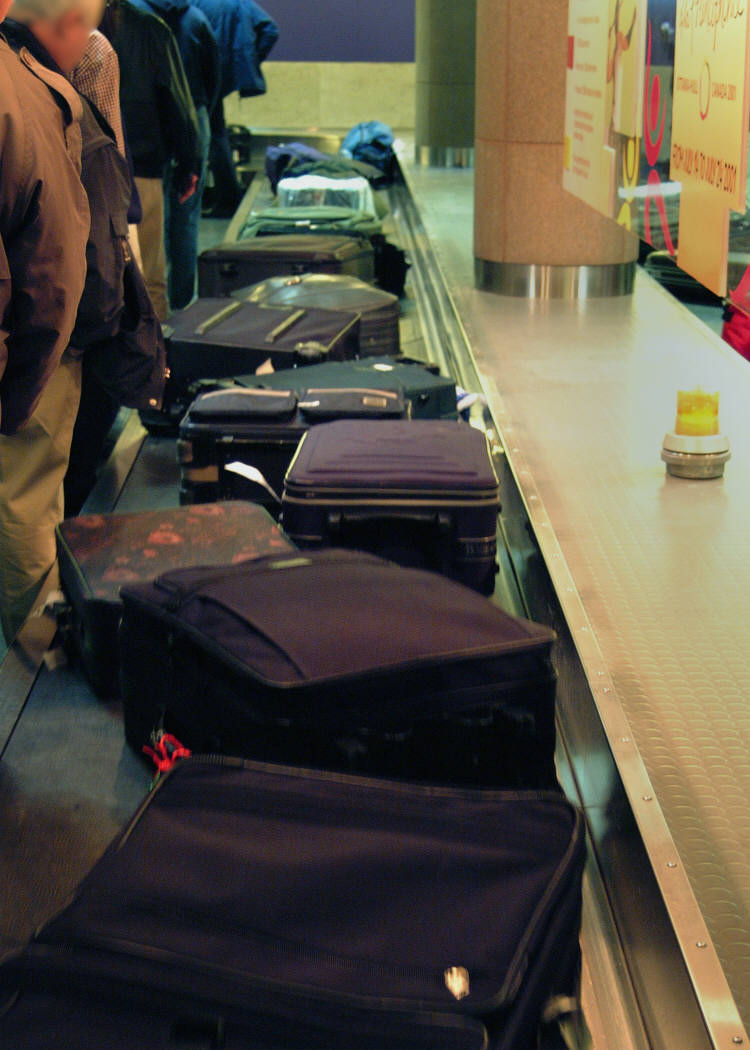
Baggage handling strike


And so we make it to August. Suits are being replaced by shorts, Paris is clearing out faster than a torpedoed bathtub, and the British press are so desperate for front page shockers that Simon Cowell fathering a child by another man's wife warrants the full splash treatment. All in all, a good time to go on holiday and, preferably like the French, not return until September's dappled sunlight begins to form longer shadows.

The Great Getaway also means that all the main motorways to southern France are choked by northern Europeans in copiously packed estate cars. The French themselves are recognisable by the plumes of cigarette smoke spewing from half-cracked windows; the Belgians by the fact they will be tailgating the car in front so closely its driver will be able to perform a full retinal scan on Brer Belg using just his rear-view mirror; the Dutch will be identified by the enormous tent-bearing roof box as they head for the great outdoors, rather than anything with indoor plumbing and a lift; the Germans? Well there are no Germans heading south as they're on the Dutch and Spanish beaches already; which just leaves the Brits, who will be smugly cruising in their Jags, heading for Tuscany with a straw fedora perched pretentiously on the rear parcel shelf.

Everyone else will be travelling by plane. Sensible people will be flying with a reputable airline that delivers them on time to the city they are intending to travel to. Less sensible people will be flying with Ryanair. Ryanair will, by reputation, also deliver them on time, but not necessarily to the airport most closely associated with the destination. It's along the lines of being dropped off on Jupiter and then having to catch a bus to Saturn.

This, as we know from boorish proclamations, is because Ryanair believes in delivering "value" to the traveller. It will fly you to Paris, like everyone else, but will land you at "Paris-Beauvais", which is in fact 98km from the centre of Paris, requiring you to take a €100 taxi. And when you add on things like €30 for an infant and €20 for an infant car seat or cot, €15 to reserve a seat or €10 to board first, €3 for a portion of microwaved chips, €4.50 for a "premium sandwich" and €2.50 for a 250ml can of Pepsi, that "€19" flight to Paris (that actually became €70 when you booked both legs...) starts to look like a very bad deal indeed, when compared to flying 'full fare' with, say, Air France (Heathrow-Charles De Gaulle return, €109 with a €16 return fare to and from the airport by train).


Of course, buying a drink or getting the seat of your choice are all options. But paying extra for an infant who would otherwise be strapped in with a parent? That's just gouging. Ryanair even, somewhat patronisingly, offers tips on "How Do I Avoid Paying Optional Fees?", which includes such suggestions as "Checked Baggage Fee -  is avoidable by simply travelling with no checked baggage". Brilliant.

This brings me to the latest declaration from the airline's loathsome CEO, Michael O'Leary: in addition, this week, to apparently asking pilots to fly slower to conserve fuel, the Irishman has declared war on luggage.

O'Leary has had a thing about luggage for a while, regarding bags as simply a burden on profit margins due to the fact they burn more fuel, and by the fact processing baggage adds time (and money) to the turnaround time of aircraft that could otherwise be in the air with fare-paying passengers.


This summer, Ryanair has raised its charges for putting bags in the holds of its Boeing 737s by a further €20, a move O'Leary justified by saying: "We don't want the bags. We will keep increasing charges until we get rid of [hold] bags."

Well excuse me. But unless you are in a hurry to flee a war zone, most people like to pack a suitcase for a trip abroad so that they have, you know, clothes, shoes, underwear, toothbrushes and all the other items you can't leave several hundred miles away at home.

Even for a weekend, I'd prefer not to go out for dinner in the clothes I'd been wearing since the taxi arrived at dawn. I get it that some people can make do with the same T-shirt and bikini for an entire month of backpacking through Thailand, but the beauty of civilisation is that hotels function much the same as your home, and even "informal" restaurants appreciate it when their patrons bathe and wear relatively recently laundered clothing.

Restricting carry-on luggage, on the other hand, is, in my view a good thing: travel, in my opinion, generally brings out the worst in people. Which is why, when queuing to board a flight these days, your queue will include a small fleet of wheeled suitcases gripped by fellow passengers who believe they have as much right to fill up an overhead locker as you have (and slow down the boarding process along the way).

But hold luggage - which may take a little longer to deliver but at least is loaded by someone who won't delay the flight (unless they go on strike, of course) - is surely a good thing. And what will O'Leary fill the empty holds of his 737s if they don't have baggage - people?

Taking a pop at Ryanair's business model is both easy and tiresome. Easy, because it goes out of its way to annoy anyone dumb enough to care. Like me. And tiresome, because its belligerence knows no bounds.

If you go into business running an airline, most of the premise is providing a customer service or, as marketing people increasingly like to say, an "experience". I don't mind anyone making money on it, and if you believe in the free market, you pay your money and make your choice.

I just object to paying money for something which is supposed to be cheap, only to get a worse service than if I was paying a premium. Which is why I'm happy to pay for an airline that treats you as a customer buying a service, rather than a piece of cargo given the privilege of riding in a seat.